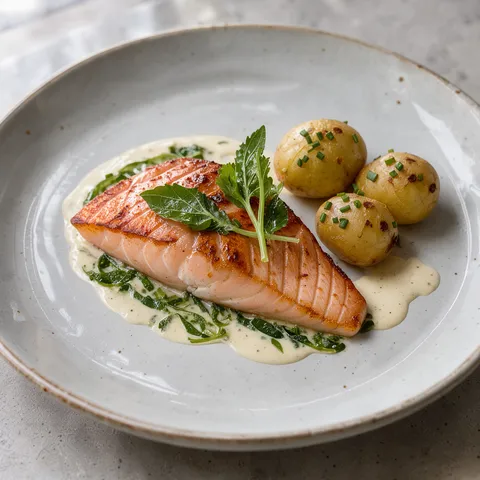
Sorrel Cream, Salmon Escalope, New Potatoes
Takes 40 min, Serves 4. Difficulty: medium.
At a glance
- Total time
- 40 min
- Serves
- Serves 4
- Difficulty
- Medium
- Dish type
- Main course
- Diet
- Gluten-free
- Allergens
- Milk, Fish, Celery, Sulphites
Ingredients
Salmon
- 600 g skinless salmon fillet (from the thick end)
- 1 tbsp sunflower oil
- sea salt
Sorrel sauce
- 80 g fresh sorrel (plus 20 g young leaves to serve)
- 2 shallots
- 100 ml white wine (alcohol-free: 100 ml Fish Fumet (Basics) + 1 tsp white wine vinegar)
- 250 ml Fish Fumet (Basics)
- 200 ml double cream
- 30 g cold butter
- salt
- white pepper
Potatoes
- 600 g small new potatoes
- 20 g butter
- 1 tbsp chopped chives
- salt
Equipment
- Saucepan
- Frying pan
- Oven
- Chef's knife
- Chopping board
- Probe thermometer
- Colander
- Wooden spoon / spatula
- Cling film
- Paring knife (optional)
Method
- Potatoes: The potatoes should all be the same size, so halve any large ones so they cook at the same time. Put the potatoes, skins on, in cold salted water. Once it comes to the boil, cook for 15 min, until a knife slides in easily. Drain and toss with the butter, chives and salt (in parallel with the sauce, 3 min prep)
- Prepare the salmon: Cut the salmon into 4 equal pieces. Place each between two sheets of cling film and press with the palm of your hand to flatten to 1 cm thick (escalope). The thin cut ensures quick, even cooking. Keep in the fridge until ready to cook (5 min)
- Prep the sorrel: Sorrel can be gritty, so wash the leaves in two changes of water. Remove the stalk and the fibrous central rib by folding the leaf and pulling. Stack the leaves for the sauce and cut into 5 mm ribbons (3 min). The oxalic acid in sorrel turns the leaves olive green as soon as they are heated. This is natural, and is why it goes in last
- Reduction: Cook the finely chopped shallots with the wine (or the alcohol-free mix) in a small saucepan over a medium heat for 4 min, until three-quarters of the liquid has evaporated. Add the fumet and boil for 8 min until reduced by half. Don't add salt early: it concentrates in the reduction and makes the sauce too salty
- Thicken with cream: Add the cream and simmer gently for 4 min, until it coats the back of a spoon. Strain out the shallots and keep the sauce warm. If the sauce boils, the fat in the cream separates and it splits, so keep it below 80°C
- Raw leaves: Finely chop the 20 g young sorrel leaves reserved for serving and toss with a few drops of olive oil and a pinch of salt. They should stay cold and crisp, a contrast to the warm sauce (2 min)
- Cook the salmon: Heat a non-stick pan until very hot and brush with a thin film of oil. Salt the escalopes and cook for 45 sec on one side and 30 sec on the other, then take out of the pan and rest for 1 min. The internal temperature should be 60°C, with the inside moist and pearly. If it sticks to the pan, don't force it: it will release on its own. Overcooked thin salmon dries out at once and white albumin seeps out (3 min)
- Finish the sauce: Return the sauce to the heat and swirl in the cold butter piece by piece to give it a shine (montée). Add the sorrel ribbons, stir for just 15 sec and take off the heat. Season with salt and white pepper. The sourness should be as lively as lemon but softened by the cream (2 min)
- Plate: Warm the plates in the oven at 70°C, as salmon cools quickly on a cold plate. Pour two spoonfuls of sorrel sauce onto each warmed flat plate, without letting it run to the edge, and place a salmon escalope on the sauce, cooked side up. Top the salmon with the raw sorrel leaves you prepared and arrange the potatoes alongside (5 min). The sourness of the sorrel cuts through the richness of the salmon, and the raw leaves add a second, fresh sharpness
Chef's note
Inspired by the Troisgros brothers' 1962 classic, escalope de saumon à l'oseille. Sorrel can be found at markets in spring. If unavailable, use spinach and lemon zest. Serves 4.
Frequently asked questions
- Why does sorrel turn olive green when cooked?
- The oxalic acid in sorrel turns the leaves olive green as soon as they heat, which is natural. So the strips go into the sauce last and are stirred for only 15 seconds.
- How do I stop the cream sauce splitting?
- If the sauce boils, the fat in the cream separates and it splits. Keep it below 80°C and swirl in the butter off the heat, piece by piece.
- Why is the salmon escalope flattened thin?
- Spread the salmon to 1 cm thick between sheets of cling film. A thin cut cooks quickly and evenly. Overcooked thin salmon dries out fast.