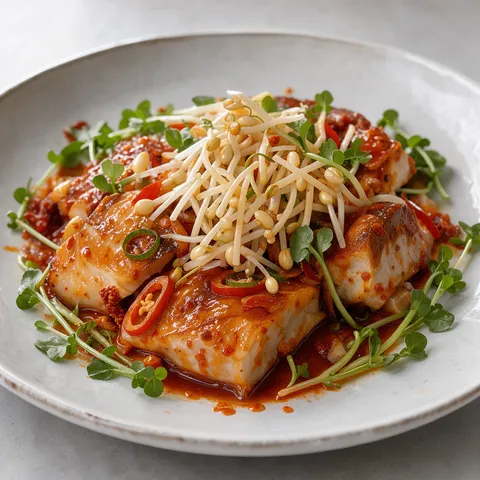
Agu-jjim Spicy Monkfish with Bean Sprouts
A Korean main course. Takes 42 min, Serves 4. Difficulty: medium.
At a glance
- Total time
- 42 min
- Serves
- Serves 4
- Difficulty
- Medium
- Cuisine
- Korean cuisine
- Dish type
- Main course
- Allergens
- Gluten, Fish, Sesame, Soya
Ingredients
Fish
- 800 g monkfish fillet or tail piece
- 1 tbsp salt
- 1 litre water (for parboiling)
Vegetables
- 300 g soybean sprouts
- 1 small bunch watercress
- 3 spring onions
- 1 green chilli
Sauce
- 4 tbsp gochugaru
- 3 tbsp soy sauce
- 1 tbsp sugar
- 2 tbsp mirin
- 6 garlic cloves (crushed)
- 1 tbsp grated ginger
- 200 ml water
- 2 tbsp potato starch (dissolved in 4 tbsp water)
- 1 tbsp sesame oil
To serve
- 1 tsp sesame seeds
- hot rice
Equipment
- Saucepan
- Colander
- Frying pan
- Mixing bowls
- Probe thermometer (optional)
Method
- Prepare the fish: Wash the monkfish under cold running water, remove the skin and membranes and cut into 4 cm pieces with a knife. The membranes turn rubbery when cooked. Pat dry with kitchen paper (~10 min)
- Parboil the fish: Boil the water with the salt in a pan, drop in the fish pieces, boil for 2 min and drain in a colander. Parboiling takes away the wild smell of the fish, so the sauce then gives a pure flavour. Discard the boiling water (~4 min)
- Prepare the vegetables: Wash the soybean sprouts, cut the watercress into 5 cm lengths and finely chop the spring onions and chilli. The watercress is added last because it wilts quickly with heat (~5 min)
- Mix the sauce: Put the gochugaru, soy sauce, sugar, mirin, garlic, ginger and 200 ml water in a bowl and stir. When gochugaru rests in the water for a few min, it releases its colour (~3 min)
- Start cooking: Spread the soybean sprouts in a wide, heavy-based pan, put the fish on top and pour the sauce over. Cover and heat over medium heat until it boils. The sprouts form a layer of steam at the bottom and the fish does not burn (~5 min)
- Cook: When it boils, uncover and cook the fish for 8 min, frequently spooning the sauce over. The fish should be white, firm and opaque in the centre, with the internal temperature reaching 63°C. The sauce reduces and thickens (~8 min)
- Thicken: Add the starch slurry in a thin thread and cook for 1 min, stirring. The sauce should become glossy and a runny consistency that clings to the spoon, and thickens at once when the starch is added (~2 min)
- Finish the vegetables: Add the watercress, spring onions and chilli and stir for 30 sec. Season with the sesame oil and take off the heat. The greens should stay bright green (~2 min)
- Plate: Pile the agu-jjim on a wide serving plate, with the fish on top and the soybean sprouts between. Sprinkle with sesame seeds. Serve with hot rice (~3 min)
Chef's note
Agu-jjim is the famous fish dish of Masan and Changwon and is made with monkfish in the original. In the original recipe minari (water dropwort) is used, and here watercress gives a similar taste. If you cannot find monkfish, a thick-fleshed white fish can be used but the texture changes.
Frequently asked questions
- Which fish is used in Agu-jjim?
- Monkfish is used in the original. If you can't find it, a thick-fleshed white fish can be tried.
- Why is monkfish parboiled?
- Parboiling removes the fish's wild smell and keeps the flavour of the sauce clear. It also firms up the membrane on the surface.
- How spicy is Agu-jjim?
- It is medium-hot and the amount of gochugaru can be adjusted. For a milder version, reduce the gochugaru to 2 tbsp.
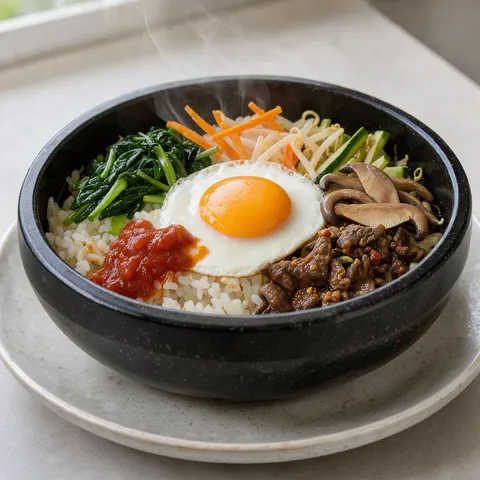 Bibimbap1 hr 15 min · Main course
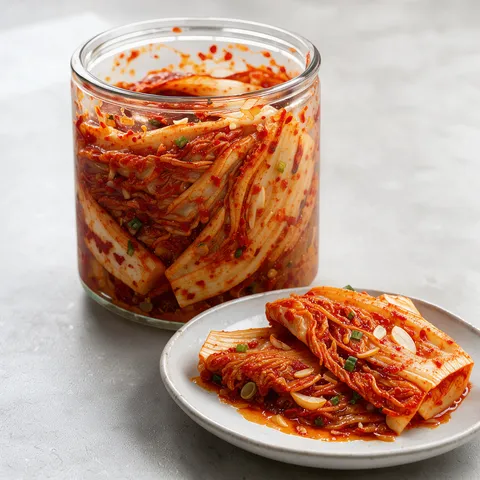 Kimchi3 hr · Side dish
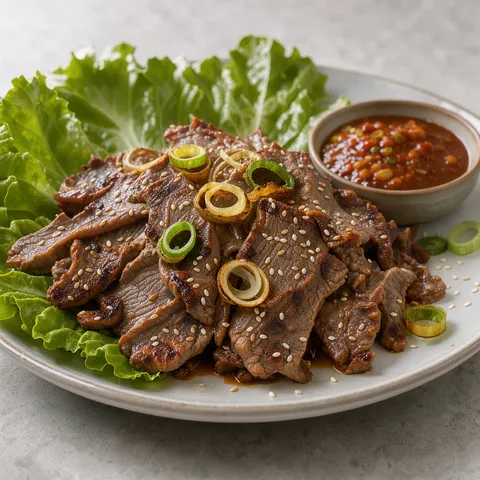 Bulgogi30 min · Main course
 Korean Braised Short Ribs1 hr 30 min · Main course
 Korean Glass Noodles with Vegetables45 min · Main course
 Kimchi Stew40 min · Soup