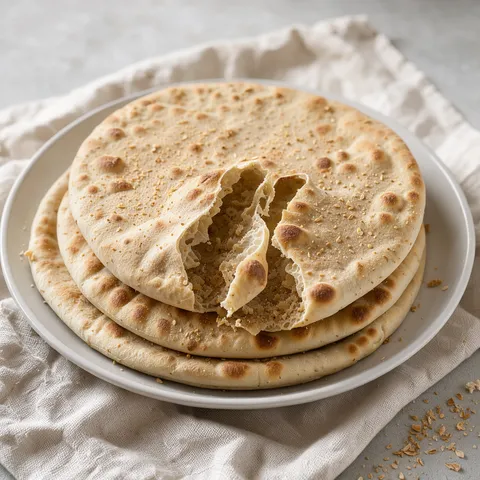
Egyptian Wholemeal Pocket Bread Aish Baladi
An Egyptian bread & pastry. Takes 51 min · +1 hr 15 min rising, 8 pieces (4 servings). Difficulty: challenging.
At a glance
- Total time
- 51 min · +1 hr 15 min rising
- Serves
- 8 pieces (4 servings)
- Difficulty
- Challenging
- Cuisine
- Egyptian cuisine
- Dish type
- Bread & pastry
- Allergens
- Gluten
Ingredients
Dough
- 400 g wholemeal flour
- 100 g plain white flour
- 7 g fast-action dried yeast
- 1 tsp sugar
- 1.5 tsp salt
- 350 ml lukewarm water
- 2 tbsp olive oil
Baking
- 3 tbsp wheat bran (for dusting the worktop)
- 1 tbsp plain flour (for rolling)
Equipment
- Baking tray
- Oven
- Mixing bowls
- Rolling pin / oklava
Method
- Activate the yeast: Mix the lukewarm water, sugar and yeast in a bowl and wait until foamy. Foam means the yeast is alive. If the water is too hot the yeast dies, so it should be lukewarm enough to hold your finger in comfortably (~5 min)
- Knead the dough: Sift the wholemeal flour, white flour and salt into a large bowl. Add the yeast mixture and olive oil and mix until the mixture comes together. Knead by hand on the worktop until the dough is smooth and elastic. Wholemeal dough is slightly sticky, so do not add too much flour (~10 min)
- Prove: Put the dough in an oiled bowl, cover with a damp tea towel and leave in a warm place until doubled in size. This time relaxes the gluten of the wholemeal and lightens the dough (~60 min)
- Divide into balls: Divide the dough into eight equal pieces and shape each into a neat ball. Cover with a damp tea towel on a worktop sprinkled with bran and rest. A ball that has not rested pulls back and tears when rolled (~6 min)
- Roll out the dough: Dust the worktop with 1 tbsp of flour. Roll the balls out with a rolling pin or your hand into rounds 18 cm across and about 5 mm thick. The thickness should be even, as thin parts do not puff up. Rest the rolled breads again on a cloth sprinkled with bran (~10 min)
- Preheat the oven: Put the tray on the bottom shelf of the oven and preheat to 250°C. A very hot oven puffs the dough quickly and leaves the inside hollow, so the bread becomes a pocket (~15 min)
- Bake: Place one or two breads at a time on the hot tray and bake in four rounds. Bake until puffed up and the underside is golden brown. The inside of the bread should be hollow and sound firm when tapped. If overbaked, it dries out and hardens (~18 min)
- Plate: Wrap the breads in a clean tea towel while hot and still soft, and serve. You can open them from the edge and put a filling inside, or eat them with the meal (~2 min)
Chef's note
Aish baladi is Egypt's most basic bread, and aish means both bread and life in Egyptian Arabic. It is traditionally baked in a high-heat oven. The oven being as hot as possible is the key to forming the pocket. If you have a baking stone at home, use it instead of the tray.
Frequently asked questions
- Why does aish baladi puff up?
- In a very hot oven the water in the dough turns to steam fast and forms an air pocket between two thin layers.
- What does aish mean?
- In Egyptian Arabic, aish means both bread and life. Aish baladi is the local wholemeal bread.
- Why is wholemeal dough stickier?
- Wholemeal flour contains bran, so it absorbs more water and has a weaker gluten network. Work with wet hands instead of adding extra flour.
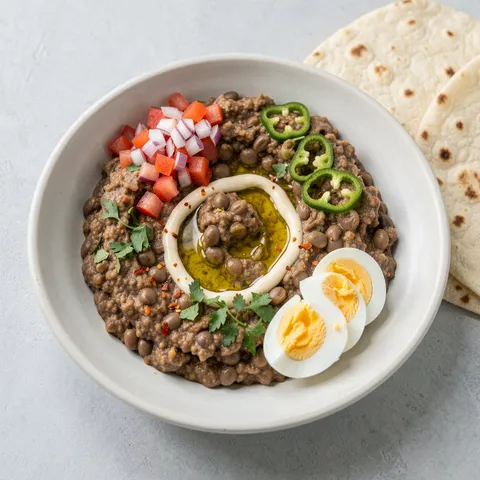 Egyptian Mashed Fava Beans2 hr · Meze
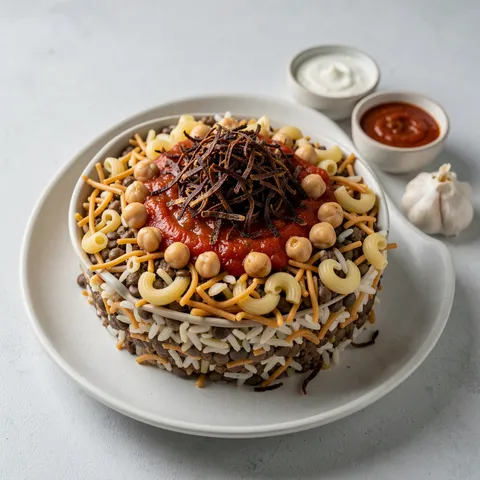 Koshari1 hr 30 min · Main course
 Molokhia1 hr 30 min · Main course
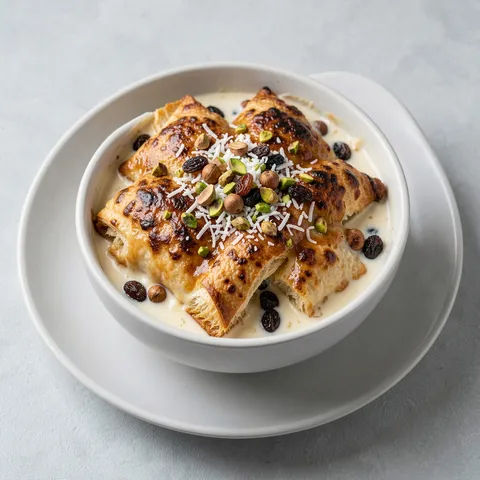 Egyptian Baked Milk and Pastry Pudding1 hr · Dessert
 Egyptian Orzo Soup in Beef Stock1 hr 50 min · Soup
 Ta'ameya1 hr 10 min · Starter