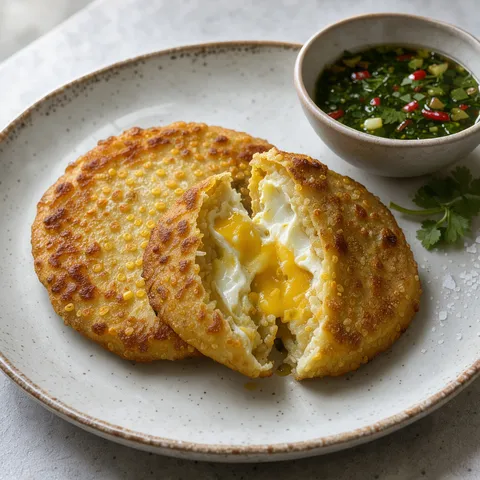
Caribbean Egg-Filled Corn Cakes Arepas de Huevo
A Colombian meze. Takes 1 hr 20 min, Serves 4. Difficulty: medium.
At a glance
- Total time
- 1 hr 20 min
- Serves
- Serves 4
- Difficulty
- Medium
- Cuisine
- Colombian cuisine
- Dish type
- Meze
- Diet
- Gluten-free
- Allergens
- Eggs
Ingredients
Dough
- 250 g pre-cooked white cornmeal (masarepa)
- 420 ml lukewarm water
- 1 tsp salt
- 1 tsp caster sugar
Filling
- 8 small eggs
- a pinch of salt
Frying
- 1.5 litres sunflower oil
Ají
- 3 tbsp chopped coriander
- 1 spring onion (finely chopped)
- 1 hot red chilli (finely chopped)
- 3 tbsp white vinegar
- 2 tbsp water
- a pinch of salt
Equipment
- Mixing bowls
- Cling film
- Saucepan
- Probe thermometer
- Colander
- Chef's knife
Method
- Make the ají: Mix the coriander, spring onion, chilli, vinegar, water and salt in a small bowl and leave until serving. The flavours pass into the vinegar as it stands
- Knead the dough: Mix the masarepa, salt and sugar in a bowl, add the lukewarm water gradually and knead by hand for 2-3 min. The dough should be soft, like play dough that does not crack in the hand or stick. If it dries, add 1-2 tbsp water. Rest covered for 10 min, so the flour absorbs the water completely. Masarepa is not ordinary cornmeal, and because it is pre-cooked it turns into dough with water at once
- Roll out the discs: Take about 30 g of dough, the size of a walnut, and wrap it in cling film for sealing. Divide the rest into 8 equal pieces (about 68 g each), roll them in your palm and roll out between two sheets of cling film into discs 11 cm across and 7 mm thick. Smooth the cracks at the edges with a finger, as a cracked arepa does not puff in the oil
- Heat the oil: Put the oil in a deep 20 cm pan (about 4.5 cm deep) and heat to 165°C with a thermometer (about 12 min)
- First fry: Lower the discs into the oil in 4 batches of 2 and fry for 2-3 min, turning now and then with a slotted spoon. The arepa should puff up like a balloon and take on a pale golden crust. The puffing opens a pocket in the dough. Lift onto kitchen paper and let cool slightly for 2 min
- Open the pocket: With a sharp knife, make a slit about 5 cm long, one finger wide, at the edge of each arepa, and widen the pocket with a finger without tearing the inside. Crack each egg into a small glass first. Set aside any arepa in which no pocket formed in the first fry
- Fill and seal: Hold the arepa upright with the slit at the top, slowly pour the egg from the glass into the pocket and sprinkle in a pinch of salt. Take a hazelnut-sized piece of the reserved dough and press it with a finger over the slit to seal the pocket completely. Raise the oil to 180°C
- Second fry: Lower the filled arepas into the oil in 4 batches of 2 with the sealed side up, fry for 3 min, then turn carefully and fry for 1 min more. The egg white sets and the yolk stays slightly runny, and the crust is deep golden and crisp. Lift onto kitchen paper and let the oil return to 180°C between batches
- Serve: Put the arepas on plates while hot, with 2 arepas per person for 4 people. Before biting, open a piece at the edge and pour a spoonful of ají inside
Chef's note
Arepa de huevo is a corn bread with egg inside, fried at street stalls on Colombia's Caribbean coast, especially in Cartagena and Barranquilla. Masarepa (pre-cooked cornmeal) is found in Latin American shops and large supermarkets, and ordinary cornmeal or polenta is no substitute. On the coast, mince is often added inside too. The egg yolk stays slightly runny: for pregnant women, small children, the elderly and people with weakened immunity, extend the second fry by 1-2 min.
Frequently asked questions
- Can I use ordinary cornmeal instead of masarepa?
- Masarepa is not regular cornmeal. It is pre-cooked, so it forms a dough with water straight away, and this recipe is made with it.
- Why don't the arepas puff up in the oil?
- They won't puff if the discs have cracks around the edges. Smooth the cracks with your finger and keep the dough soft and not sticky to the hands.
- How do you fill and seal the egg pocket?
- Crack the egg into a small glass first and pour it into the pocket through the slit, sprinkle in salt and seal the slit completely with the dough you set aside. Then bring the oil to 180°C and fry a second time.
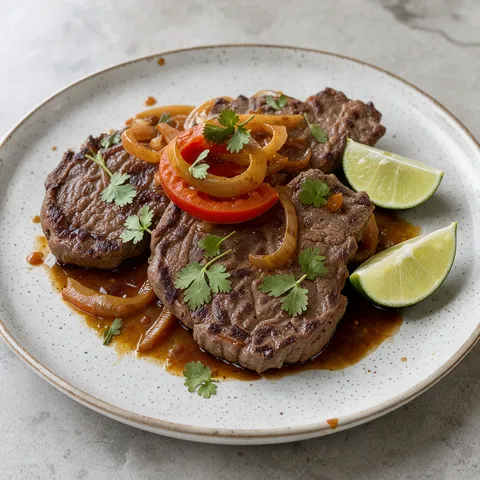 Colombian Beef Steak with Onions28 min · Main course
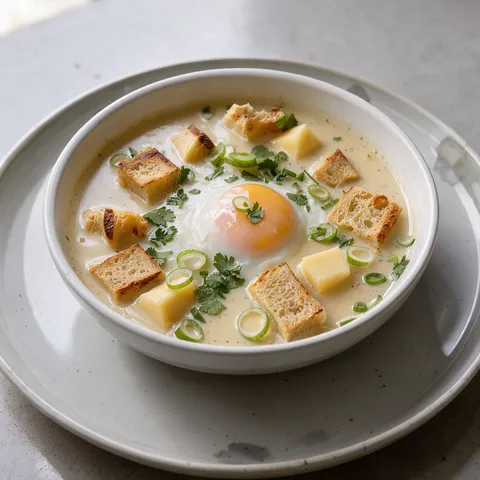 Colombian Milk and Egg Soup20 min · Breakfast
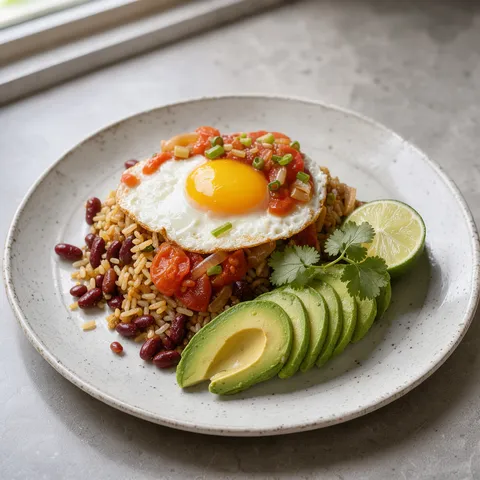 Colombian Fried Rice and Beans29 min · Main course
 Bogotá Three-Potato Chicken Soup1 hr 20 min · Soup
 Twice-Fried Plantain50 min · Meze
 Ajiaco Santafereño 2.01 hr 20 min · Soup