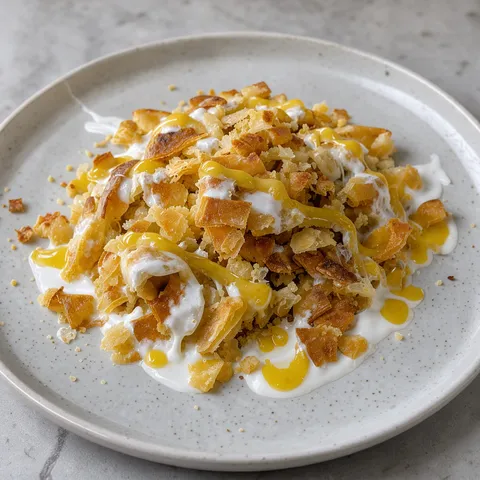
Buttered Pastry Crumbs and Yoghurt Babikko
A Turkish bread & pastry. Takes 1 hr 30 min, Serves 4. Difficulty: medium.
At a glance
- Total time
- 1 hr 30 min
- Serves
- Serves 4
- Difficulty
- Medium
- Cuisine
- Turkish cuisine
- Dish type
- Bread & pastry
- Allergens
- Gluten, Milk
Ingredients
Dough
- 500 g plain flour
- 250 ml milk
- 80 g melted butter
- 1 tsp salt
Greasing
- 80 g melted butter
Frying
- 60 g butter
To serve
- 400 g yoghurt
- 100 ml water
- 50 g butter
Equipment
- Baking tray
- Oven
- Frying pan
- Pastry brush
- Baking paper
- Balloon whisk
- Mixing bowls
- Food processor (optional)
Method
- Knead the dough: Put the flour and salt in a bowl and make a well in the centre. Add the warm milk and melted butter. Knead for 6 min, until the dough is firm and smooth. A yeast-free, firm dough crumbles into separate grains when made into crumbs
- Rest the dough: Divide the dough into 4 equal pieces, cover with a damp tea towel and rest for 15 min. As the dough rests the gluten relaxes and it rolls out thinly, whereas without a rest it shrinks back
- Roll out and brush with butter: Preheat the oven to 200°C. Roll each piece out thinly on a floured surface to the size of the tray. Brush with the melted butter using a pastry brush. Fold each piece in thirds and shape into a round or rectangle 1 cm thick (the kete shape). The butter keeps the layers separate and crisp as they bake
- Bake the ketes: Arrange the ketes on a tray lined with baking paper and bake in the 200°C oven for 22-25 min, until the surface is golden and feels hard when pressed. They should be completely dry and crisp inside, because moisture makes the crumbs clump
- Cool and crumble: Cool the ketes on a wire rack for 10 min. Crumble into separate grains using 4-5 pulses in a food processor, or by hand. Coarse crumbs should remain, so do not reduce them to powder
- Toast in butter: Melt 60 g butter in a large frying pan over medium heat. Add the crumbs and toast for 6-7 min, stirring constantly. The crumbs should absorb the butter and take on a light golden colour, and smell like toasted flour and butter
- Prepare the yoghurt (as crumbs toast): Loosen the yoghurt with the water, whisking until runny. Do not thin it too much, because it should be able to sit on the crumbs. Melt 50 g butter in a small pan
- Plate: Pile the toasted crumbs on a serving plate. Pour the slightly thinned yoghurt over, then drizzle over the melted butter while it is sizzling hot. When the hot butter touches the yoghurt it sizzles lightly and the crumbs soften
- Serve: Serve straight away. As the crumbs absorb the yoghurt they soften, and one more spoonful of yoghurt can be added if you like
Chef's note
According to the Erzincan recipe on the Culture Portal, babikko is a dish made with kete dough, in which the baked ketes are crumbled, toasted in butter and served with thinned yoghurt. The source gives neither the amount of flour nor the oven time, and the kete shape is not described, so these details are the recipe writer's own. In place of the halbur (sieve) and rondo (a rotary grater) the source uses to make the crumbs, a food processor or your hands can be used.
Frequently asked questions
- Why should the crumbs for Babikko be loose and separate?
- A firm dough without yeast breaks into loose, separate crumbs. Crumble the kete with 4-5 pulses in a food processor or by hand, without grinding it to a powder.
- How should the kete look when baked?
- The surface should turn golden and feel hard when pressed. The inside should be completely dry and crisp, as moisture makes the crumbs clump.
- How is the yoghurt for Babikko prepared?
- Whisk the yoghurt with water until runny. Don't thin it too much, as it should be able to sit on top of the crumbs.
 Buttered Kete Crumbs and Yoghurt 2.054 min · Bread & pastry
 Chilled Wheat Yoghurt Soup1 hr · Soup
 Noodle and Yoghurt Soup1 hr 10 min · Soup
 Lamb, Chickpea and Potato Stew1 hr 15 min · Soup
 Marinated Sea Bass30 min · Meze
 Crispy Fried Liver Slices25 min · Meze
 Courgette Crisps30 min · Meze