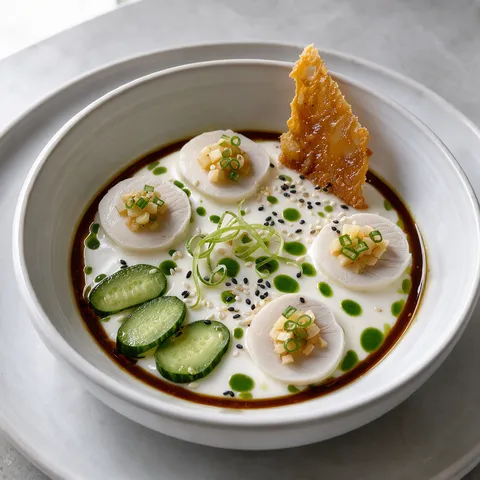
Bai Qie Ji 2.0
A Chinese main course. Takes 1 hr 15 min, Serves 4. Difficulty: challenging.
At a glance
- Total time
- 1 hr 15 min
- Serves
- Serves 4
- Difficulty
- Challenging
- Cuisine
- Chinese cuisine
- Dish type
- Main course
- Allergens
- Gluten, Milk, Sesame, Soya, Celery
Ingredients
Chicken
- 4 skin-on boneless chicken breasts (about 170 g each)
- 1 litre Chicken Stock (Basics)
- 4 slices of ginger
- 2 spring onions
- 1 tsp salt
Crisp skin
- skins removed from the breasts
- flaky salt
Rice cream
- 80 g jasmine rice
- 700 ml Chicken Stock (Basics)
- 2 slices of ginger
- 1 tbsp chicken fat (rendered from the skins)
- 1/2 tsp salt
Green oil
- green parts of 6 spring onions
- 20 g fresh ginger
- 120 ml neutral oil
- 1/2 tsp salt
Classic ginger and spring onion
- 30 g fresh ginger (finely grated)
- white parts of 3 spring onions (very finely chopped)
- 1/2 tsp salt
- 60 ml neutral oil
Soy jus
- 300 ml poaching liquid
- 1 tbsp light soy sauce
- 1 tsp rock sugar
- 1 tsp Shaoxing rice wine
- 1 tsp cornflour (mixed with 1 tbsp water)
- 1/2 tsp Chinkiang black vinegar
Cucumber
- 1 cucumber
- 1/2 tsp salt
- 1 tbsp Chinkiang black vinegar
- 1 tsp sugar
- 1 tsp sesame oil
To finish
- 2 spring onions (cut into fine threads and curled in iced water)
- 1 tsp toasted white sesame seeds
- flaky salt
Equipment
- Oven
- Baking tray
- Baking paper
- Saucepan
- Blender
- Fine sieve / chinois
- Cling film
- Probe thermometer
- Mixing bowls
- Muslin
- Frying pan
- Chef's knife
- Chopping board
Method
- Bake the skin: Preheat the oven to 180°C. Peel the skins off the breasts and scrape the excess fat from the inside with the back of a knife. Lay them flat on a tray lined with baking paper, then cover with a second sheet of baking paper and a second tray so the skin stays flat. Bake for 20-25 min, until golden and glassy. Set aside 1 tbsp of the fat rendered on the tray, sprinkle the skins with flaky salt and cool on a wire rack: they crisp up as they cool
- Rice cream: While the oven is on, wash the rice, bring to the boil with the stock and ginger and cook over low heat for 30 min, scraping the bottom now and then, until the grains have completely broken down. This is a quick version of the congee in Yu Pian Zhou (Cantonese Fish Congee). Remove the ginger, blend for 1 min with the reserved chicken fat and pass through a fine sieve. It should flow slowly off a spoon like silk: loosen with hot water if needed. Season, cover and keep warm
- Wrap the breasts: Salt the skinned breasts, then wrap each one tightly in 3 layers of cling film to form a cylinder and twist the ends like a sweet wrapper to tighten. A cylinder cooks evenly and gives a neat round cross-section
- Poach: In a wide pan, heat the stock to 80°C with the ginger, spring onions and salt. Add the cylinders and, keeping the liquid between 75-78°C with a thermometer, poach for about 25 min, until the internal temperature at the thickest part reaches 68°C, then leave in the liquid for another 5 min. As in classic bai qie ji, the liquid never boils, so the breast stays juicy and firm rather than dry
- Shock in ice: Transfer the cylinders, still in their cling film, to iced water for 5 min. The ice bath does the same job here as in the classic: the outside firms up and the cut edge is sharp. Then leave at room temperature. Strain and set aside 300 ml of the poaching liquid
- Green oil: Blanch the spring onion greens in boiling water for 10 sec, transfer straight to iced water and squeeze thoroughly in your hand. Blend with the ginger, oil and salt for 2 min, then leave to drip through muslin set in a fine sieve for 10 min. Do not press, or the oil turns cloudy. A clear, emerald oil remains
- Classic mix: Put the grated ginger, chopped spring onion whites and salt in a small heatproof bowl. Heat the oil in a small pan to 180°C, pour it over so it sizzles and cooks, and stir
- Soy jus: Boil the reserved poaching liquid with the soy sauce, rock sugar and wine in a small pan for 8 min, until reduced by half. Stir in the cornflour slurry and cook for 30 sec, then stir in the black vinegar. It should be a loose but glossy jus
- Cucumber: Lay the cucumber on the board, smash it by pressing down with the flat of the knife and break it into 3 cm pieces. Salt and leave for 10 min, drain off the liquid and mix with the black vinegar, sugar and sesame oil. Smashed cucumber holds the dressing better than a clean cut
- Slice: Unwrap the breasts, pat dry and cut each into 5 slices 2 cm thick with a sharp knife. Put flaky salt and a drop of green oil on each cut face
- Plate: Pour 3 tbsp rice cream into the centre of a shallow bowl and tilt the bowl gently to make a flat pool. Arrange the five slices in the middle of the pool, slightly overlapping. Top each slice with 1/2 tsp of the classic ginger and spring onion mix. Spoon the soy jus around the edge of the pool and drop 6-7 drops of green oil onto the cream. Place three pieces of smashed cucumber beside the slices and stand a shard of crisp skin upright among the slices. Scatter with the spring onion threads and sesame seeds and serve at once
Chef's note
The three elements of classic bai qie ji are kept: chicken cooked without boiling, the ice bath and the ginger and spring onion oil. The rice served alongside the chicken becomes a silky rice cream, and the ginger and spring onion oil becomes both the classic sizzle and an emerald oil. The crunch, absent from the classic, comes from the skin, and the sourness from the black-vinegar cucumber. Holding the breast at 68°C makes it safe to eat. Soy sauce, Shaoxing wine and Chinkiang vinegar are traditionally bought ready-made from Asian shops.
Frequently asked questions
- Why do poached chicken breasts stay juicy and not dry?
- The water never boils and is kept at 75-78°C. The breasts are wrapped in cling film into tight cylinders, so they cook evenly and stay firm.
- Why can the green oil turn out cloudy?
- If you press the oil through a muslin-lined sieve, it turns cloudy. Wait for it to drip through by itself, so it stays emerald and clear.
- How is the crisp chicken skin prepared?
- Scrape the excess fat from the inside of the skins and bake them flat between sheets of baking paper. When golden and glassy, season with salt and cool them on a wire rack, where they crisp up as they cool.
 Cantonese White-Cut Chicken with Ginger2 hr · Main course
 Mapo Tofu35 min · Main course
 Kung Pao Chicken30 min · Main course
 Peking Duck2 hr · Main course
 Char Siu1 hr · Main course
 Crystal Prawn Dumplings1 hr 30 min · Starter
 Open-Topped Dumplings50 min · Starter