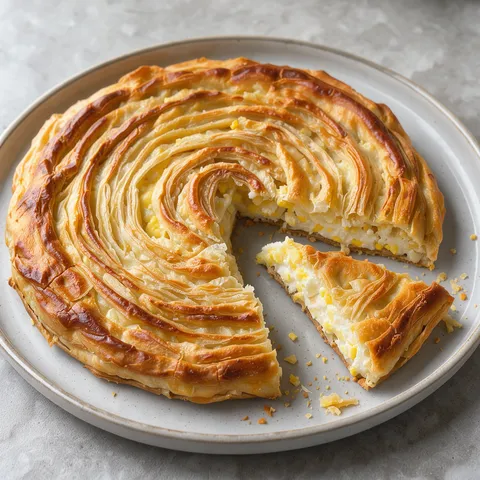
Bulgarian Cheese Borek Banitsa
A Bulgarian bread & pastry. Takes 2 hr 25 min, 28 cm round tin, 8-10 slices. Difficulty: challenging.
At a glance
- Total time
- 2 hr 25 min
- Serves
- 28 cm round tin, 8-10 slices
- Difficulty
- Challenging
- Cuisine
- Bulgarian cuisine
- Dish type
- Bread & pastry
- Allergens
- Gluten, Milk, Eggs
Ingredients
Dough
- 500 g plain flour
- 1 tsp salt
- 1 tbsp cider vinegar
- 2 tbsp sunflower oil
- 270-290 ml lukewarm water
- 150 g half-and-half mix of cornflour and plain flour for rolling
Filling
- 400 g Bulgarian white cheese (sirene, crumbled)
- 4 eggs
- 250 g strained (Greek-style) yoghurt
- 1/2 tsp bicarbonate of soda
- 100 ml sparkling water
For brushing
- 120 g butter (melted) + 3 tbsp sunflower oil
Topping
- 1 egg
- 2 tbsp plain yoghurt
Equipment
- Mixing bowls
- Rolling pin / oklava
- Tongs
- Pastry brush
- Baking tray
- Oven
- Chef's knife
- Precision scales
Method
- Knead the dough: Put the flour and salt in a bowl and make a well in the centre. Add the vinegar, oil and lukewarm water and knead, first with a spoon and then by hand, for 10 min. The dough should be smooth and elastic, soft and pliable like an earlobe. The vinegar relaxes the gluten so the dough stretches thin without tearing
- Rest: Weigh the dough and divide it into 10 equal balls (80 g each), round each one, oil it, cover and rest for 30 min. Rested gluten relaxes, so the balls can be rolled out thinly with a rolling pin
- Make the filling: Put the yoghurt in a bowl, whisk in the bicarbonate of soda and leave for 2 min: the yoghurt will froth and rise. Add the eggs, sparkling water and crumbled cheese and mix with a fork. The pieces of cheese should stay large, so do not mash them. The yoghurt with bicarbonate gives banitsa its light, puffy texture
- Roll out the sheets: Dust the work surface with the cornflour and flour mix. Roll a ball out with a rolling pin into a 20 cm circle first, then, using a thin rolling pin or stretching it over the backs of your hands, take it to about 45 cm across, thin enough to see the pattern underneath. Tears do not matter, as the sheet is crumpled in banitsa
- Fill and roll: Brush the melted butter and oil mixture over the whole rolled-out sheet. Spoon 3-4 tbsp of filling along one edge and scatter a few spoonfuls over the sheet too. Starting from the filled edge, roll up loosely, then push the roll in from both ends to crumple it gently like an accordion. The crumpling leaves air between the layers and creates crisp layers
- Arrange in the tin: Oil a 28 cm round tin. Coil the first roll like a snail, starting from the centre of the tin, then add the following rolls end to end to widen the spiral outwards. This arrangement is called vita banitsa
- Prepare the top: Whisk the egg and 2 tbsp yoghurt and brush evenly over the banitsa. Drizzle the remaining butter over the top. Making light cuts along the spiral at 5-6 cm intervals with a sharp knife makes slicing easier
- Bake: Bake on the middle shelf of an oven preheated to 200°C for 15 min, then lower to 180°C and bake for another 25-30 min. It is ready when the top is deep golden and the centre stays firm when you shake the tin. If the base has not coloured, move it to the bottom shelf for the last 5 min
- Rest: Cover the banitsa with a clean tea towel as it comes out of the oven and leave for 10 min. The steam softens the top crust slightly, so it does not shatter when sliced
- Plate: Serve the banitsa whole, in the tin or on a large board, so the spiral shows. Cut the first slice as a triangle and turn it on its side so the layers show. Serve with a glass of ayran (salted yoghurt drink) or cold boza
Chef's note
In Bulgaria banitsa is the pastry of breakfast, the festive table and New Year's Eve, when paper wishes are hidden inside it. In Bulgarian homes the thin pastry sheets (kori) are usually shop-bought; here the dough is rolled out from scratch. If the cheese is salty, do not add salt to the filling. Yield: 28 cm round tin, 8-10 slices.
Frequently asked questions
- Why does banitsa dough stretch thin without tearing?
- Vinegar goes into the dough, and it relaxes the gluten so the dough stretches without tearing. Rest the dough balls for 30 minutes as well. Small tears in banitsa aren't a problem.
- What does the yoghurt with bicarbonate do in the filling?
- Left for 2 minutes after adding the bicarbonate to the yoghurt, the mixture foams and gives the banitsa its light, airy texture. Leave the cheese in large pieces without crushing them.
- Why does banitsa break when sliced?
- When it comes out of the oven, cover it with a clean cloth for 10 minutes. The steam softens the top crust slightly so it doesn't break when slicing.
 Bob Chorba1 hr 40 min · Soup
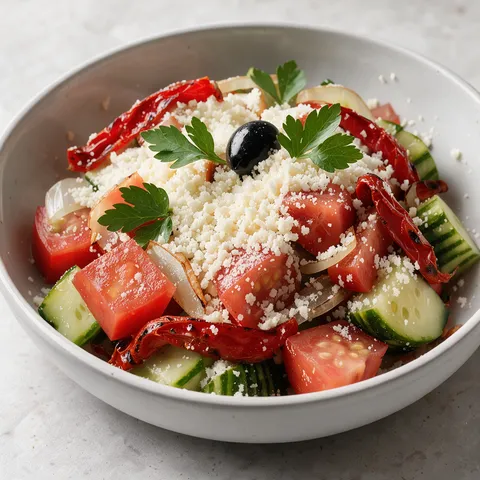 Shopska Salata35 min · Starter
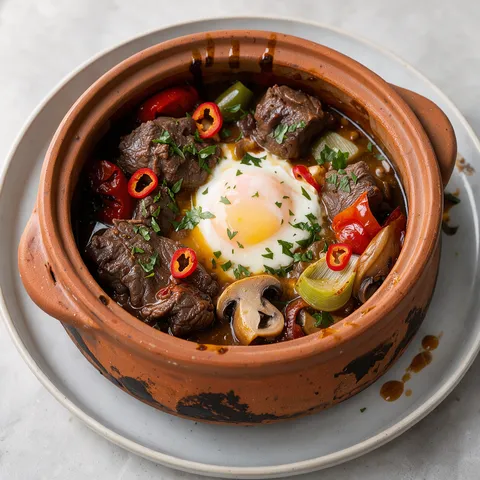 Bulgarian Beef and Vegetable Stew in a Clay Pot2 hr · Main course
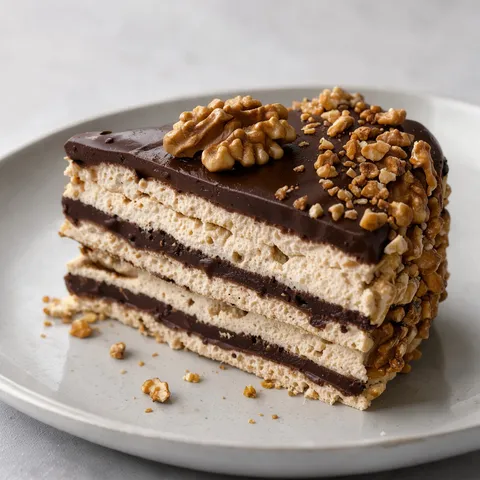 Garash Torta1 hr 45 min · Patisserie
 Shopska Salata 2.01 hr 15 min · Starter
 Bulgarian Aubergine and Pepper Spread1 hr 10 min · Meze