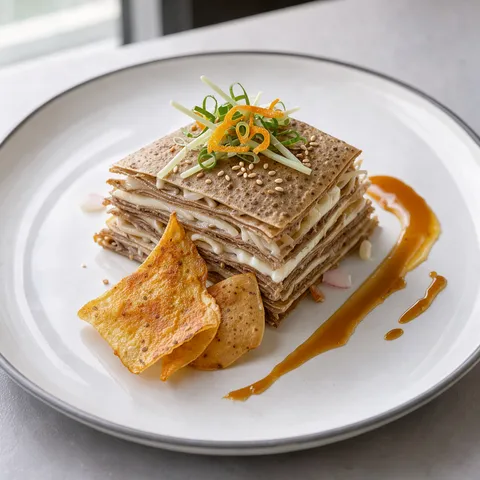
Bingtteok 2.0
A Korean bread & pastry. Takes 1 hr 11 min, Serves 4. Difficulty: challenging.
At a glance
- Total time
- 1 hr 11 min
- Serves
- Serves 4
- Difficulty
- Challenging
- Cuisine
- Korean cuisine
- Dish type
- Bread & pastry
- Allergens
- Gluten, Milk, Eggs, Sesame, Soya
Ingredients
Buckwheat crêpes
- 150 g buckwheat flour
- 375 ml water
- 1/4 tsp salt
- 1 tbsp neutral oil (for greasing the pan)
Radish namul
- 350 g Korean radish (fine matchsticks)
- 2 garlic cloves (finely chopped)
- 1 tbsp sesame oil
- 1/2 tsp salt
- 1 spring onion (thin rings)
Sesame yoghurt cream
- 150 g strained yoghurt
- 2 tbsp tahini
- 1 tbsp honey
- 1/2 tsp salt
- 1 tbsp lemon juice
- 1 tbsp toasted sesame seeds
Mandarin soy glaze
- 4 mandarins (about 200 ml freshly squeezed juice)
- 1 tbsp soy sauce
- 1 tbsp sugar
- 1 tsp finely grated mandarin zest
Crêpe crisps
- 2 crêpes (cooked separately)
- 200 ml oil for deep-frying (2 cm deep)
- flaky sea salt
To finish
- 1 tbsp toasted sesame seeds
- spring onion shoots
- finely grated mandarin zest
Equipment
- Frying pan
- Saucepan
- Mixing bowls
- Balloon whisk
- Ladle
- Baking paper
- Kitchen scissors
- Chef's knife
- Box grater
- Probe thermometer
Method
- Prepare the buckwheat batter: Whisk the buckwheat flour with the water and salt for 2 min until lump-free. The batter should be the consistency of thin milk so the crêpes come out thin. Rest for 5 min, as the flour absorbs the water and the crêpes become more flexible (~7 min)
- Reduce the mandarin and soy glaze: Boil the mandarin juice, soy sauce, sugar and zest in a large frying pan over medium-high heat. Cook for 10 min until reduced by half to a glossy glaze that lightly coats the back of a spoon. The mandarin acid balances the saltiness of the soy and brings the citrus identity of Jeju to the dish. Leave to cool, as it thickens as it cools (~10 min)
- Sauté the radish namul: Heat the pan for 2 min and add the sesame oil, then sauté the radish matchsticks and garlic for 4 min until translucent and the liquid has cooked off. Season with the salt. Take off the heat and add the spring onion. The filling should be dry and lukewarm, as moist filling makes the layers slide and softens the crêpe (~6 min)
- Whisk the sesame yoghurt cream: Whisk the strained yoghurt, tahini, honey, salt, lemon juice and sesame seeds in a bowl with a whisk for 2 min until smooth. The cream should stay on the spoon without running. The tahini makes the cream creamy and nutty, and the yoghurt adds a slight tang (~2 min)
- Cook the crêpes: Heat a non-stick pan over medium heat and brush with a thin film of oil. Pour a ladle of batter into the pan and tilt the pan to spread it within 1 min. Cook for 2 min until the edges come away and the surface is matt, and do not flip. Cook 10 crêpes in this way and allow 22 min in total. Stack the cooked crêpes with baking paper between them (~22 min)
- Make the crêpe crisps: Cut two crêpes into triangles with scissors. Heat the oil in a small pan to 180°C with a thermometer within 2 min and fry the triangles for 1 min until puffed and crisp. Transfer to kitchen paper and sprinkle with flaky sea salt. The crisps scented with buckwheat give the plate height and textural contrast (~3 min)
- Build the layers: Put a crêpe on a plate, and spread 1 tbsp radish namul and a thin layer of sesame yoghurt cream over it. Put on another crêpe and continue, pressing down. Keep the filling and cream thin, as thick layers slide. Make 8 layers and put a crêpe without filling on top (~6 min)
- Cool and set: Wrap the tower in cling film and rest in the fridge for 10 min. Chilling the cream sticks the layers together and gives a clean slice. If you cut without waiting, the layers slide (~10 min)
- Cut: Cut the cold tower into 4 slices with a wet, sharp knife. Wet and wipe the knife between cuts. The cross-section of the slices, with their layers, will be the beauty of the plate (~2 min)
- Plate: Put a drop of the mandarin and soy glaze on a flat white plate and draw a line with the back of a spoon. Stand a slice upright on the glaze. Lean two crêpe crisps alongside. Finish with mandarin zest, sesame seeds and spring onion shoots. Serve at once, cold or at room temperature (~3 min)
Chef's note
The buckwheat crêpe and radish namul filling of the classic bingtteok is kept, but here the roll becomes a layered tower and is completed with the citrus of Jeju (mandarin). Soy sauce is a traditional ready-made product. Buckwheat crêpes are fragile, and a thin, rested batter tears less.
Frequently asked questions
- Why does buckwheat crêpe tear so easily?
- Buckwheat has no gluten, so the batter is fragile. Resting the batter and making thin crêpes reduces tearing.
- What can I use instead of mandarin?
- Orange or clementine becomes a glaze in the same way. If you use grapefruit, increase the sugar.
- Can I make the stack ahead?
- Assemble the stack a day ahead and keep it in the fridge under cling film. Add the crisp crêpe chips and the glaze just before serving.
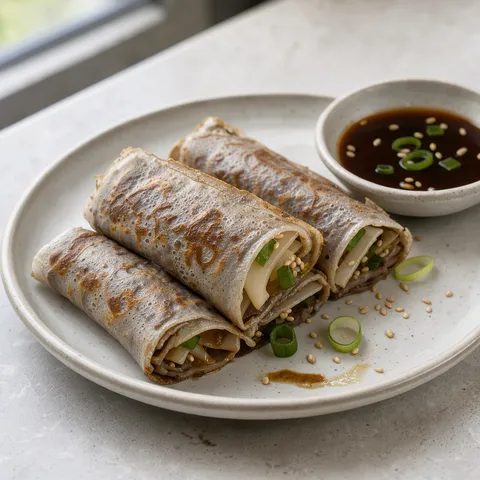 Korean Buckwheat Crêpes with Radish Filling33 min · Bread & pastry
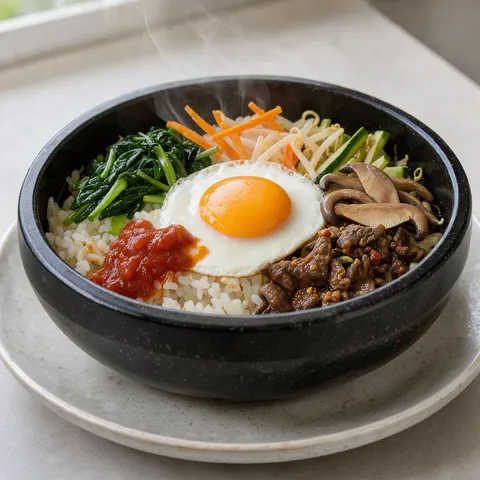 Bibimbap1 hr 15 min · Main course
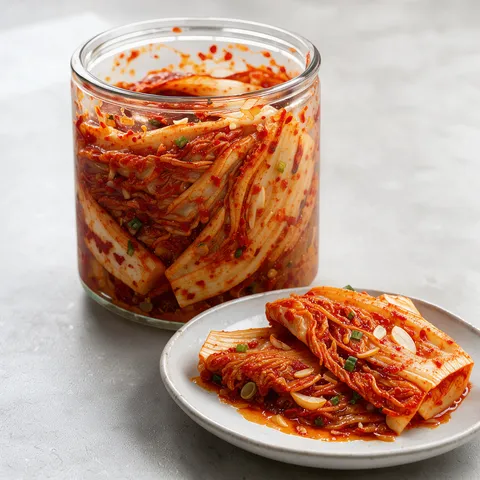 Kimchi3 hr · Side dish
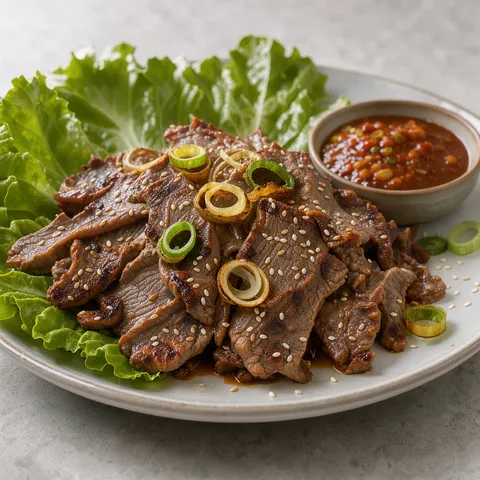 Bulgogi30 min · Main course
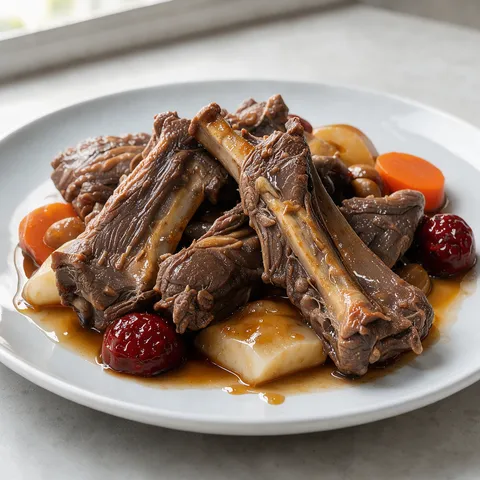 Korean Braised Short Ribs1 hr 30 min · Main course
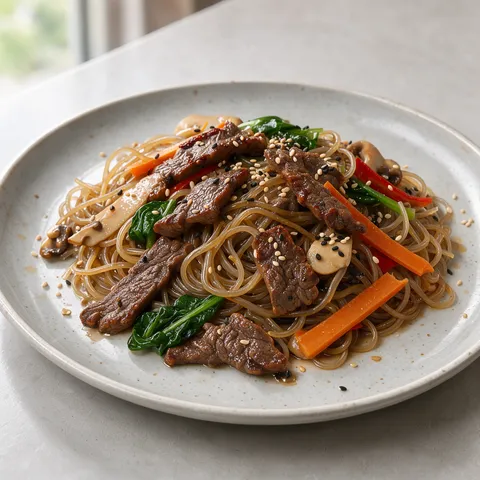 Korean Glass Noodles with Vegetables45 min · Main course
 Kimchi Stew40 min · Soup