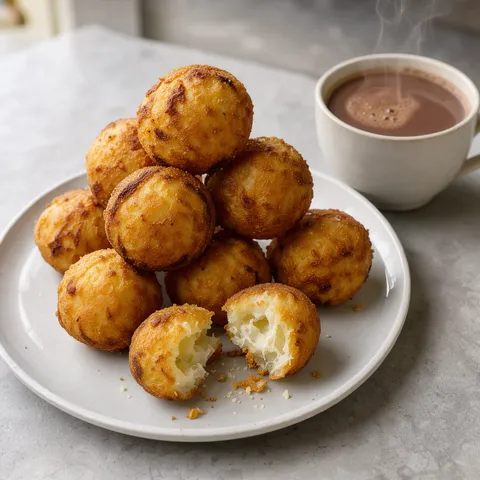
Colombian Cheese Fritters Buñuelos Colombianos
A Colombian bread & pastry. Takes 1 hr 15 min, Serves 4. Difficulty: medium.
At a glance
- Total time
- 1 hr 15 min
- Serves
- Serves 4
- Difficulty
- Medium
- Cuisine
- Colombian cuisine
- Dish type
- Bread & pastry
- Diet
- Vegetarian, Gluten-free
- Allergens
- Milk, Eggs
Ingredients
- Dough (about 15, 30 g each): 250 g well-drained salty full-fat white cheese (in place of queso costeño)
- 100 g cassava starch (almidón de yuca or tapioca starch)
- 30 g cornflour
- 25 g sugar
- 1/2 tsp baking powder
- 1 egg
- 1-2 tbsp milk (if needed)
Frying
- 2.5 litres sunflower oil
Equipment
- Food processor
- Mixing bowls
- Heavy-based saucepan
- Probe thermometer
- Ladle
- Colander
Method
- Break down the cheese: Press the cheese with kitchen paper to remove its liquid. Process in a food processor for 1 min, until it resembles fine, damp sand with no lumps left. If the cheese stays grainy, the surface of the buñuelo cracks as it fries and oil gets in
- Add the dry ingredients: Add the cassava starch, cornflour, sugar and baking powder to the cheese and pulse the processor for 10 sec to mix
- Knead: Transfer the mixture to a bowl, add the egg and knead by hand for 3-4 min. The dough should be smooth, non-sticky and the consistency of play dough. Take a piece and roll it into a ball: if the edges crack add 1 tbsp milk, and if it sticks to your hands add 1 tbsp cassava starch. Cover the dough with cling film and rest for 10 min, so the starch absorbs the moisture evenly
- Heat the oil: While the dough rests, heat 2.5 litres oil to 150°C in a deep, heavy-based 5-litre pan at least 22 cm across. The oil should come no more than halfway up the pan and be at least 6-7 cm deep, as the buñuelos swell to twice their size and need to turn freely. Keep water away from the pan
- Shape the balls: Divide the dough into 30 g pieces and roll between your palms into smooth balls 3.5-4 cm across, leaving no cracks. A ball with a cracked surface opens up in the oil or bursts and spits oil
- Fry: With the oil at 150°C, lower 5 balls in gently with a slotted spoon. They sink to the bottom first and rise to the surface after 2-3 min. Once they rise, spoon oil over them with a ladle and turn them gently. At the right temperature the buñuelos turn on their own as they swell. Fry for 12-14 min in total, until evenly deep golden and almost doubled in size. For the last 2 min you can raise the oil to 165°C. If the oil is too hot, the outside darkens fast and the inside stays raw and doughy
- Drain: Lift out with a slotted spoon and drain on kitchen paper. Wait for the oil to return to 150°C and fry the remaining batches, three batches in total
- Check: Break one buñuelo from the first batch in half. The inside should be lightly hollow, cheesy and cooked, moist but not doughy. If raw, extend the time by 2 min in the remaining batches
- Plate: Pile the warm buñuelos in a pyramid in a basket or on a plate. Serve warm, as in Colombia, with a cup of hot chocolate or coffee
Chef's note
Buñuelos are indispensable on the Christmas table in Colombia, especially in December, with natilla, the panela and cinnamon custard, and are also eaten at breakfast all year round. Queso costeño is the salty, firm white cheese of the Caribbean coast, and its closest equivalent is a well-drained, salted white brined cheese. The salt and moisture of the cheese vary, so adjust the dough consistency with milk and starch. If you will reuse the frying oil, strain it and store it in a covered container.
Frequently asked questions
- Why do buñuelos burst or crack in the oil?
- Balls with cracks open up in the oil or burst and spit hot fat. Roll the balls between your palms until perfectly smooth with no cracks at all.
- What temperature should the oil be for buñuelos?
- Start frying at 150°C. If the oil is too hot, the outside darkens quickly and the inside stays raw and doughy.
- Why is the cheese blitzed in a food processor?
- If the cheese stays grainy, the buñuelo cracks as it browns and takes in oil. Drain it first, then blitz until it looks like fine, lump-free sand.
 Colombian Beef Steak with Onions28 min · Main course
 Colombian Milk and Egg Soup20 min · Breakfast
 Colombian Fried Rice and Beans29 min · Main course
 Bogotá Three-Potato Chicken Soup1 hr 20 min · Soup
 Twice-Fried Plantain50 min · Meze
 Ajiaco Santafereño 2.01 hr 20 min · Soup