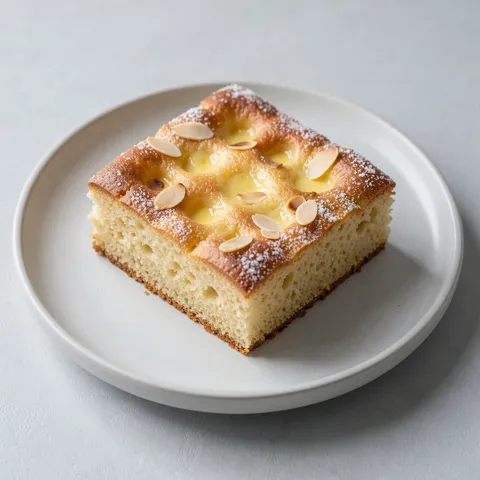
German Butter Cake with Almonds Butterkuchen
A German patisserie. Takes 55 min · +1 hr 15 min rising, 24×30 cm tin, 12 slices. Difficulty: medium.
At a glance
- Total time
- 55 min · +1 hr 15 min rising
- Serves
- 24×30 cm tin, 12 slices
- Difficulty
- Medium
- Cuisine
- German cuisine
- Dish type
- Patisserie
- Allergens
- Gluten, Milk, Eggs, Tree nuts
Ingredients
Dough
- 500 g strong white bread flour
- 7 g fast-action dried yeast
- 60 g caster sugar
- 1/2 tsp salt
- 250 ml lukewarm milk (about 35°C)
- 80 g melted and cooled butter
- 1 egg
Topping
- 120 g cold butter
- 100 g caster sugar
- 60 g flaked raw almonds
Tin
- 24×30 cm
- 12 slices
Equipment
- Baking tray
- Baking paper
- Mixing bowls
- Oven
Method
- Knead the dough: Mix the flour, sugar, salt and yeast, add the milk, egg and lukewarm butter and knead for 8-10 min, until you have an elastic dough that sticks only slightly to your hands. Lukewarm butter does not kill the yeast, but hot butter does, so it should feel lukewarm on the palm of your hand. (~10 min)
- First prove: Put the dough in an oiled bowl, cover with a damp cloth and prove in a warm place for 45 min, until doubled in size (waiting: 45 min).
- Spread in the tin: Line the tin with baking paper. On a lightly floured worktop, roll the dough out to 24×30 cm without pressing out the air, place it in the tin and push it towards the corners with your fingers. If the dough springs back, rest it for 5 min. (~5 min)
- Second prove: Cover the tin with a cloth and leave to prove for 30 min, until the dough surface is puffed and soft (waiting: 30 min). Preheat the oven to 200°C meanwhile.
- Make the dimples and add the topping: Press your fingertips 2 cm deep into the dough to make a dimple every 3 cm. Put the cold butter in small pieces into the dimples and scatter over the sugar first, then the almonds. The butter melts in the dimples as it bakes and works into the dough, and the sugar caramelises. (~6 min)
- Bake: Bake on the middle shelf of the 200°C oven for 20-22 min, until the top is golden brown and the edges of the almonds darken. If the base has browned, move the tin to the top shelf for 5 min. (~22 min)
- Cool and slice: Leave the cake to rest in the tin for 10 min, so that the hot butter is drawn into the dough. Let it become lukewarm on a wire rack and cut into 12 slices. (~12 min)
Chef's note
Butterkuchen is a classic of weekend breakfast and coffee hour in North Germany (Hamburg, Bremen), and the dimples on its surface are left for the butter and sugar. Cold butter gives the best result, as it greases the dough while melting in the dimples. It is best eaten on the day, and the next day it is refreshed by heating in a 150°C oven for 5 min.
Frequently asked questions
- How warm should the butter in the dough be?
- Melt the butter and let it cool until lukewarm. If it is hot, it kills the yeast, so it should feel just warm in the palm of your hand.
- What are the dimples on top of the Butterkuchen for?
- Press dimples about 2 cm deep with your fingertips and put cold butter in them. The butter melts into the dimples as it bakes and soaks into the dough, and the sugar caramelises.
- What if the dough keeps springing back in the tin?
- Rest the dough for 5 minutes, then push it out towards the corners again with your fingers. Do not press the air out of the dough as you spread it.
 German Beef Roulades2 hr 30 min · Main course
 Meatballs in Caper Sauce1 hr 05 min · Main course
 Swabian Cheese Noodles55 min · Main course
 Swabian Potato Salad1 hr · Side dish
 Bavarian Pretzels1 hr 55 min · Bread & pastry
 Käsespätzle 2.01 hr 20 min · Main course