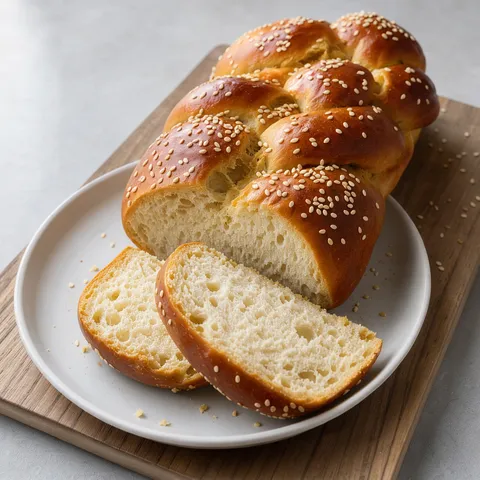
Sweet Braided Egg Bread Challah
An Israeli bread & pastry. Takes 3 hr 45 min (2 hr 15 min of it rising), 1 large plaited loaf, 12 slices. Difficulty: medium.
At a glance
- Total time
- 3 hr 45 min (2 hr 15 min of it rising)
- Serves
- 1 large plaited loaf, 12 slices
- Difficulty
- Medium
- Cuisine
- Israeli cuisine
- Dish type
- Bread & pastry
- Allergens
- Gluten, Eggs, Sesame
Ingredients
Dough
- 500 g strong white bread flour (high protein)
- 7 g fast-action dried yeast
- 50 g caster sugar or honey
- 10 g salt
- 2 eggs (at room temperature)
- 80 ml sunflower oil
- 180 ml lukewarm water (about 38°C)
Topping
- 1 egg yolk
- 1 tbsp water
- 1 tbsp sesame seeds
Equipment
- Mixing bowls
- Precision scales
- Baking tray
- Baking paper
- Pastry brush
- Oven
- Cling film
- Stand mixer (optional)
- Probe thermometer (optional)
Method
- Knead the dough: Mix the flour, yeast and sugar in a large bowl and sprinkle the salt on one side of the bowl, away from the yeast, so the salt does not touch the yeast directly. Make a well in the centre, add the eggs, oil and lukewarm water, and mix the salt into the dough as you start kneading. Knead first with a wooden spoon, then by hand on the work surface for 10-12 min, or in a stand mixer with the dough hook on medium speed for 8 min. It is ready when the dough is smooth, silky and slightly sticky, and a small piece stretched out forms a thin membrane that lets light through without tearing
- First prove: Transfer the dough to a lightly oiled bowl, cover with cling film and leave in a warm place (24-26°C) for about 1.5 hr, until doubled in size. When pressed with a finger, the dent should fill back slowly. If it fills back immediately, wait a little longer. If it does not fill back at all, it has over-proved, so shape it at once
- Divide and rest: Knock the air out of the dough with your palm and divide it into 6 equal pieces (about 145 g each) using scales. Shape each piece into a ball, cover and rest for 10 min, so the gluten relaxes and the dough does not spring back when stretched
- Roll the strands and braid: Roll each ball on the work surface with your hands into a 40 cm strand, slightly thicker in the middle and tapering at the ends. Join the six strands at one end and tuck the ends underneath. Make a six-strand braid: move the far right strand to the far left, then the second from the left to the far right, and repeat. If a six-strand braid seems too hard, make two three-strand braids and lay the smaller one on top of the larger. Tuck the end of the braid underneath too
- Second prove: Transfer the braid to a baking tray lined with baking paper, cover loosely with cling film and leave for 45 min, until it has grown to about 1.5 times its size and a fingertip dent springs back slowly. Meanwhile, preheat the oven to 180°C
- Brush and bake: Whisk the egg yolk with 1 tbsp water and brush it thinly over the whole surface of the braid and between the strands with a pastry brush, as egg that runs onto the tray sticks and burns. Sprinkle with the sesame seeds. Bake on the middle shelf for 28-32 min. If the top darkens too much by the 20 min mark, cover with foil. It is ready when the crust is glossy and deep amber, the base sounds hollow when tapped, and the internal temperature is 88-90°C
- Cool: Transfer the bread to a wire rack immediately and cool for at least 15 min: cut it while hot and the crumb turns doughy. Makes 12 slices
Chef's note
Challah is a dairy-free egg bread served at Friday-night dinners and on festival tables in Jewish cooking, and it is also one of the classics of market and bakery culture in Israel. This is why oil is used instead of butter. When it goes stale the next day, cutting it into thick slices and frying them in a pan with egg and milk is very common. Keep the salt and yeast apart, as direct contact slows the yeast.
Frequently asked questions
- Why keep the salt away from the yeast in challah dough?
- Sprinkle the salt on one side of the bowl, away from the yeast, so the two don't touch directly. Mix it into the dough when you start kneading.
- How do I know the dough has proved?
- When pressed with a finger, the dent should fill back in slowly. If it springs back at once, give it a little longer. If it doesn't fill back at all, it is overproved, so shape it straight away.
- Why shouldn't I slice challah straight away?
- Move the loaf to a wire rack at once and cool for at least 15 minutes. Sliced hot, the crumb turns gummy. It is done when the crust is amber, it sounds hollow when tapped underneath and the inside reads 88-90°C.
 Israeli Aubergine and Mayonnaise Salad55 min · Salad
 Shakshuka55 min · Main course
 Pitta with Fried Aubergine, Egg and Amba1 hr 15 min · Main course
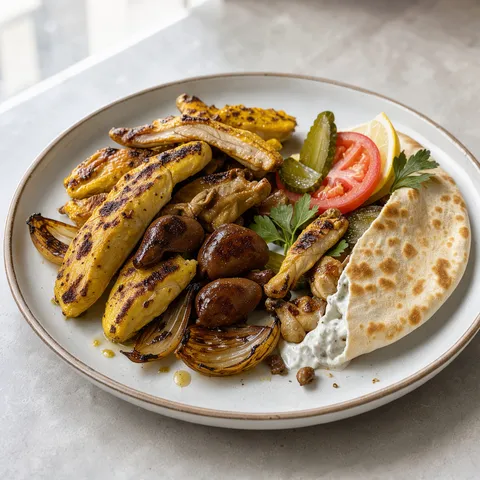 Jerusalem Mixed Grill of Chicken50 min · Main course
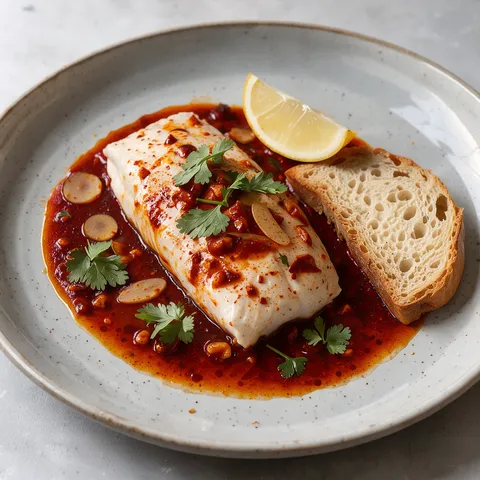 Libyan Jewish Fish in Spicy Red Sauce50 min · Main course
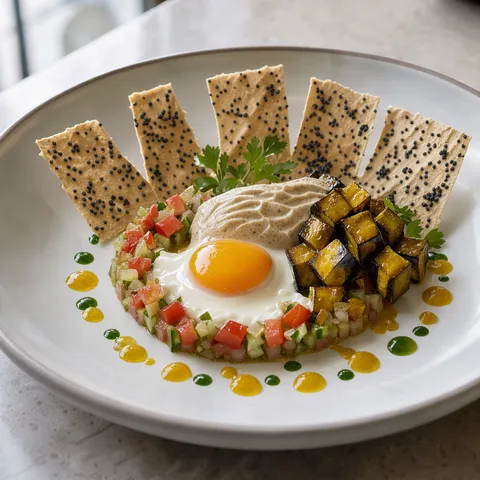 Sabich 2.01 hr 20 min · Starter