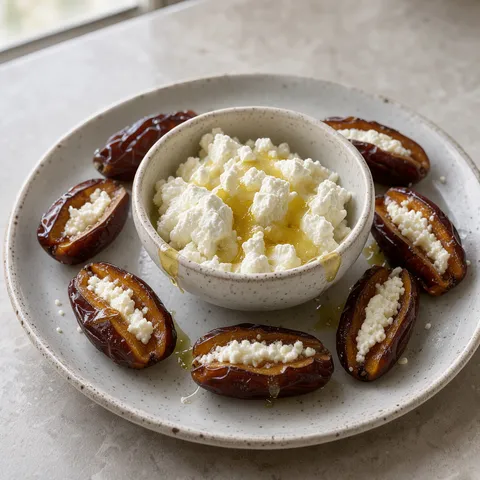
Emirati Fresh Cheese from Laban with Dates and Ghee Chami
An Emirati and Gulf meze. Takes 1 hr · +1 hr 30 min draining, Serves 4. Difficulty: medium.
At a glance
- Total time
- 1 hr · +1 hr 30 min draining
- Serves
- Serves 4
- Difficulty
- Medium
- Cuisine
- Emirati and Gulf cuisine
- Dish type
- Meze
- Diet
- Gluten-free
- Allergens
- Milk
Ingredients
Laban
- 1 kg whole-milk yoghurt
- 1 litre water (or 2 litres fresh, unsalted ayran)
Salt
- 1/2 tsp salt
To serve
- 12 soft dates (Medjool or Mazafati)
- 2 tbsp ghee (melted)
- a pinch of ground cumin (optional). Makes about 300 g (serves 4 for breakfast)
Equipment
- Mixing bowls
- Balloon whisk
- Heavy-based saucepan
- Wooden spoon / spatula
- Probe thermometer
- Colander
- Muslin
- Ladle
Method
- Make the laban: Whisk the yoghurt with the water in a large bowl for 2 min, until smooth, slightly frothy and the consistency of ayran. In the Gulf, laban is described as the sour liquid left after butter has been churned from milk, and yoghurt thinned with water to ayran at home is the closest equivalent. Takes 5 min in total
- Heat: Transfer the laban to a heavy-based saucepan and heat over medium heat, scraping the bottom with a wooden spoon to stop it catching. After 15-20 min, when the thermometer reads 85-90°C, the laban splits: white curds gather on the surface, with a clear, yellowish-green liquid underneath. Do not let it boil: boiled curds turn hard and rubbery
- Rest the curds: Turn off the heat and leave the pan uncovered for 10 min. During this time the curds firm up a little more and are ready to be strained together
- Set up the strainer: Line a colander with 2 layers of muslin and set it over a bowl. Takes 2 min in total
- Transfer: Ladle the curds into the muslin, then slowly pour in the remaining liquid. Do not throw away the whey: it can be used in bread dough or soup. Takes 5 min in total
- Salt and drain: Sprinkle the salt over the curds, tie the corners of the muslin, hang it from the handle of a wooden spoon and leave to drain over the bowl for 1 hr 30 min. Chami drained briefly is moist and crumbly, while chami drained for longer is drier and can be sliced. Emirati chami is a crumbly, moist cheese
- Adjust the consistency: Open the muslin, transfer the cheese to a bowl and mix, crushing it lightly with a fork. Check the salt. If too dry, moisten with 1-2 tbsp whey. Takes 3 min in total
- Prepare the dates: Slit the dates lengthways, remove the stones and fill each one with a teaspoon of chami. Takes 10 min in total
- Serve: Put the remaining chami in a small bowl, drizzle with melted ghee and, if you like, sprinkle with a pinch of cumin. Serve with the stuffed dates alongside Arabic coffee, or for breakfast with chebab and regag bread. Keeps in a covered container in the fridge for 3 days
Chef's note
Chami (chamee, jami) is the fresh cheese of Emirati cuisine, made from laban. It resembles fresh curd cheese and dry curd cheese, but is moister and slightly sour. It is traditionally served with dates and ghee, and is also said to be offered stuffed inside dates.
Frequently asked questions
- What can I use if I can't find laban?
- According to the recipe, the closest substitute at home is ayran made by thinning yoghurt with water. Whisk the yoghurt and water until it is the consistency of a frothy ayran.
- Should I boil the laban when making chami?
- No, don't boil it. The laban curdles when a thermometer reads 85-90°C, whereas a boiled curd turns tough and rubbery.
- How is chami stored?
- Keep it in a closed container in the fridge. According to the recipe it keeps for 3 days.
 Emirati Lamb and Vegetable Stew with Regag Bread1 hr 55 min · Main course
 Sweet Saffron Vermicelli with Omelette45 min · Dessert
 Balaleet 2.01 hr 15 min · Dessert
 Emirati Spiced Chicken and Mashed Rice1 hr 30 min · Main course
 Emirati Sweet Bread with Dates and Cardamom2 hr 40 min · Bread & pastry
 Emirati Saffron Cardamom Pancakes55 min · Bread & pastry