Catalan Burnt Cream Crema Catalana
A Spanish dessert. Takes 35 min · +4 hr chilling, 4 servings (4 bowls). Difficulty: easy.
At a glance
- Total time
- 35 min · +4 hr chilling
- Serves
- 4 servings (4 bowls)
- Difficulty
- Easy
- Cuisine
- Spanish cuisine
- Dish type
- Dessert
- Diet
- Vegetarian, Gluten-free
- Allergens
- Milk, Eggs
Ingredients
Custard
- 700 ml whole milk
- pared zest of 1 lemon (without the white pith)
- pared zest of 1 orange
- 1 cinnamon stick
- 6 egg yolks
- 130 g caster sugar
- 30 g cornflour
Topping
- 4 tbsp (about 50 g) caster sugar
Equipment
- Saucepan
- Balloon whisk
- Fine sieve / chinois
- Mixing bowls
- Kitchen blowtorch
- Wooden spoon / spatula
- Probe thermometer (optional)
Method
- Infuse the milk: Heat the milk with the lemon and orange zest and the cinnamon over medium heat until just below the boil (steam rising from the surface, about 85°C). Take off the heat, cover and leave to infuse for 15 min. The zest flavours the milk, but if you boil it the milk may split
- Prepare the yolks: Whisk the egg yolks, sugar and cornflour in a bowl for 2 min, until pale and smooth. The cornflour gives the custard a soft, lump-free texture
- Add the milk: Strain the infused milk and pour it onto the egg mixture in a thin stream, whisking all the time. Hot milk added all at once would cook the eggs, and adding it gradually (tempering) prevents this
- Cook: Pour the mixture into a saucepan and stir constantly with a wooden spoon over low heat for 6-8 min. It should reach 82-85°C and coat the back of the spoon: a line drawn with your finger should hold. Don't let it boil or the eggs will curdle
- Pour into dishes: Immediately pass through a fine sieve and pour into 4 dishes (about 10 cm across, earthenware or porcelain). Cover with cling film touching the surface so no skin forms
- Chill: Once it has cooled to room temperature, transfer to the fridge and chill for at least 4 hr. The custard reaches its full set as it cools
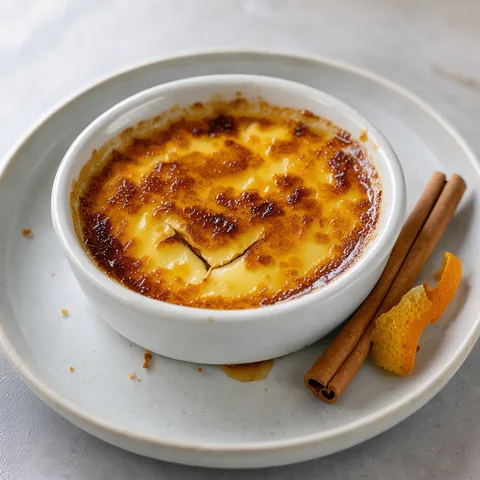
- Caramelise: Just before serving, blot the surface of each custard with kitchen paper and sprinkle 1 tbsp sugar evenly over each. Pass a blowtorch over the sugar for 30-40 sec, until amber. A thin crust should form that cracks like glass
- Plate: Serve with the custard still cold underneath and the crust warm on top. Place a cinnamon stick and a curl of orange zest beside each dish. Crack the crust with the tip of a spoon and eat it with the custard
Chef's note
The Catalan dessert for St Joseph's Day (19 March). It differs from crème brûlée in being made with milk, thickened with starch and flavoured with cinnamon and citrus, and it is not baked. If you have no blowtorch, make a caramel in a pan and pour it over the custard, but work quickly. No raw egg yolk is used: the custard reaches 82°C, so it is safe.
Frequently asked questions
- Why isn't the milk boiled for crema catalana?
- Take the milk off the heat at about 85°C, when steam rises from the surface. If it is boiled, the milk may spoil. It is infused with the zests for 15 minutes.
- How do I make the caramel crust on top?
- Just before serving, blot the surface with kitchen paper and sprinkle on an even layer of sugar. Heat it with a blowtorch for 30-40 seconds until amber. You want a thin crust that cracks like glass.
- How do I stop a skin forming on the custard?
- Once poured into the dishes, cover by pressing cling film onto the surface. Then let it come to room temperature and chill in the fridge for at least 4 hours.
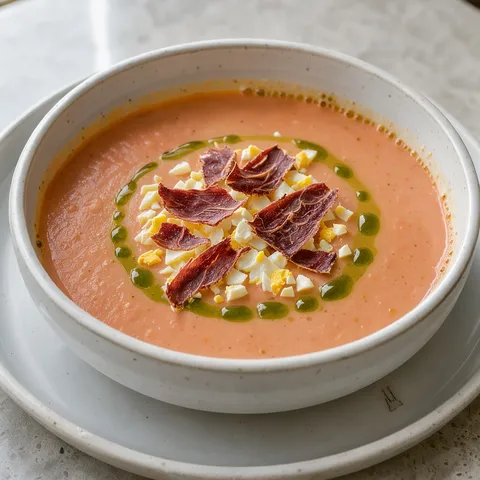 Cold Córdoba Tomato and Bread Soup25 min · Soup
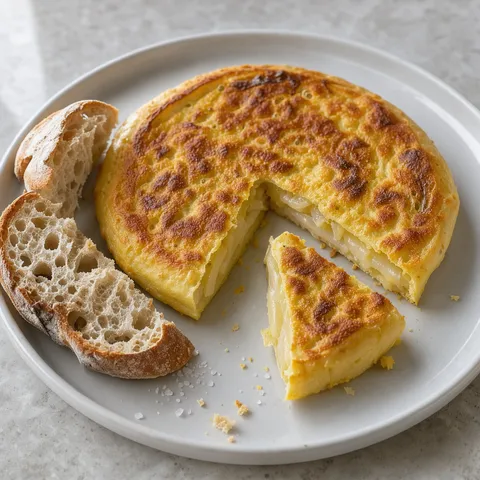 Spanish Potato Omelette1 hr 5 min · Main course
 Paella Valenciana1 hr 20 min · Main course
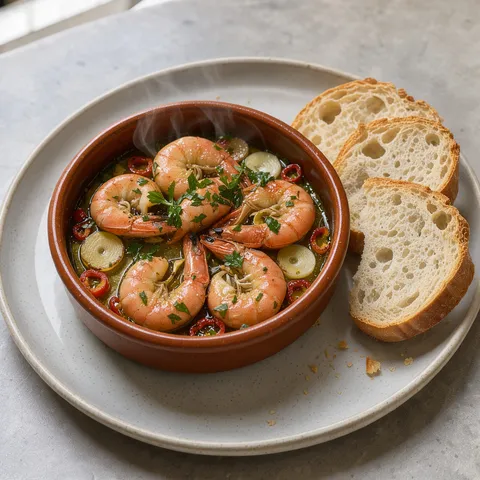 Sizzling Garlic Prawns20 min · Starter
 Meatballs in Almond Sauce1 hr 10 min · Main course
 Tortilla Española 2.01 hr 25 min · Main course