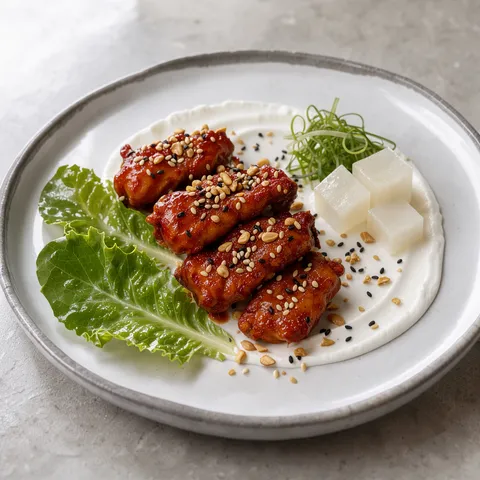
Dak-gangjeong 2.0
A Korean main course. Takes 1 hr 25 min, Serves 4. Difficulty: challenging.
At a glance
- Total time
- 1 hr 25 min
- Serves
- Serves 4
- Difficulty
- Challenging
- Cuisine
- Korean cuisine
- Dish type
- Main course
- Allergens
- Gluten, Milk, Tree nuts, Sesame, Soya
Ingredients
Chicken
- 800 g boneless chicken thighs (3 cm cubes)
- 1 tsp salt
- 1/2 tsp black pepper
- 1 tbsp sake
- 1 tsp ginger juice
Coating
- 60 g potato starch
- 40 g plain flour
- 1/2 tsp salt
- 180 ml cold soda water or cold water
- 1 litre oil (for frying)
Gangjeong sauce
- 4 tbsp light brown sugar
- 3 tbsp soy sauce
- 1 tbsp gochugaru (Korean chilli flakes)
- 3 garlic cloves (grated)
- 1 tbsp cider vinegar
- juice of 1/2 apple (from a grated apple)
- 3 tbsp water
- 1 tsp sesame oil
Pickled radish (chikin-mu)
- 250 g white radish (cubed)
- 100 ml water
- 50 ml rice vinegar
- 1 tbsp sugar
- 1 tsp salt
Ssamjang labneh
- 120 g strained yoghurt
- 1 tsp miso
- 1/2 tsp gochugaru
- 1 garlic clove (grated)
- 1 tsp honey
Peanut and sesame crumb
- 3 tbsp roasted peanuts (coarsely crushed)
- 1 tbsp sesame seeds
Garnish
- 2 spring onions (thin strips)
- lettuce leaves
Equipment
- Heavy-based saucepan
- Probe thermometer
- Colander
- Mixing bowls
- Frying pan
- Chef's knife
- Chopping board
- Balloon whisk
- Box grater
Method
- Prepare the pickle: Heat the water, vinegar, sugar and salt for 2 min to dissolve, pour over the radish cubes and cool. Put them in a cold water bath so that the radish cubes do not turn yellow from the heat and stay crisp. After 30 min the pickle is ready, so leave it until the chicken is fried
- Marinate the chicken: Mix the chicken cubes with the salt, pepper, sake and ginger juice and rest for 20 min. The other preparations are done in parallel during this time
- Make the labneh: Mix the strained yoghurt, miso, gochugaru, garlic and honey until smooth and keep cold. This cold, sour and creamy sauce contrasts with the hot chicken
- Toast the peanuts: Toast the peanuts and sesame seeds in a dry pan for 2 min and crush coarsely
- Make the batter: Whisk the starch, flour, salt and cold soda and rest for 10 min in the fridge. Cold soda adds air to the batter and gives crispness
- First fry: Heat the oil to 160°C, coat the chicken cubes in the batter, add them 10-12 pieces at a time, in 4 rounds, and fry each round for 5-6 min, until golden. The internal temperature should reach 74°C. Lift out with a slotted spoon and rest. Fry all the chicken like this in 4 rounds
- Second fry: Raise the oil to 185°C and fry the chicken again in 4 groups, each group for 90 sec. The coating should be glassy crisp and deep golden. The second fry makes sure the crispness lasts even when combined with the sauce
- Boil the sauce: Boil the brown sugar, soy, gochugaru, garlic, vinegar, apple juice and water in a small pan over low heat for 4-5 min, until you have a glossy glaze that coats the spoon. Add the sesame oil at the end
- Combine: Put the hot chicken in a large bowl, pour in two-thirds of the sauce and toss quickly for 15 sec. The chicken should be glossy and coated, and any more soaks the coating
- Plate: Smear the labneh across the plate in a broad stripe and pile the chicken on top. Put the pickled radish alongside and add the peanut crumb and spring onion strips. Drip over the remaining sauce and serve with lettuce leaves: the chicken, labneh and radish are eaten wrapped in the lettuce
Chef's note
Dak-gangjeong is a street food. In this interpretation the batter is lightened with cold soda, the frying is done twice and the sweet-spicy glaze is balanced with cold labneh. The chikin-mu pickle is a nod to the Korean fried chicken tradition. With a deep fryer, you can fry in one go at 180°C for 7 min. Contains no pork. The meeting of cold labneh with the hot, sticky, spicy glaze is the heart of this interpretation: if you spread the labneh on the plate before the chicken, the underside of the chicken does not go soggy. When boiling the sauce, it is at the right consistency when the bubbles on the surface start to come up large and slow, and if it boils too much it caramelises and sets hard. The lettuce leaves are for wrapping a bite, and link to the ssam tradition at the Korean table.
Frequently asked questions
- Why is the chicken fried twice?
- The second fry is done when the oil is hotter and makes the coating glass-crisp and a deep golden colour. This keeps the chicken crisp even once it is combined with the sauce.
- Why does the chicken go soggy when sauced and how do I prevent it?
- Too much sauce makes the coating soggy. Toss the hot chicken with only two-thirds of the sauce for 15 seconds, and the chicken should be glossy and coated.
- What is Dak-gangjeong served with?
- In the recipe, the chicken, labneh and pickled radish are wrapped in lettuce leaves. The labneh gives a cold, sour contrast to the hot chicken.
 Korean Sweet-Spicy Fried Chicken55 min · Main course
 Bibimbap1 hr 15 min · Main course
 Kimchi3 hr · Side dish
 Bulgogi30 min · Main course
 Korean Braised Short Ribs1 hr 30 min · Main course
 Korean Glass Noodles with Vegetables45 min · Main course
 Kimchi Stew40 min · Soup