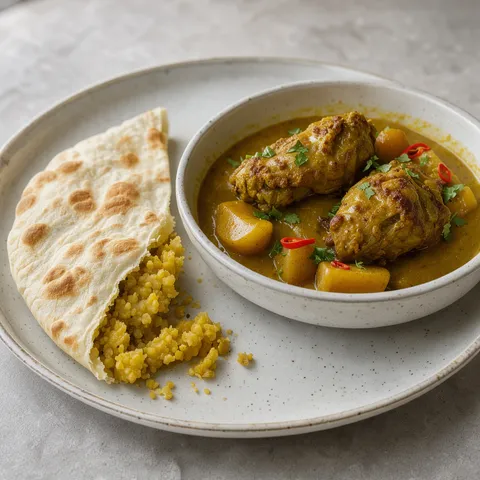
Dhal Puri and Chicken Curry Guyanese Split Pea Roti
A Guyanese main course. Takes 1 hr 25 min, Serves 4. Difficulty: medium.
At a glance
- Total time
- 1 hr 25 min
- Serves
- Serves 4
- Difficulty
- Medium
- Cuisine
- Guyanese cuisine
- Dish type
- Main course
- Allergens
- Gluten, Milk, Mustard
Ingredients
Dhal puri dough (makes 8)
- 400 g plain flour
- 2 tsp baking powder
- 1 tsp salt
- 1 tsp sugar
- 2 tbsp sunflower oil
- 1 tsp sunflower oil (for brushing on top)
- about 260 ml lukewarm water
Filling
- 200 g yellow split peas
- 800 ml water
- 1/2 tsp turmeric
- 3 garlic cloves
- 1 red chilli
- 1 tsp cumin seeds (toasted in a dry pan and crushed in a mortar)
- 1 tsp salt
Cooking
- 60 ml melted butter or sunflower oil
Chicken curry
- 1 kg bone-in chicken thighs (8 pieces, skinless)
- 3 tbsp Curry Powder (Basics)
- 1 tsp ground cumin
- 1 tsp garam masala
- 1 onion
- 5 garlic cloves
- 4 spring onions
- 1/2 bunch coriander
- 4 thyme sprigs
- 1 red chilli
- 3 tbsp sunflower oil
- 2 medium potatoes (cut into 4)
- 600 ml water
- 1.5 tsp salt
Equipment
- Saucepan
- Ladle
- Colander
- Baking tray
- Mixing bowls
- Blender
- Food processor
- Heavy-based saucepan
- Wooden spoon / spatula
- Rolling pin / oklava
- Cast-iron frying pan
- Pastry brush
- Probe thermometer (optional)
- Pressure cooker (optional)
- Pestle and mortar (optional)
Method
- Boil the split peas: Wash the peas and bring to the boil in a pan with 800 ml water and the turmeric, skimming with a ladle. Cook over low heat for 25-30 min, until the peas are soft enough to mash with a finger but still hold their shape. Peas that turn mushy will not dry and tear when you roll the puri. Drain in a colander, spread on a tray and cool for 10 min, letting the steam escape. In a pressure cooker this step takes 6 min (4-litre pressure cooker, 800 ml water, and as the peas foam, fill it to no more than 1/3)
- Knead the dough: While the peas cook, mix the flour, baking powder, salt and sugar in a bowl. Add the oil and lukewarm water and knead for 8 min, until soft and pliable, like an earlobe. Brush 1 tsp oil on top, cover and rest for at least 30 min. A rested dough does not pull back when rolled out
- Marinate the chicken: Blend the onion, garlic, spring onions, coriander, thyme leaves, chilli and 3 tbsp water in a blender for 1 min to make a green paste. This is the green seasoning of Guyanese cooking. Rub half of the paste and 1 tsp of the salt onto the chicken in a bowl, and leave while you prepare the rest
- Grind the filling: Pulse the cooled peas in a food processor for 1 min with the garlic, chilli, mortar-crushed cumin and salt. The texture should be fine, dry and crumbly like sand, and if it turns into a paste you have overprocessed it
- Fry the curry: Make a thick paste of the curry powder and ground cumin with 5 tbsp water. Heat the oil in a heavy-based pan over medium heat, fry the remaining green seasoning for 2 min, add the curry paste and fry for 4 min, stirring constantly with a wooden spoon. The paste is ready when it separates its oil and thickens. Raw curry powder tastes earthy, and frying softens it
- Cook the chicken: Add the chicken and turn for 6 min, until completely coated with curry. Add the potatoes and 600 ml water, bring to the boil, lower the heat and cook partly covered for 30 min. The potatoes should begin to break down and thicken the sauce, and the chicken should come off the bone. The internal temperature at the thickest piece should reach 74°C, and if in doubt, check with a probe thermometer
- Fill the puris: While the curry cooks, divide the dough into 8 equal balls. Flatten each ball in your palm to 10 cm, put 2 heaped tbsp of filling in the centre, gather the edges like a purse and seal tightly. Place sealed-side down on a floured surface. Rest for 5 min
- Roll out and cook: Roll each puri with a rolling pin, with light, even pressure, from the centre outwards to 22-24 cm across. It does not matter if the filling shows in places. Heat a cast-iron pan over medium-high heat, lay in the puri, turn after 40 sec, brush the cooked side with butter, turn again and brush the other side. Take off after about 3 min in total, when brown spots appear and the puri puffs slightly. Keep the cooked ones wrapped in a clean cloth, as they stay soft in the steam
- Finish the curry and plate: Fold the garam masala and the remaining salt into the curry 2 min before turning off the heat. Put a folded puri on the plate, with the chicken curry and plenty of sauce and potatoes beside it. The puri is torn by hand and dipped into the sauce
Chef's note
Dhal puri differs from the layered Buss Up Shut (Trinidadian Shredded Layered Paratha Roti) and the Roti Canai (Folded Pan Flatbread with Lentil Curry) in that the split pea filling is inside the dough rather than between layers. In Guyana it is regarded as the star of festival and wedding tables in Indo-Guyanese communities. Not overcooking the peas is the only secret of this recipe. If you choose a Guyanese-style cumin-heavy curry powder, the flavour settles into place.
Frequently asked questions
- Why does my dhal puri tear when I roll it out?
- If the split peas are cooked to a mush, the filling stays wet and the puri tears. Cook the peas until they just hold their shape, cool them completely and rest the dough so it doesn't spring back.
- Why is the curry powder fried first?
- Raw curry powder tastes dusty and frying softens it. The paste is ready when the oil separates and it thickens.
- How do I keep the cooked puris soft?
- Keep them wrapped in a clean tea towel as they come off the pan. The steam keeps them soft.
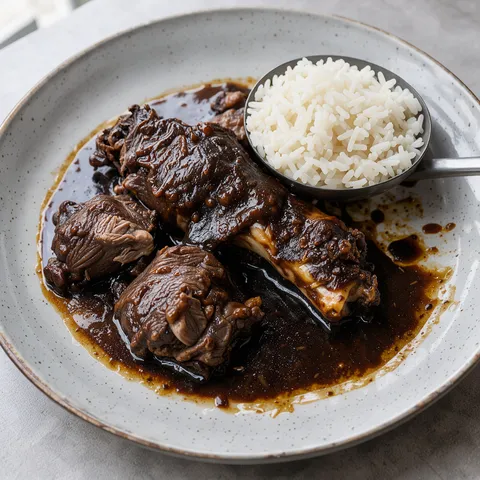 Cassareep Beef and Oxtail Stew2 hr 15 min · Main course
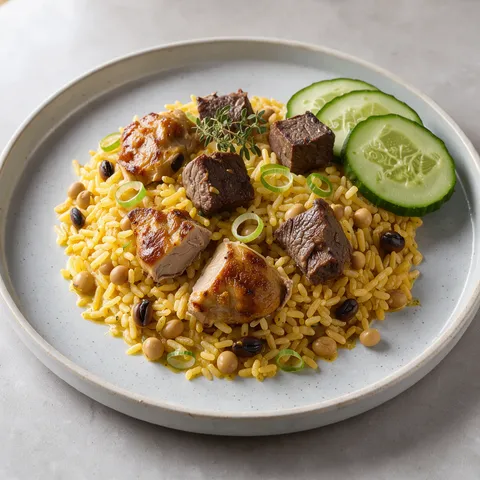 Guyanese One-Pot Coconut Rice1 hr 40 min · Main course
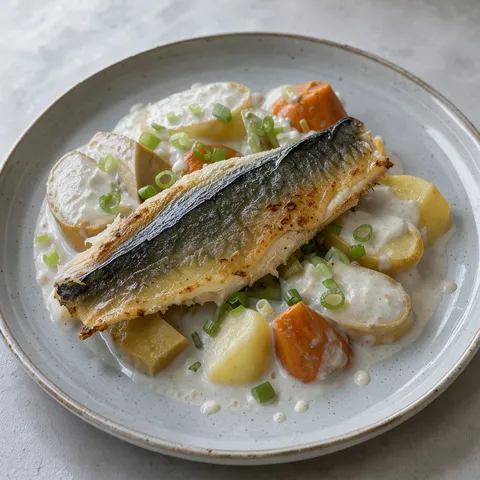 Guyanese Coconut Root Vegetable Stew55 min · Main course
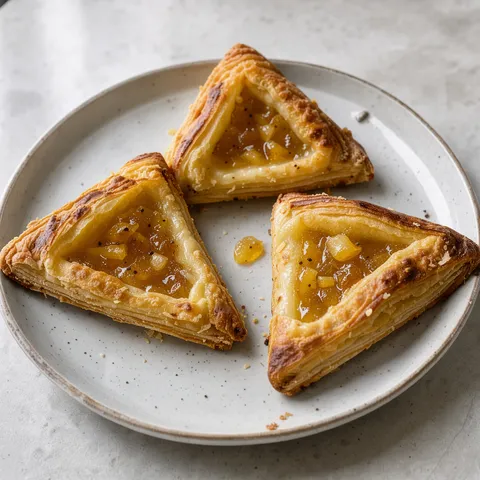 Guyanese Spiced Pineapple Jam Tarts2 hr 10 min · Patisserie
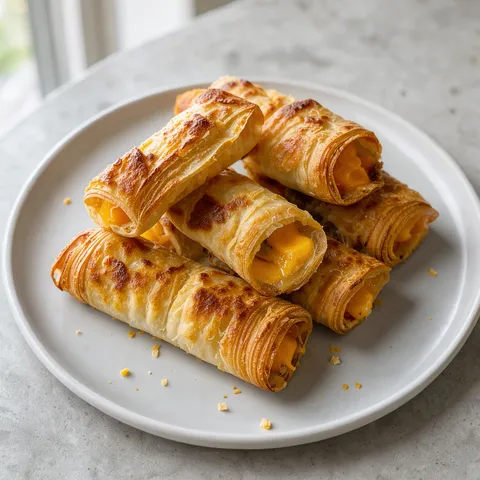 Guyanese Flaky Cheddar Pastries1 hr 45 min · Bread & pastry
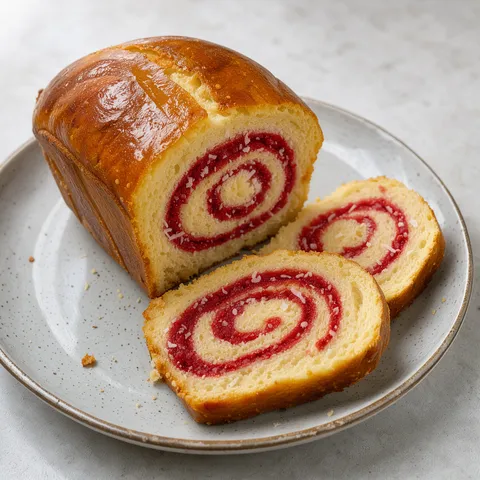 Guyanese Red Coconut Swirl Bread1 hr 20 min · Bread & pastry