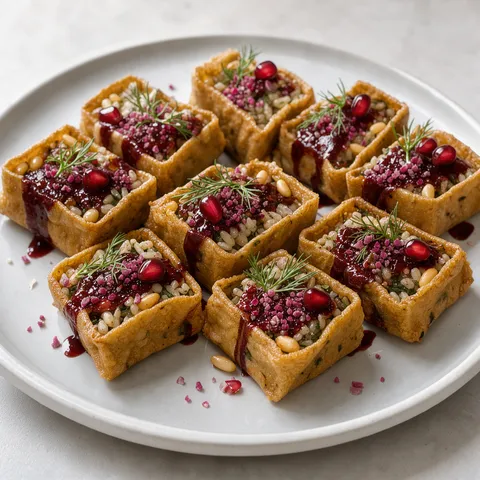
Olive Oil Rice Tofu Pouches Dolma Inari
A Japanese meze. Takes 1 hr 28 min, Makes 24. Difficulty: challenging.
At a glance
- Total time
- 1 hr 28 min
- Serves
- Makes 24
- Difficulty
- Challenging
- Cuisine
- Japanese cuisine
- Dish type
- Meze
- Allergens
- Gluten, Soya
Ingredients
- Tofu pouches (24 pouches, 28 pieces cut, 4 spare): 800 g firm tofu (2 blocks × 400 g, each about 14×9×4 cm)
- 2 litres neutral oil (about 3.2 cm deep in a wide 28 cm pan)
Hand water
- 100 ml water
- 1 tbsp lemon juice
Pouch simmering liquid
- 250 ml water
- 3 tbsp soy sauce
- 2 tbsp pomegranate molasses
- 1 tbsp caster sugar
- 1 cinnamon stick. Pilaf filling (24 × 24 g, about 580 g): 180 g baldo rice
- 150 g onion (2 mm dice)
- 3 tbsp olive oil
- 20 g pine nuts
- 20 g currants
- 1 tbsp tomato paste
- 1/2 tsp cinnamon
- 1/2 tsp allspice
- 1/2 tsp caster sugar
- 1 tsp salt
- 270 ml hot water
- 2 tbsp chopped dill
- 1 tbsp chopped mint
- 1 tbsp lemon juice
Glaze (about 80 g)
- 3 tbsp pomegranate molasses
- 1 tbsp soy sauce
- 1 tsp caster sugar
- 4 tbsp pouch simmering liquid
Plate
- Sumac Onions (Basics, 24 × 3 g, about 75 g)
- 24 small sprigs dill
- 24 pomegranate seeds
Equipment
- Sauté pan
- Saucepan
- Heavy-based saucepan
- Probe thermometer
- Colander
- Mixing bowls
- Chef's knife
- Chopping board
- Muslin
- Pastry brush
- Precision scales
- Silicone spatula
- Rolling pin / oklava
Method
- Press and slice the tofu: Wrap the tofu blocks in kitchen paper, put a plate and 1 kg weight on top and press for 20 min, because excess water spits in hot oil and the pouch does not puff. Cut the dried block with a sharp knife into 8 slices 5 mm thick, split each slice into two pieces of 7×9 cm and pick 28 pieces. Test for doneness: no water comes from the surface when pressed with a finger. In the meantime wash the rice and leave in lukewarm water for 10 min, and measure and cut the 28 pieces on the board (~20 min)
- Cook the pilaf filling: While the tofu is pressed, heat the olive oil in a sauté pan over low heat and fry the onion for 8 min, until translucent and lightly golden. Add the pine nuts and currants and stir for 2 min, until the nuts take colour, add the drained rice and stir for 2 min, then add the tomato paste and spices and fry for 1 min more. Add the hot water, and once it boils lower the heat, cover and cook for 12 min. Take off the heat, put a piece of muslin and the lid over it and rest for 10 min so the grains finish in the steam. Olive oil pilaf holds its shape in the pouch when lukewarm, whereas hot pilaf tears the pouch. This step finishes while the tofu fries
- Fry in two stages: Heat the oil to 120°C in a wide 28 cm pan with a thermometer and fry the tofu pieces in batches of 7 for 5 min (4 batches), until the pieces rise to the surface and turn pale and slightly puffed, because at 120°C the steam builds up slowly. When all the pieces are done, raise the oil to 180°C and fry the pieces again in batches of 7 for 1.5 min, until light golden. The first low heat puffs the tofu from the inside and makes the pouch openable, and the second high heat forms the crust on the outside. Lift out with a slotted spoon and drain on kitchen paper. The tofu must be thoroughly dry, as wet tofu spits in the oil (~26 min)
- Open the pouch: Lay the fried pieces on the board and roll once lightly over them with a rolling pin so that the inner layers loosen. With the tip of a sharp knife, make a fine slit 6 cm long along one short edge of each piece to open a pocket. Test for doneness: the mouth of the pocket opens easily with 2 fingers and the inner walls do not tear. A torn piece counts as a spare (~5 min)
- Simmer the pouches: Hold the fried pieces in boiling water for 2 min so the excess oil goes, then rinse. Bring the simmering liquid ingredients to the boil in a wide pan, add the pieces and cook over low heat for 8 min, turning occasionally with a spoon. The pieces absorb the liquid and take on a deep golden-brown colour. Pomegranate molasses and soy sauce combine the Turkish sweet-sour balance with Japanese umami. Take off the heat, rest the pouches in their own liquid for 2 min, then lift out and set aside 4 tbsp of the simmering liquid for the glaze (~12 min)
- Season the pilaf: Put the pilaf in a wide dish and mix in the dill, mint and lemon juice with the spatula using cutting movements, taking care not to crush the grains. Taste and add a pinch of salt if it needs it. The pilaf should be lukewarm, about 30°C. The weight of olive oil dolma comes from the herbs, and if the herbs wilt with hot pilaf, they lose their colour and aroma (~4 min)
- Fill: Squeeze the pouches lightly in your palm to remove excess liquid and open the mouth with two fingers. Wet your hand with the hand water (water and lemon juice), roll 24 g of pilaf into a ball and place it in the pouch, pressing lightly into the corners but without overfilling. Fold the open end inwards and arrange with the top facing up. The moisture of the olive oil dolma combines with the soy liquid of the pouch. Weigh the first three pouches, and each should be about 44 g (~12 min)
- Reduce the glaze: Boil the pomegranate molasses, soy sauce, sugar and 4 tbsp simmering liquid in a small pan for 5 min, until it coats the back of a spoon and drips heavily. It thickens further as it cools, so take it off the heat while it is still runny. It makes about 80 g of glaze. This step is done during the filling
- Glaze and garnish: Brush a thin coat of glaze on top of each pouch, giving a glossy, dark surface. Top with a pinch of Sumac Onions, a sprig of dill and a pomegranate seed. The pomegranate seed is a burst of acidity and the sumac onions add sharpness. Too much glaze makes the pouch soggy (~6 min)
- Serve: Arrange the pouches side by side on a flat ceramic plate and put a few drops of the remaining glaze at the edge of the plate. They taste best at room temperature, and if taken from the fridge, take them out 15 min earlier so the rice softens. Eaten by hand (~3 min)
Chef's note
Serve at room temperature. Allow 3 per person, 80 people × 3 = 240 pieces. As the recipe makes 24, the multiplier is 240/24 = 10, or 10.5 with 5% allowed for waste (8.4 kg firm tofu, 1.9 kg baldo rice, 1.6 kg onion, 32 tbsp olive oil, 210 g pine nuts, 210 g currants, 53 tbsp pomegranate molasses (simmering liquid and glaze), 42 tbsp soy sauce (simmering liquid and glaze), 790 g Sumac Onions). Completely plant-based, expected yield 24-26 pouches. This is a reinterpretation of Inari Zushi (Sushi Rice in Tofu Pouches): instead of vinegared sushi rice, the pouches are filled with olive oil pilaf with the spices and herbs of Turkish dolma, and the simmering liquid is brought to a Japanese-Turkish balance with pomegranate molasses and soy. In Japan the inari pouch is bought ready-made as aburaage, whereas here it is made at home by pressing the tofu and frying it at two temperatures. The pouches keep in their simmering liquid in the fridge for 2 days, the pilaf is cooked 3 hr before serving, the filled inari within 4 hr, and the glaze is brushed on just before serving. A single 28 cm pan holds 7 pieces, so 294 pieces for 10.5 times the recipe make 42 batches, about 4 hr 30 min in a single pan and about 1 hr 10 min in 4 pans. It is not gluten-free (soy sauce contains wheat) and can be made gluten-free with tamari.
Frequently asked questions
- Why is the pilaf filled into the pouches lukewarm?
- Olive oil pilaf holds its shape in the pouch when lukewarm, while hot pilaf tears the pouch. Herbs also lose their colour and aroma if wilted by hot pilaf.
- Why does the recipe cut 28 pieces of tofu instead of 24?
- Pieces that tear are counted as spares. 4 of the 28 pieces are spare.
- Why is the pomegranate glaze taken off the heat while still runny?
- The glaze thickens further as it cools. Take it off the heat when it coats the back of a spoon and drips slowly.
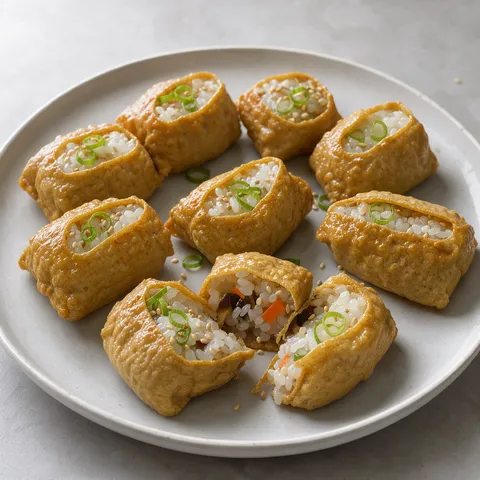 Sushi Rice in Tofu Pouches1 hr 31 min · Meze
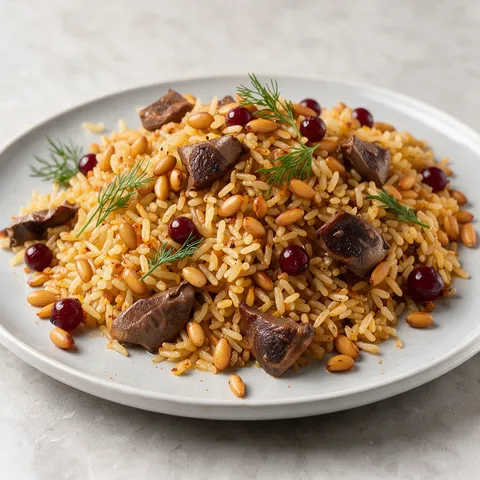 Liver and Pine Nut Rice50 min · Side dish
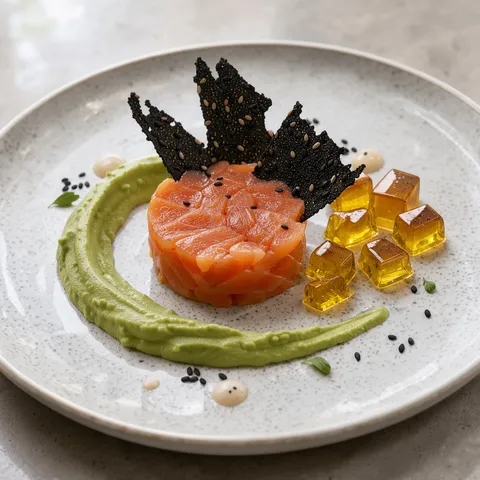 Salmon Tartare, Black Sesame Crisp, Wasabi Avocado45 min · Starter
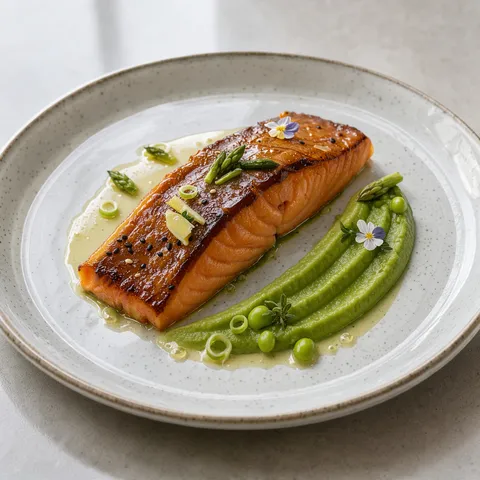 Salmon, Miso Glaze, Dashi Beurre Blanc, Edamame Purée50 min · Main course
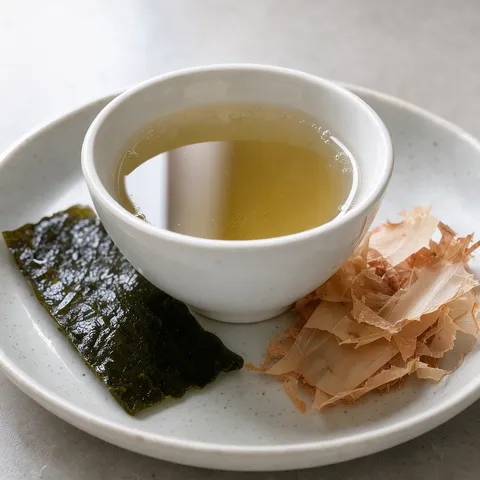 Ichiban Dashi1 hr 45 min · Basic recipe
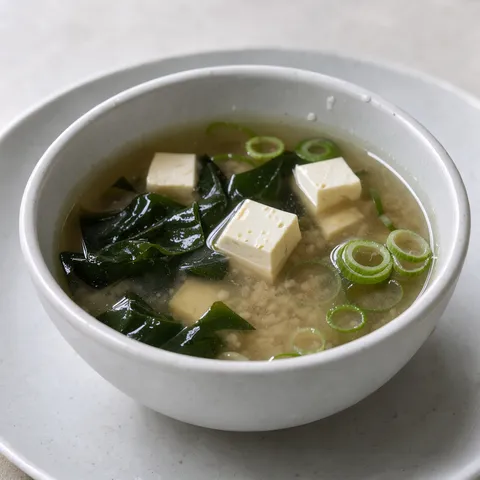 Miso Soup15 min · Soup
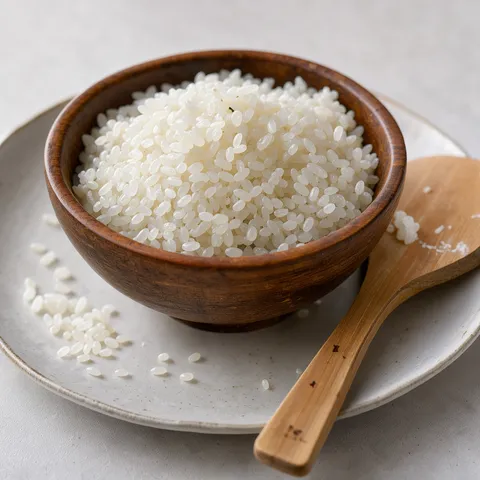 Sushi Rice1 hr 15 min · Basic recipe
 Nigiri45 min · Main course