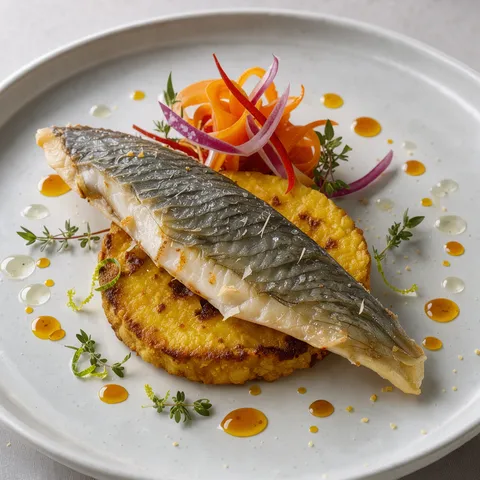
Escovitch Fish 2.0
A Jamaican main course. Takes 1 hr 15 min, Serves 4. Difficulty: challenging.
At a glance
- Total time
- 1 hr 15 min
- Serves
- Serves 4
- Difficulty
- Challenging
- Cuisine
- Jamaican cuisine
- Dish type
- Main course
- Diet
- Gluten-free
- Allergens
- Milk, Fish, Tree nuts
Ingredients
Fish
- 4 skin-on sea bream or sea bass fillets (120-140 g each)
- 20 g salt for the cure
- 10 g sugar
- grated zest of 1 lime
- 2 tbsp sunflower oil
Escovitch liquid
- 300 ml white vinegar
- 150 ml water
- 2 tbsp sugar
- 1 tsp salt
- 12 allspice berries (lightly crushed)
- 1/2 Scotch bonnet
- 2 thyme sprigs
Escovitch gel
- 250 ml of the escovitch liquid
- 2 g agar agar powder
Pickled ribbons
- 1 large carrot
- 1/2 red pepper
- 1 small red onion
- the rest of the escovitch liquid
Scotch bonnet oil
- 100 ml sunflower oil
- 1 tbsp allspice berries (crushed)
- 1/2 Scotch bonnet
- 1 thyme sprig
Coconut milk
- 100 g desiccated coconut
- 250 ml hot water
Bammy discs
- 500 g fresh or frozen cassava (peeled)
- 1/2 tsp salt
- 3 tbsp sunflower oil
To finish
- fresh thyme leaves
- 1 lime (grated zest)
Equipment
- Saucepan
- Blender
- Muslin
- Box grater
- Fine sieve / chinois
- Probe thermometer
- Squeezy bottle
- Cast-iron frying pan
- Frying pan
- Cake ring / food ring
- Silicone spatula
- Vegetable peeler
- Chef's knife
- Chopping board
- Mixing bowls
Method
- Infuse the escovitch liquid: Bring the vinegar, water, sugar, salt, allspice, Scotch bonnet and thyme to the boil in a saucepan. Take off the heat, leave to infuse for 10 min, then strain. Set 250 ml aside for the gel and keep the rest hot for the ribbons. All the flavour of the classic escovitch pickle is concentrated in this liquid
- Extract the coconut milk and grate the cassava: Blend the desiccated coconut with the hot water in a blender for 1 min and squeeze hard through muslin to get about 200 ml of milk. Grate the cassava on the fine side of the grater, put it in a clean piece of muslin and twist to squeeze out all the liquid. Discard the squeezed liquid and do not use it anywhere. The dry cassava dough holds together in the pan as a single disc. Mix with the salt. Cassava must not be eaten raw. The discs need to be heated through thoroughly in both cookings
- Set the gel: Whisk the reserved 250 ml of liquid with the agar in a small saucepan and boil for 2 min. Agar only dissolves at a boil. Pour into a bowl and stand the bowl in a larger bowl of iced water. It sets firm within 10 min. Then blend for 1 min into a smooth, fluid gel and fill a squeeze bottle. The gel holds the sharpness of the vinegar on the plate in drops, without spreading
- Infuse the Scotch bonnet oil: Put the oil, allspice, Scotch bonnet and thyme in a small saucepan and hold at 70°C with a thermometer for 15 min. If it gets hotter the chilli burns and the oil turns bitter. Strain and fill a squeeze bottle
- Cure the fish: Mix the salt, sugar and lime zest, spread a thin layer over the flesh side of the fillets and chill for 15 min. The cure firms the outside of the flesh and distributes the salt evenly. Then rinse quickly under cold water and pat dry with kitchen paper, especially the skin
- Cook the bammy discs (first cooking): Heat a cast-iron pan over medium-low heat and brush with 1 tbsp oil. Place an 8 cm pastry ring in the pan, press a quarter of the cassava dough into it to a thickness of 1 cm and lift off the ring. Cook four discs for 6-7 min per side, until the cassava turns translucent and the disc has set and can be turned easily by hand. This first cooking cooks the cassava through
- Prepare the pickled ribbons: Peel the carrot into long thin ribbons with a peeler, cut the red pepper into fine matchsticks, halve the red onion and separate the layers into individual petals. Pour the rest of the hot escovitch liquid over them and leave for 15 min. The ribbons stay crisp while absorbing the vinegar and allspice
- Soak the bammy and crisp it: Lay the cooked discs in the coconut milk and let each side soak up the milk for 2-3 min. Heat the remaining 2 tbsp oil in the cast-iron pan over medium heat and fry the discs for 2-3 min per side, until golden and crisp outside and creamy inside. This is how bammy is cooked in Jamaica too, in two stages
- Cook the fish: Heat the oil in a non-stick pan over medium-high heat. Place the fillets skin side down and press with a spatula for the first 30 sec. Cook without moving for 4-5 min, until the skin is golden and glass-crisp and the flesh is opaque three-quarters of the way up. Turn and take off the heat after 30 sec. The crispness of the classic fried fish is kept, but the vinegar is no longer poured over the skin, so the skin stays crisp
- Plate: Place a bammy disc slightly in front of the centre of the plate. Lay the fish skin side up diagonally on the disc. Curl the carrot ribbons around your finger and put them behind the fish in a small pile with the drained pepper matchsticks and onion petals. Squeeze 7-8 drops of escovitch gel of different sizes around the fish and let a few drops of Scotch bonnet oil fall between them. Scatter over the fresh thyme leaves, grate lime zest over the skin and serve immediately
Chef's note
The classic escovitch is kept intact: the vinegar pickle, allspice, Scotch bonnet, fried fish and the bammy beside it. What changes is the balance: the vinegar enters the plate as a gel without soaking the skin, the Scotch bonnet gives its heat in measured amounts as a clear oil, and the bammy becomes a creamy base with coconut milk. The agar gel can be prepared a day ahead, and the oil keeps in the fridge for a week.
Frequently asked questions
- Why is the cassava squeezed so thoroughly?
- Grated cassava is squeezed in muslin until all the liquid is out. The dry mixture holds together in the pan as a single disc.
- Why is the Scotch bonnet oil infused at 70°C?
- Any hotter and the chilli burns and the oil turns bitter. So the oil is held at 70°C with a thermometer.
- How does the escovitch liquid get onto the plate?
- The liquid is set into a gel with agar, blitzed in a blender and piped out in drops. That way the vinegar doesn't soak the fish skin.
 Jamaican Pickled Fried Fish1 hr · Main course
 Jamaican Jerk Chicken1 hr 20 min · Main course
 Curry Goat2 hr 35 min · Main course
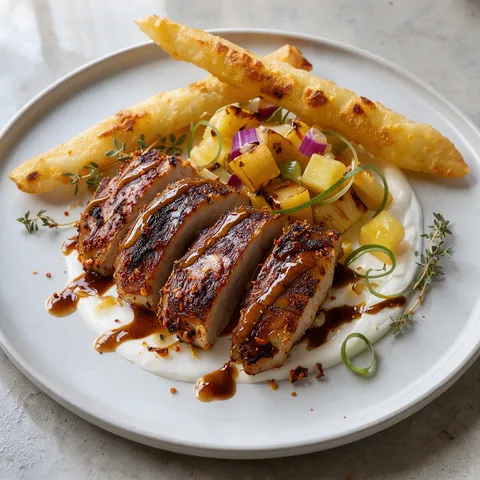 Jamaican Jerk Chicken 2.01 hr 25 min · Main course
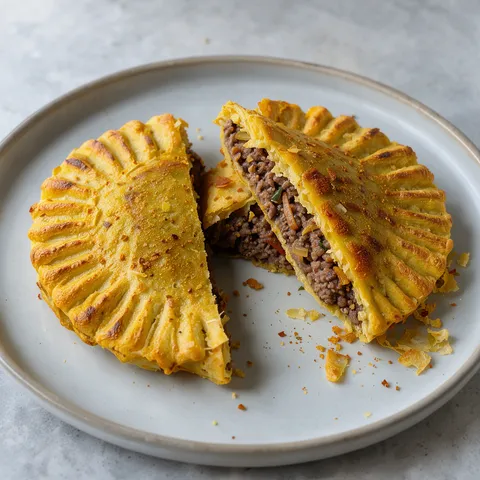 Spiced Beef in Turmeric Pastry1 hr 50 min · Bread & pastry
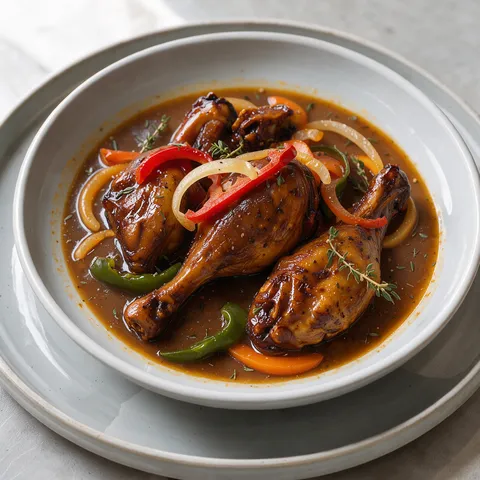 Jamaican Caramelised Chicken Stew1 hr 25 min · Main course
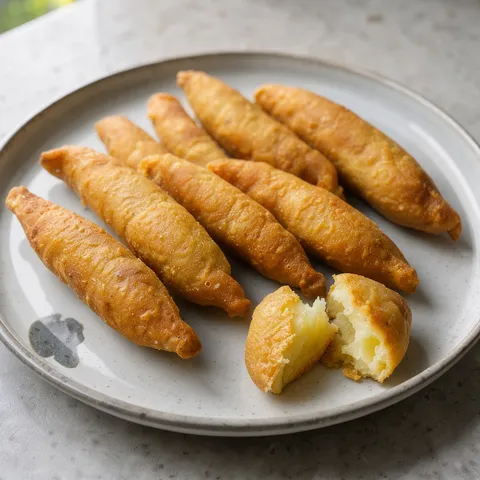 Jamaican Sweet Cornmeal Fried Dough50 min · Bread & pastry