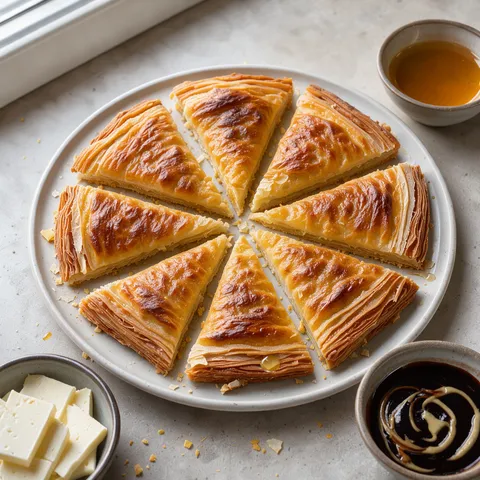
Egyptian Layered Ghee Pastry Feteer Meshaltet
An Egyptian bread & pastry. Takes 1 hr 45 min, 1 pieces 24 cm (4 servings). Difficulty: medium.
At a glance
- Total time
- 1 hr 45 min
- Serves
- 1 pieces 24 cm (4 servings)
- Difficulty
- Medium
- Cuisine
- Egyptian cuisine
- Dish type
- Bread & pastry
- Allergens
- Gluten, Milk, Sesame
Ingredients
Dough
- 500 g plain flour
- 1 tsp salt
- 1 tsp sugar
- 300 ml lukewarm water (about 40°C)
Folding
- 200 g Clarified Butter (Basics)
- warm and liquid (60 g for resting the balls, 120 g for the layers, 20 g for the top)
To serve
- 2 tbsp honey
- 2 tbsp grape molasses (or sugar cane molasses)
- 2 tbsp tahini
- 100 g full-fat white cheese (sliced)
Tin
- 26 cm round baking tin
Equipment
- Mixing bowls
- Baking tray
- Oven
- Pastry brush
- Silicone spatula
- Chef's knife
Method
- Knead the dough: Mix the flour, salt and sugar in a large bowl. Add the water a little at a time and knead for 10 min. The dough should be very soft, silky and slightly sticky, and when you press it with a finger the dent should spring back slowly. Well-developed gluten lets the dough stretch paper-thin without tearing
- Divide and rest in the fat: Divide the dough into 4 equal balls (about 200 g each) and roll them with the smooth side up. Pour 60 g clarified butter into a deep tray, set the balls in the fat and turn each one once to coat both sides. Cover with cling film and rest at room temperature for 30 min. Meanwhile, preheat the oven to 230°C (conventional)
- Stretch the first sheet: Grease the worktop with the fat from the balls. Flatten one ball with the heel of your hand, then lift it by the edges and gently pull outwards, stretching it over the worktop into a sheet 50-60 cm across and so thin that you can see your hand through it. Small holes do not matter. They disappear between the layers
- Grease and fold: Spread 30 g clarified butter all over the sheet with your hand or a brush. Fold two opposite edges over each other in the middle, then fold the other two edges in the same way to make a square envelope about 18 cm across. The fat left between the folds turns to steam in the oven and separates the layers
- Wrap the sheets around each other: Stretch the second ball to the same thinness and grease it with 30 g clarified butter. Put the first envelope in the middle of the sheet, folded side down, and fold the edges of the sheet over it to enclose it. Repeat with the third and fourth sheets, each time placing the envelope upside down so that the layers are evenly distributed. In the end you have a single envelope of 4 sheets wrapped one inside another. Stretching and folding takes about 20 min
- Rest and shape: Rest the envelope for 10 min. Then, pressing gently with your palms from the centre outwards, shape it into a round disc about 24 cm across and 3 cm thick. Transfer it to the tin and brush the top with the remaining 20 g clarified butter
- Bake: Put the tin on the bottom shelf of the oven and bake for 15 min, until the base is crisp. Then move it to the middle shelf, lower the heat to 220°C and bake for another 12-15 min, until the surface is deep golden and the layers have visibly puffed up at the edges. When you lift the feteer slightly with a spatula, the underside should also be golden and firm
- Rest: Leave the feteer in the tin for 5 min after taking it out of the oven. Press the edges gently inwards with your palms: this separates the layers and aerates the texture
- Plate: Cut the feteer into 8 triangular slices with a knife and arrange the slices in a fanned-out circle on a large serving plate. Put three small bowls alongside: one with honey, one with molasses mixed with tahini, one with sliced white cheese. Serve hot
Chef's note
Feteer meshaltet is the festive and guest bread of rural Egypt, especially the Delta villages, where it is baked in brick ovens. In the feteer shops of Cairo the baker tosses the dough into the air to stretch it. This recipe is written for stretching on the worktop at home. Traditionally it is eaten with asal iswed (sugar cane molasses) and tahini, or with mish and white cheese. Sugar cane molasses has to be bought ready-made. If you cannot find it, grape molasses is a good substitute. To make the clarified butter, see Clarified Butter (Basics).
Frequently asked questions
- What does the clarified butter do in feteer?
- The fat left between each layer turns to steam in the oven and separates the layers. The dough balls also rest in 60 g clarified butter, and more is drizzled over the sheets.
- What if a hole appears in a feteer sheet?
- Small holes don't matter, as they disappear between the layers. Stretch the sheet to 50-60 cm across, thin enough to see your hand through.
- Why is the baked feteer pressed in from the sides?
- Once out of the oven, press it lightly inward with your palms, as this movement separates the layers and aerates the texture. Serve with honey, grape molasses with tahini, and white cheese.
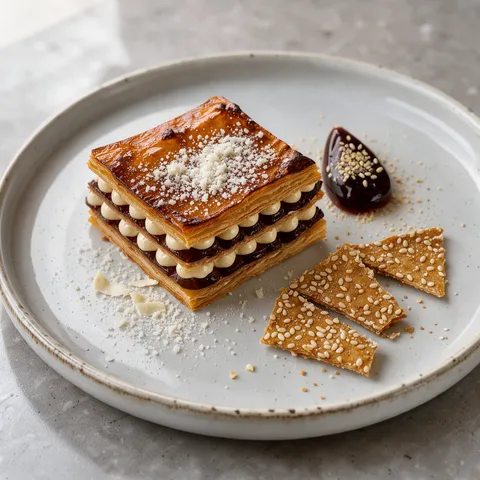 Feteer Meshaltet 2.01 hr 25 min · Dessert
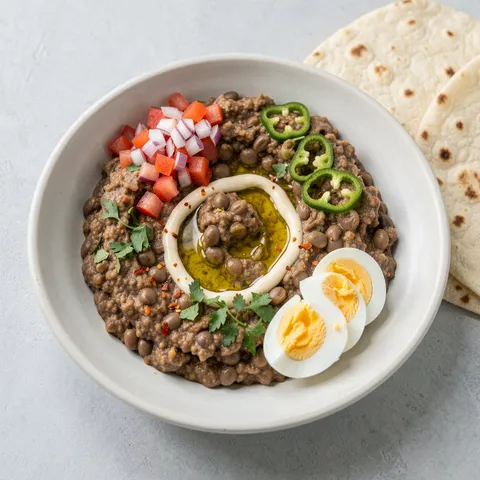 Egyptian Mashed Fava Beans2 hr · Meze
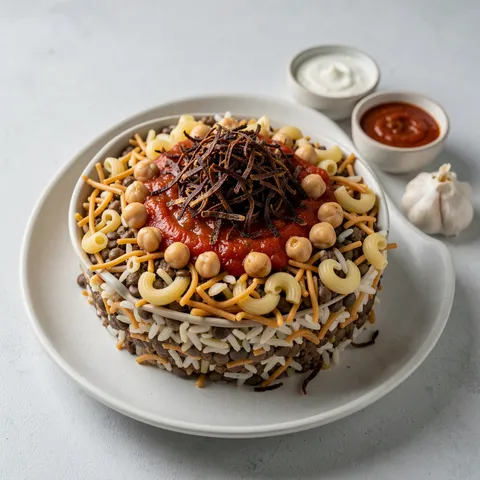 Koshari1 hr 30 min · Main course
 Molokhia1 hr 30 min · Main course
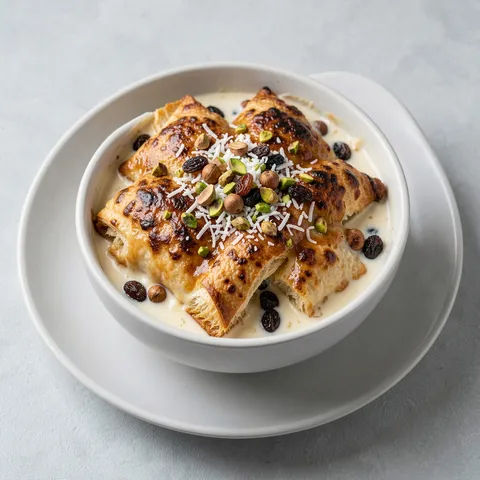 Egyptian Baked Milk and Pastry Pudding1 hr · Dessert
 Egyptian Orzo Soup in Beef Stock1 hr 50 min · Soup
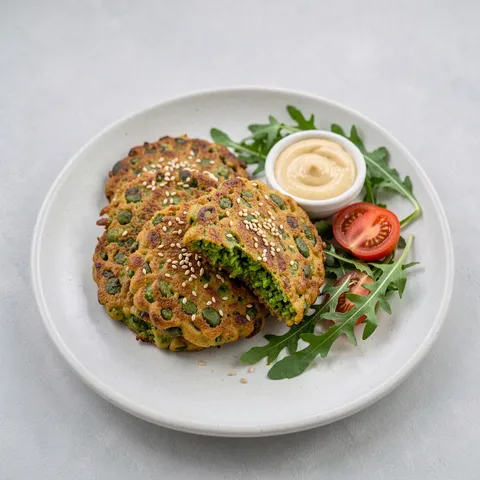 Ta'ameya1 hr 10 min · Starter