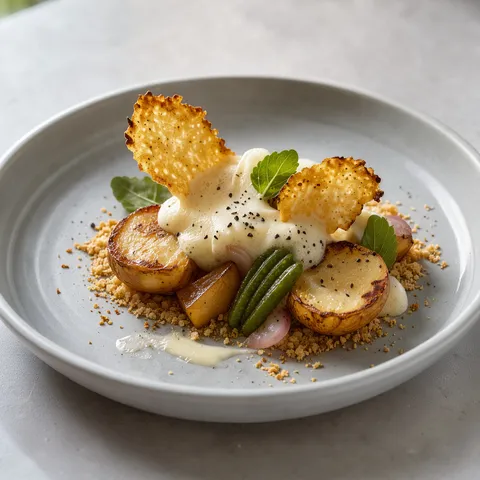
Fondue 2.0
A Swiss main course. Takes 1 hr 20 min, Serves 4. Difficulty: professional.
At a glance
- Total time
- 1 hr 20 min
- Serves
- Serves 4
- Difficulty
- Professional
- Cuisine
- Swiss cuisine
- Dish type
- Main course
- Allergens
- Gluten, Milk, Sulphites
Ingredients
Fondue foam
- 100 g Gruyère (grated)
- 100 g Vacherin Fribourgeois (diced)
- 120 ml dry white wine (Chasselas)
- 80 ml milk
- 80 ml whipping cream (35% fat)
- 1 tsp cornflour
- 1 tbsp kirsch
- 1 garlic clove
- nutmeg
- white pepper
Cheese crisps (frico)
- 80 g Gruyère (finely grated)
Potatoes
- 600 g small waxy potatoes
- 1 litre salted water
- 30 g butter
- 1 rosemary sprig
Kirsch pears
- 2 firm pears
- 30 g butter
- 1 tbsp sugar
- 2 tbsp kirsch
Crumbs
- 150 g day-old sourdough country bread (from the bakery)
- 30 g butter
- 1 garlic clove
- 1 tsp dried thyme
Pickled shallots
- 8 shallots
- 80 ml white wine vinegar
- 80 ml water
- 1 tbsp sugar
- 1/2 tsp salt
- 4 black peppercorns
- 2 cornichons (thinly sliced into fans)
To finish
- sorrel or rocket shoots
- black pepper
Equipment
- Saucepan
- Cast-iron frying pan
- Frying pan
- Silicone spatula
- Cream whipper (siphon)
- Fine sieve / chinois
- Bain-marie bowl
- Probe thermometer
- Chef's knife
- Vegetable peeler
Method
- Make the pickled shallots: Peel the shallots and halve the larger ones. Bring the vinegar, water, sugar, salt and peppercorns to the boil, add the shallots and boil for 3 min, then take off the heat and leave to cool in the liquid. The plate of pickles served alongside a classic fondue is gathered here into a single sharp, crisp element
- Boil and fry the potatoes: Boil the potatoes in their skins in the salted water for 15 min, until a knife slides in without resistance, then drain and leave to steam dry for 5 min. Flatten each potato to 1.5 cm thick with the base of a glass so that the skin cracks. Fry the potatoes in a cast-iron pan with the butter and rosemary over medium-high heat for 4-5 min on each side, until the cracked edges are deep golden and crisp. Potatoes that are creamy inside and crisp outside take the place of the classic boiled potatoes
- Make the frico: Heat a non-stick frying pan over medium heat. Sprinkle a tablespoon of the Gruyère into the pan in a thin 8 cm round. Cook for 2-3 min, until the cheese bubbles and the edges turn golden, then lift off with a spatula and drape over a rolling pin to curl. It sets in 30 sec. Make 8
- Toast the crumbs: Tear the bread, crust and all, into coarse crumbs by hand. Melt the butter in a frying pan, add the crushed garlic and thyme, then toast the crumbs over medium heat for 5-6 min, until golden and crisp. Remove the garlic. The bread that is dipped into fondue becomes a crisp base here
- Caramelise the pears: Peel and core the pears and cut into 1.5 cm dice. Melt the butter and sugar in a frying pan, add the pears and sauté over medium-high heat for 4 min, until caramelised at the edges. Take the pan off the heat, add the kirsch and boil for 1 min to cook off the alcohol. If you flambé, keep your face and arms away from the pan, turn off the extractor hood and keep the pan lid in hand to smother the flame if it flares up. The pears should keep some bite. In Switzerland kirsch is drunk after fondue: here it returns in a sweet accompaniment
- Cook the fondue base: Halve the garlic and rub it around the inside of the pan. Heat the wine and, just below boiling, melt in the cheeses a little at a time over low heat. Mix the cornflour and kirsch to a slurry, add it and cook for 2 min, stirring. Add the milk and cream and stir until smooth, without letting it go above 70°C. Season with nutmeg and white pepper. The milk and cream thin the cheese, giving the fondue a fluid enough texture to become a foam in the siphon
- Fill the siphon: Pass the hot mixture through a fine sieve twice, as strands of cheese can block the siphon nozzle. Pour about 450 ml of the mixture into a 0.5 litre cream siphon without going over the fill line, screw on the lid and charge with one N2O cartridge. Shake vigorously 10 times. Keep the siphon in a 60-65°C water bath: the foam must be served hot. Above 70°C the cheese releases its fat
- Test the foam: Squirt a little into a bowl: the foam should be a light, glossy cloud that holds its own weight. If it is too runny, shake the siphon a little more. If it is too thick, add 2 tbsp hot milk to the mixture and refill
- Plate: Spread an 8 cm round bed of crumbs in the centre of a warm, deep plate. Arrange three fried potatoes on top in a triangle, cracked sides up. Scatter the pear dice and pickled shallots between the potatoes and stand the cornichon fans upright alongside
- Pipe the foam: Holding the siphon upside down, pipe the fondue foam in a billowing cloud, starting from the centre of the plate and covering part of the potatoes and crumbs, so that potatoes and pears still show at the edges
- Finish: Lean two fricos upright against the foam. Scatter over the sorrel shoots and add a grind of black pepper. Serve immediately: the foam starts to collapse within 3-4 min
Chef's note
The two cheeses, the wine and the kirsch of Fribourg's moitié-moitié fondue are kept. The shared pot on the table is brought onto a single plate: the cheese becomes a hot foam, the dipped bread a crisp base, the boiled potatoes crushed fried potatoes, the pickles on the side shallots and cornichons, and the toasted cheese crust left at the bottom of the pot (la religieuse) a crisp frico. Without a siphon, froth the same mixture with a stick blender and pour it over straight away.
Frequently asked questions
- Why shouldn't the fondue foam go above 70°C in the siphon?
- If the temperature goes above 70°C, the cheese releases its fat. So keep the siphon in a 60-65°C water bath and serve the foam hot.
- Why is the fondue mixture strained before going into the siphon?
- Strands of cheese can block the siphon nozzle. So pass the hot mixture through a fine sieve twice and fill the siphon without going over the fill line.
- What if the foam is too runny or too thick?
- If it is too runny, shake the siphon a little more. If it is too thick, stir 2 tablespoons of hot milk into the mixture and refill. The foam should be light, glossy and hold its own weight like a cloud.
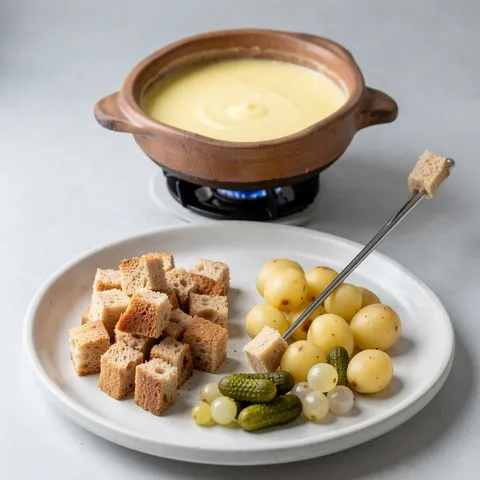 Swiss Half-and-Half Cheese Fondue35 min · Main course
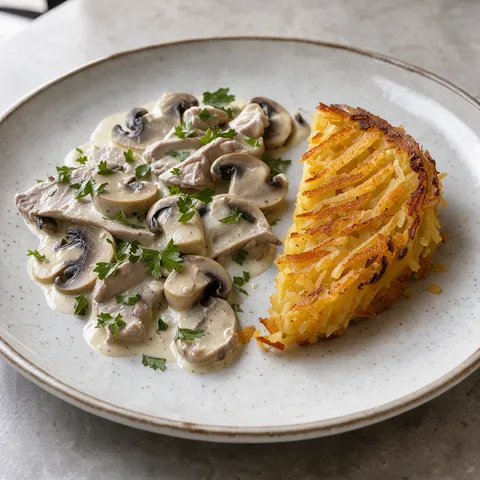 Zurich-Style Veal with Rösti1 hr 10 min · Main course
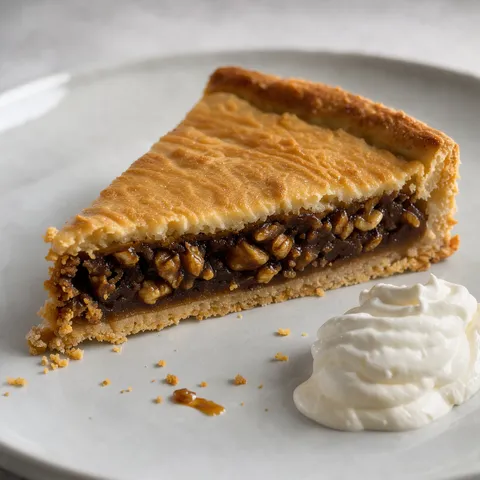 Engadine Caramel Walnut Tart1 hr 50 min · Patisserie
 Älplermagronen 2.01 hr 15 min · Main course
 Swiss Alpine Pasta with Apple Compote55 min · Main course
 Graubünden Barley Soup2 hr 5 min · Soup
 Valais Raclette with Jacket Potatoes29 min · Main course