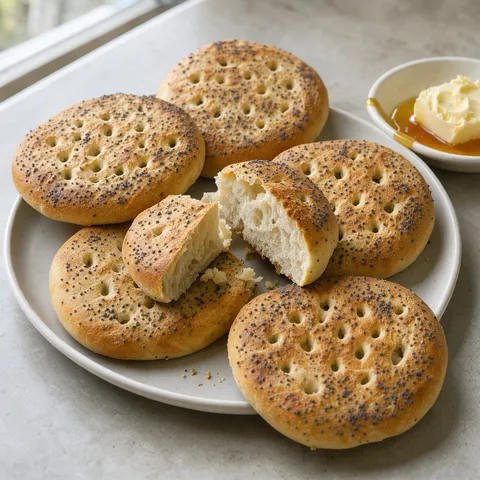
Baked Bread with Yoghurt and Poppy Seeds Hamursuz
A Turkish breakfast. Takes 1 hr · +15 min resting, 6 pieces (4 servings). Difficulty: medium.
At a glance
- Total time
- 1 hr · +15 min resting
- Serves
- 6 pieces (4 servings)
- Difficulty
- Medium
- Cuisine
- Turkish cuisine
- Dish type
- Breakfast
- Allergens
- Gluten, Milk, Eggs
Ingredients
Dough
- 500 g plain flour
- 100 g yoghurt
- 60 ml sunflower oil
- 1 egg
- 1/2 tsp bicarbonate of soda
- 1 tsp fine salt
- 150-170 ml lukewarm water
Topping
- 2 tbsp poppy seeds
- 2 tbsp yoghurt
Equipment
- Mixing bowls
- Baking tray
- Baking paper
- Oven
- Pastry brush
- Precision scales (optional)
Method
- Preheat the oven: Start heating the oven to 230°C and line a tray with baking paper. Bread rises quickly and forms a crust in a hot oven and stays flat and hard in a cold one (~12 min, in parallel with the other steps).
- Mix the dough: In a large bowl, mix 500 g of flour, 1/2 tsp of bicarbonate of soda and 1 tsp of salt. Make a well in the centre, add the yoghurt, 60 ml of oil and the egg, and bring together by adding water a little at a time. The bicarbonate reacts with the acid in the yoghurt and gives the bread a light rise (~6 min).
- Knead: Knead the dough for 6 min, until it is a firm but smooth ball. The entry says the dough is made firm, and this consistency does not stick to the hand and springs back slowly when pressed. If it becomes too soft the flatbread spreads out, in which case add 1-2 tbsp of flour (~6 min).
- Rest: Put the dough in the bowl, cover and leave for 15 min. The gluten relaxes and the dough does not spring back when you flatten it by hand (waiting, 15 min).
- Divide and flatten: Weigh and divide the dough into 6 equal pieces (about 135 g each) and roll into balls. Flatten each ball by hand to about 14 cm across and sprinkle with a thin layer of poppy seeds (~6 min).
- Gather the edges: Pull or cut small pieces from the edge of each flattened piece, gather them in the centre and re-roll. This movement works the poppy seeds into the dough and gives the bread its pattern and speckled crumb, which is the distinctive feature of traditional hamursuz (~5 min).
- Shape: Press the gathered dough by hand into a round about 14 cm across and 8-9 mm thick, brush with a thin layer of yoghurt and sprinkle on the remaining poppy seeds. Mark a pattern of lines and dots on the surface with the tip of a knife or a fork. The pattern stops the surface puffing up too much as it bakes (~6 min).
- Bake: Arrange the six breads, spaced apart, on a 40×50 cm tray, put the tray on the lower-middle shelf and bake for 28 min in the oven turned down to 220°C, until the top is golden and the base sounds hollow when tapped hard. Rest for 5 min before slicing once cooked (~28 min).
- Serve: Slice the bread while hot and serve as it is or with honey, butter and white brined cheese (~3 min).
Chef's note
Hamursuz, or hamirsiz, is a yoghurt-and-poppy-seed bread from Afyonkarahisar, and the Culture Portal entry says it is filling and can be eaten plain at breakfast (https://www.kulturportali.gov.tr/turkiye/afyonkarahisar/neyenir/hamursuz-hamirsiz654880). The quantities in the entry are very large, so the proportions were scaled down to 500 g of flour. The entry gives no resting time, so it was added. The next day it can be eaten warmed in a dry pan.
Frequently asked questions
- What does the bicarbonate of soda do in Hamursuz?
- It reacts with the acid in the yoghurt and gives the bread a light lift.
- Why is the Hamursuz dough made firm?
- A very soft dough spreads flat. It should not stick to your hands and should spring back slowly when pressed.
- Why is the top marked with lines and dots?
- The pattern stops the surface puffing up too much as it bakes.
 Chilled Wheat Yoghurt Soup1 hr · Soup
 Noodle and Yoghurt Soup1 hr 10 min · Soup
 Lamb, Chickpea and Potato Stew1 hr 15 min · Soup
 Marinated Sea Bass30 min · Meze
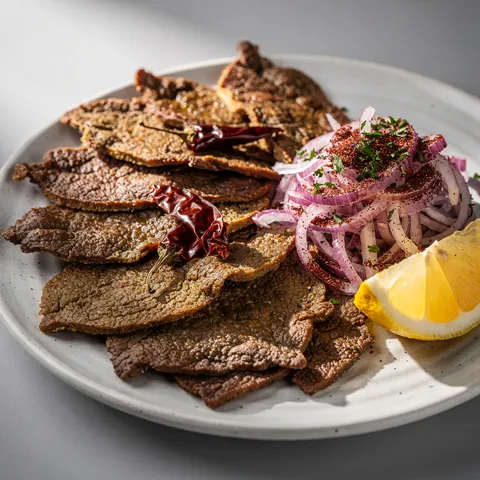 Crispy Fried Liver Slices25 min · Meze
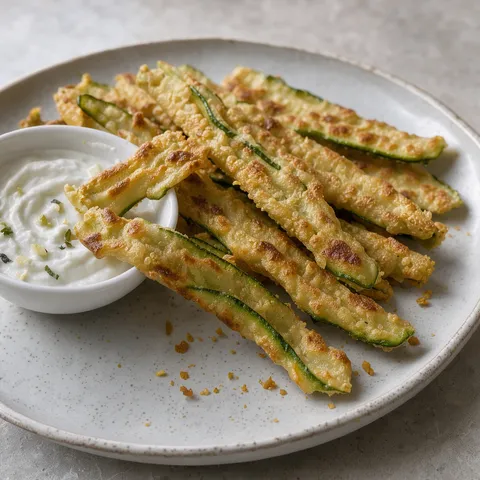 Courgette Crisps30 min · Meze