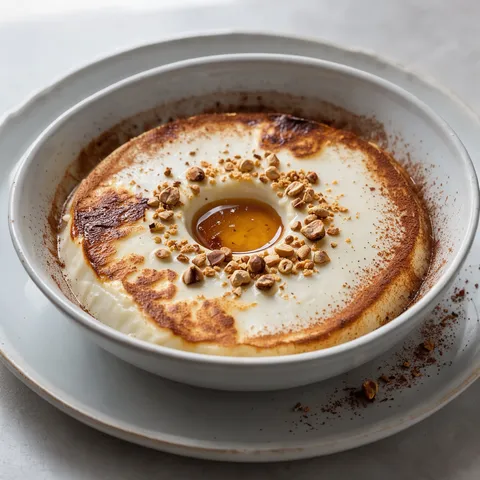
Black Sea Milk Flour Pudding Hasuta
A Turkish dessert. Takes 35 min, Serves 4. Difficulty: easy.
At a glance
- Total time
- 35 min
- Serves
- Serves 4
- Difficulty
- Easy
- Cuisine
- Turkish cuisine
- Dish type
- Dessert
- Diet
- Vegetarian
- Allergens
- Gluten, Milk, Tree nuts
Ingredients
Hazelnuts
- 50 g shelled hazelnuts
Hasuta
- 80 g butter
- 90 g plain flour
- 1 litre whole milk
- 110 g caster sugar
- a pinch of salt
Topping
- 20 g butter
- 1/2 tsp cinnamon (optional)
Equipment
- Oven
- Baking tray
- Saucepan
- Heavy-based saucepan
- Wooden spoon / spatula
- Balloon whisk
- Frying pan
- Chef's knife
- Chopping board
- Mixing bowls
- Probe thermometer (optional)
Method
- Toast the hazelnuts: Preheat the oven to 160°C, spread the hazelnuts on a tray and toast for 10-12 min, until light brown inside. While they are hot, rub them in a cloth to remove the skins and, once cool, roughly chop with a knife. Toasted hazelnuts give the pudding its Black Sea aroma
- Warm the milk: Heat the milk in a saucepan over medium heat to 60°C, that is, until it steams but before small bubbles appear at the edges. Warm milk blends into the toasted flour without lumps, while cold milk shocks the flour and butter into lumps
- Toast the flour: Melt the 80 g butter in a second heavy-based saucepan over low heat, add the flour and toast for 6-8 min, stirring constantly with a wooden spoon. It foams at first, then loosens, smells nutty like hazelnuts and turns pale beige. Do not let it go brown, as burnt flour makes the pudding bitter
- Add the milk: Take the pan off the heat, pour in a quarter of the warm milk and whisk quickly. The mixture first thickens into a paste. Then add the remaining milk in three additions, whisking until smooth each time. Return the pan to low heat
- Cook: Add the sugar and salt and cook for 10-12 min, scraping the base with a wooden spoon. When the hasuta starts to boil, large bubbles burst on the surface, so keep the heat at its lowest to stop it spitting. It is ready when it thickly coats the back of a spoon, a line drawn through it with a finger does not close up and a path scraped across the base of the pan stays open for a few seconds. You want a texture thicker than a milk pudding but softer than helva
- Pour into bowls: Immediately divide the hasuta between four shallow bowls and tap the bottoms gently on the work surface to level the tops
- Brown the butter: Heat the 20 g butter in a small frying pan for 2 min, until it smells of hazelnuts and turns light brown
- Plate: Make a small hollow in the centre of each bowl with the back of a spoon and pour the hot butter into it. Scatter the chopped hazelnuts around the hollow and, if you like, a pinch of cinnamon at the edge. Serve hot or warm, as it thickens as it cools
Chef's note
Hasuta is described as a pudding made around Trabzon and Rize on winter evenings, for new mothers and for guests, and its name and texture change from village to village. Some households use honey or grape molasses instead of sugar, and some leave out the hazelnuts altogether. Whole milk and good butter are the whole flavour of this pudding, so do not cut down the fat.
Frequently asked questions
- Why is hasuta made with warm milk?
- Warm milk mixes into the toasted flour without lumps. Cold milk makes the flour and butter seize into lumps, so heat the milk to 60°C.
- What should I watch for when toasting the flour?
- Toast the flour for 6-8 minutes, stirring constantly, until it smells nutty and turns pale beige. If it goes brown, burnt flour makes the dessert bitter.
- What consistency should hasuta have?
- It should be thicker than a custard but softer than halva. It should coat the back of a spoon thickly and a line drawn with a finger should not close up.
 Chilled Wheat Yoghurt Soup1 hr · Soup
 Noodle and Yoghurt Soup1 hr 10 min · Soup
 Lamb, Chickpea and Potato Stew1 hr 15 min · Soup
 Marinated Sea Bass30 min · Meze
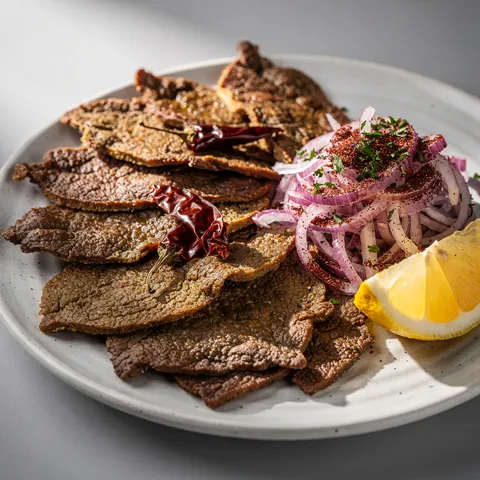 Crispy Fried Liver Slices25 min · Meze
 Courgette Crisps30 min · Meze