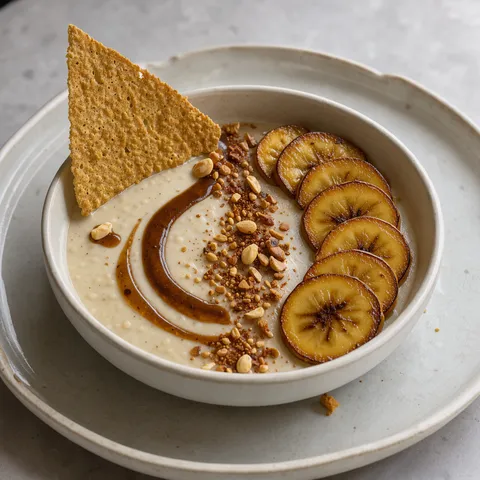
Hausa Koko 2.0
A Ghanaian breakfast. Takes 1 hr 17 min, Serves 4. Difficulty: challenging.
At a glance
- Total time
- 1 hr 17 min
- Serves
- Serves 4
- Difficulty
- Challenging
- Cuisine
- Ghanaian cuisine
- Dish type
- Breakfast
- Allergens
- Gluten, Milk, Peanuts, Tree nuts
Ingredients
Millet
- 200 g millet flour
- 1 litre water
- a pinch of fine salt
- 200 ml coconut milk
Syrup
- 60 g fresh ginger
- 6 cloves
- 100 g sugar
- 150 ml water
Peanut crunch
- 80 g shelled peanuts
- 2 tbsp sugar
- 1/2 tsp ground ginger
- 1/2 tsp black pepper
- a pinch of salt
- 1 tbsp water
Banana
- 2 ripe bananas
- 20 g sugar
- 1 tsp lemon juice
- 1 tbsp sunflower oil
Equipment
- Saucepan
- Balloon whisk
- Blender
- Fine sieve / chinois
- Oven
- Baking tray
- Baking paper
- Frying pan
- Mixing bowls
- Chef's knife
- Silicone spatula
Method
- Prepare the oven and tray: Preheat the oven to 180°C and line the tray with baking paper. For the crisp, the porridge must go into the oven immediately, because millet porridge that cools sets and will not spread (~4 min).
- Cook the millet porridge: Whisk 200 g millet flour with 400 ml cold water into a smooth slurry. Bring 600 ml water to the boil with the salt, pour in the slurry in a thin stream, whisking constantly, and turn the heat down. Cook for 12 min, stirring with a wooden spoon, until you have a thick porridge and the bottom of the pan shows. The porridge should be quite thick and glossy, because part of it will become the crisp and part the cream (~16 min).
- Spread the crisp batter: Put one third of the porridge (about 300 g) on the lined tray and spread it with a wet spatula into a 25×30 cm rectangle 2 mm thick. Thinly spread porridge loses water in the oven and turns glassy and crisp, while the thicker parts stay soft inside (~5 min).
- Bake the crisp: Put the tray on the middle shelf of the oven and bake for 38 min, until the edges are brown and the surface dry and hard, turning the tray around at 20 min for even cooking. When done it should sound crisp and have taken on a golden colour. If the edges are dark, move the tray down for the last 5 min. When done, turn off the oven and leave the crisp to cool inside for 5 min, so that the remaining moisture escapes and the crisp turns crunchy (~38 min).
- Blend the cream until smooth: Blend the remaining porridge (about 600 g) with 200 ml warmed coconut milk in a blender for 2 min, until you have a silky smooth, thick cream. It should not be boiling hot before blending, and leave the blender lid slightly ajar. Pass through a fine sieve, return to the pan and keep warm. Sieving removes the remaining grains and millet husk and makes the texture smooth (~8 min, while the crisp bakes).
- Make the ginger and clove syrup: Peel and finely chop the 60 g ginger and boil it with the 6 cloves, 100 g sugar and 150 ml water in a small pan over medium heat for 8 min, until the syrup has reduced by half and thickened, then strain through a fine sieve. The syrup is fluid when hot and thickens as it cools, so it is enough to keep the consistency at a thin film on the back of a spoon (~10 min, while the crisp bakes).
- Make the peanut crunch: Toast the 80 g peanuts in a dry pan over medium heat for 3 min, add the 2 tbsp sugar, ginger, black pepper, salt and 1 tbsp water and stir for 2 min, until the sugar dries and coats the peanuts. Spread on baking paper and cool, then break up coarsely with a knife. The sugar layer gives the peanuts a crisp, spiced shell (~7 min, while the crisp bakes).
- Caramelise the banana: Cut the 2 bananas into 1 cm half-rounds. Heat 1 tbsp oil and the 20 g sugar in a non-stick pan over medium-high heat, cook the bananas for 1 min on each side, until the edges are deep golden, and drizzle with the lemon juice. The caramel crisps the edges and leaves the middle soft (~4 min).
- Break up the crisp: Take the crisp off the tray, cool it for 5 min and break it by hand into irregular pieces of 4 cm. The crisp gets crunchier as it cools, while a hot crisp curls (~5 min).
- Plate: Heat the cream and put 200 ml (about 200 g) into each of 4 shallow bowls, making a slight well in the middle with the back of a spoon. Drizzle 1 tbsp of syrup into the well, fan the banana slices at the edge, scatter the peanut crunch on one side and stand the crisp upright. Serve at once. The crisp should be stood upright on top, not at the edge, so that it does not go soft (~5 min).
Chef's note
This recipe is a reinterpretation of the classic Hausa Koko (Ghana's ginger and clove millet porridge): the flavour axis is kept but the form changes. The millet becomes both a silky cream and a crisp oven crisp, and the spice moves into the syrup and the peanuts. The contrast between the hot cream and the cold, crunchy crisp is the main idea of the dish. Completely vegan. The cream, syrup and peanuts are made while the crisp bakes. The classic counterpart is Hausa Koko.
Frequently asked questions
- Why is the millet crisp spread thinly?
- Thinly spread porridge loses water in the oven and turns glass-crisp. Thicker parts stay soft inside. If the porridge cools it sets and won't spread, so the batter goes straight into the oven.
- What consistency should the ginger and clove syrup have?
- The syrup is runny while hot and thickens as it cools. A consistency that leaves a thin film on the back of a spoon is enough.
- How is the crisp served so it doesn't go soft in the cream?
- Stand the crisp upright in the cream and not at the edge. Serve straight away.
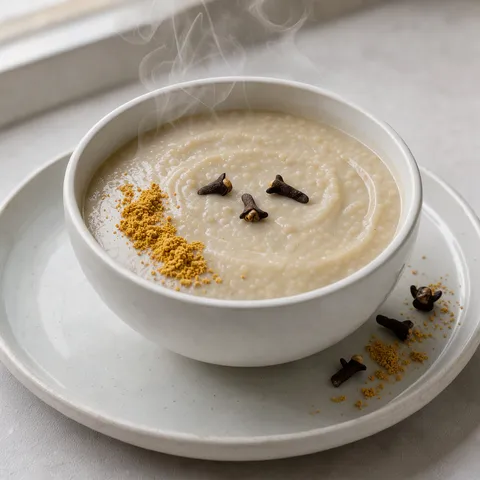 Ghanaian Spiced Millet Porridge28 min · Breakfast
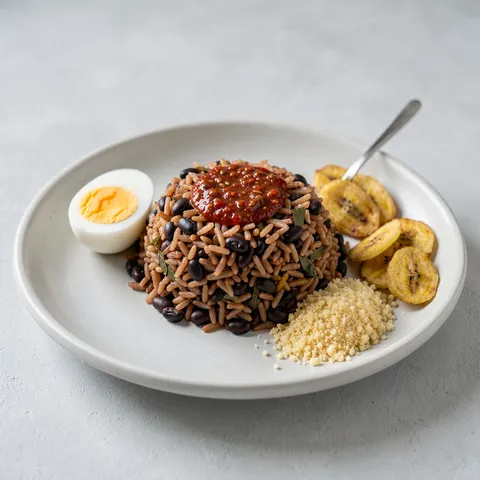 Ghanaian Rice and Black-Eyed Beans1 hr 15 min · Main course
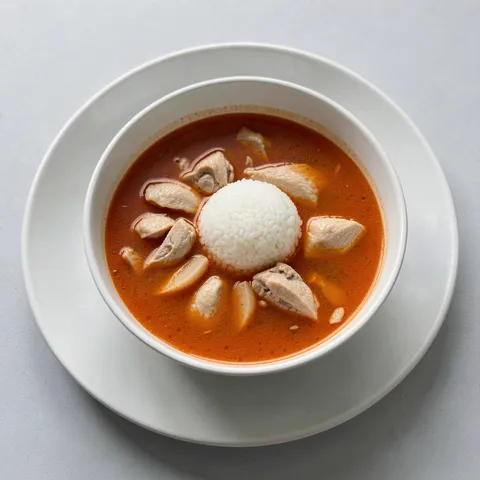 Ghanaian Tomato and Chicken Soup1 hr 10 min · Soup
 Ghanaian Spiced Fried Plantain35 min · Starter
 Kelewele 2.055 min · Starter
 Nkatenkwan and Omo Tuo1 hr 25 min · Soup
 Taro Leaves with Melon Seed1 hr 15 min · Main course