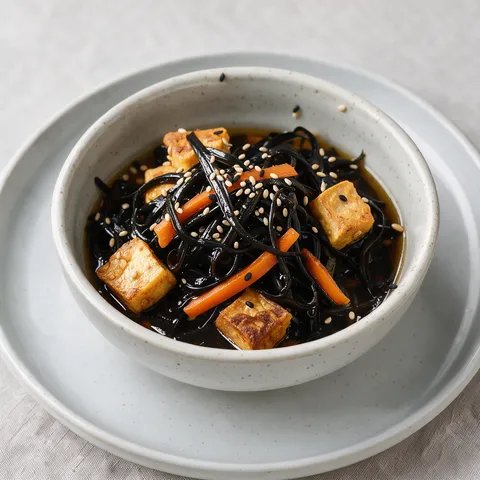
Simmered Hijiki with Tofu Hijiki no Nimono
A Japanese meze. Takes 26 min · +30 min soaking, 4 servings (side dish or meze). Difficulty: easy.
At a glance
- Total time
- 26 min · +30 min soaking
- Serves
- 4 servings (side dish or meze)
- Difficulty
- Easy
- Cuisine
- Japanese cuisine
- Dish type
- Meze
- Allergens
- Gluten, Fish, Sesame, Soya
Ingredients
Hijiki
- 20 g dried hijiki (soaked in lukewarm water for about 30 min)
- 1 carrot
- 200 g firm tofu (in place of aburaage, cubed)
- 2 tbsp neutral oil
Kombu dashi
- 5 g kombu
- 250 ml water (same 30 min soaking time as the hijiki)
Sauce
- 2 tbsp soy sauce
- 2 tbsp mirin
- 1 tbsp sake (optional)
- 1 tbsp caster sugar
To finish
- 1 tsp sesame seeds
- 1 tsp sesame oil
Equipment
- Frying pan
- Mixing bowls
- Chopping board
- Chef's knife
- Wooden spoon / spatula
Method
- Rinse the hijiki: Rinse the hijiki, soaked for 30 min in lukewarm water, twice in plenty of water and drain. Hijiki swells 3-4 times in water and the stems can be tough, so cut into 4-5 cm pieces. The kombu soaking water is ready with the kombu in the same time. (~2 min)
- Chop the vegetables and tofu: Cut the carrot into matchsticks 4 cm long. Press the tofu with kitchen paper for 5 min to remove its water and cut into 1.5 cm cubes. Removing the water well gives a crisp outside and soft inside when fried.
- Fry the tofu: Heat 1 tbsp of the oil in a pan over medium-high heat, arrange the tofu in a single layer and fry for 6 min, turning, until golden on every side. If you turn it too often it will not form a crust. Put on kitchen paper so that it releases the excess oil and absorbs the sauce better.
- Sauté the vegetables: Add the remaining 1 tbsp oil to the same pan and stir the carrot and hijiki for 3 min, until the aroma of the seaweed opens up and blends into the oil. Hijiki loves oil, and if stirred dry it stays tough.
- Cook with the kombu dashi: Remove the kombu and add the kombu water, soy sauce, mirin, sake and sugar to the pan. Add the fried tofu as well and cook with the lid ajar over medium-low heat for 9 min, until the liquid is almost absorbed and the seaweed is glossy. Turn occasionally with a wooden spoon during cooking.
- Toast the sesame seeds: While the dish simmers, warm the sesame seeds in a small dry pan for 1 min, until they pop and smell fragrant. The sesame oil is added after taking off the heat, as it loses its aroma in the heat.
- Plate: Spoon the dish into a small bowl and finish with the sesame oil and sesame seeds. Serve at room temperature. The flavour settles more the next day. (~1 min)
Chef's note
Hijiki is an everyday side dish of the Japanese table and keeps in the fridge for 4 days. Dried seaweeds can be found in Asian grocers. Hijiki contains high levels of inorganic arsenic, so the food authorities of some countries, such as the United Kingdom, do not recommend eating it. Do not eat it often or in large portions, and do not give it to pregnant women or children. You can use arame or wakame instead of hijiki, and the soaking time is 15 min. If you find aburaage (fried tofu pouches), cut them into thin strips and use instead of the tofu.
Frequently asked questions
- How do I prepare dried hijiki?
- Soak the hijiki in lukewarm water for 30 minutes, rinse it twice in plenty of water and drain. It swells to 3-4 times its size and the tough stalks are cut into 4-5 cm pieces.
- Why is the tofu pressed before frying?
- Pressing out the water with kitchen paper gives a crisp outside and soft inside when fried. Fried tofu also soaks up the sauce better.
- When is the sesame oil added?
- Add the sesame oil after cooking, at the finishing stage. It loses its aroma in the heat, so it does not go into the simmering sauce.
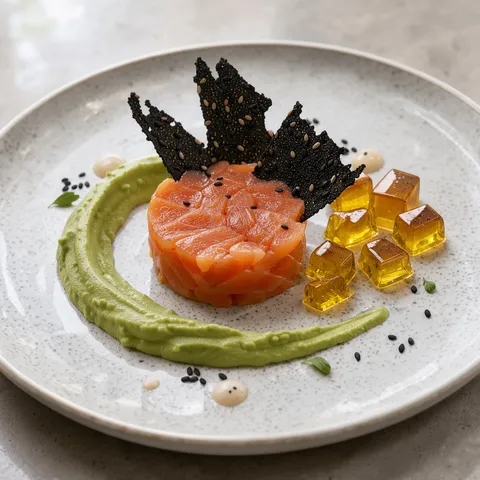 Salmon Tartare, Black Sesame Crisp, Wasabi Avocado45 min · Starter
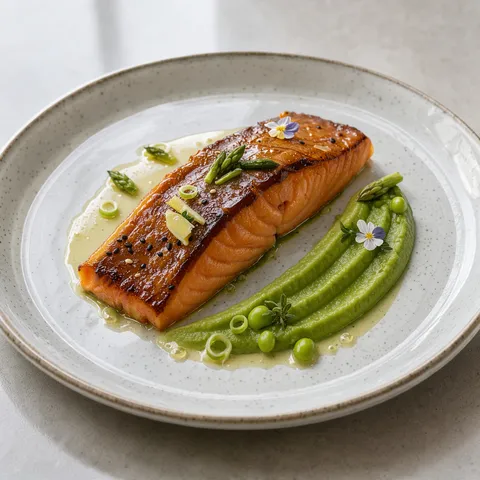 Salmon, Miso Glaze, Dashi Beurre Blanc, Edamame Purée50 min · Main course
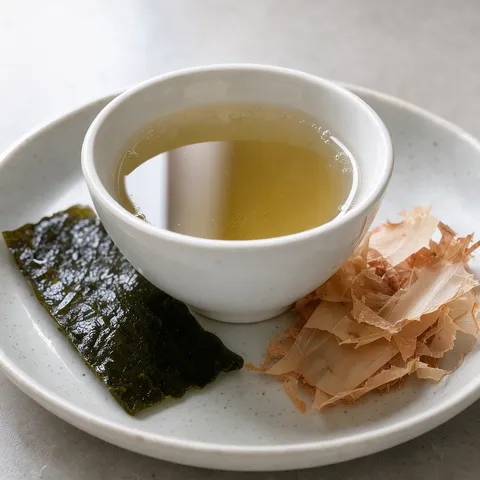 Ichiban Dashi1 hr 45 min · Basic recipe
 Miso Soup15 min · Soup
 Sushi Rice1 hr 15 min · Basic recipe
 Nigiri45 min · Main course