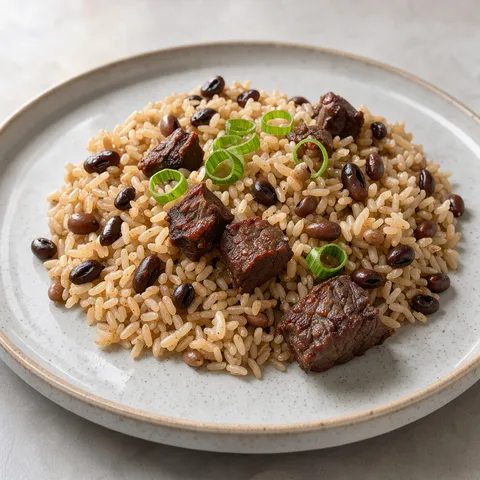
Southern Black-Eyed Bean Pilaf Hoppin' John
An American main course. Takes 1 hr 20 min (pressure cooker: about 1 hr 5 min), Serves 4. Difficulty: medium.
At a glance
- Total time
- 1 hr 20 min (pressure cooker: about 1 hr 5 min)
- Serves
- Serves 4
- Difficulty
- Medium
- Cuisine
- American cuisine
- Dish type
- Main course
- Diet
- Gluten-free
- Allergens
- Celery
Ingredients
Black-eyed beans
- 300 g dried black-eyed beans (picked over and washed)
- 1.2 litres water
- 1 bay leaf
- 1 tsp salt
Base
- 100 g beef bacon (smoked beef brisket without fenugreek coating, 1 cm strips)
- 1 tbsp sunflower oil
- 1 medium onion (finely chopped)
- 1 green pepper (finely chopped)
- 2 celery sticks (finely chopped)
- 2 garlic cloves (finely chopped)
- 1/2 tsp dried thyme
- 1/4 tsp hot paprika
Rice
- 250 g long-grain rice (washed and drained)
- 500 ml black-eyed bean cooking water
- 1/2 tsp salt
To serve
- 3 spring onions (thinly sliced)
- 1 tbsp cider vinegar
Equipment
- Saucepan
- Ladle
- Heavy-based saucepan
- Colander
- Mixing bowls
- Wooden spoon / spatula
- Pressure cooker (optional)
Method
- Boil the black-eyed beans: Without soaking, put the beans in a pan with 1.2 litres of cold water and the bay leaf, bring to the boil and skim off the foam that rises with a ladle (about 8 min). Reduce the heat and cook with the lid half open for 35 min, until the beans are soft and their skins stay whole. Add the salt in the last 10 min, as salt added early toughens the skins. In a pressure cooker: after skimming, lock the lid, cook on low heat for 8 min once it reaches pressure and let the pressure release naturally (about 10 min), then open the lid, add the salt and stir. This saves 15 min
- Build the base: While the beans cook, fry the oil and beef bacon in a wide heavy-based pan over medium heat for 6 min, until the bacon releases its fat and the edges crisp. Lift onto a plate with a slotted spoon. In the same fat, soften the onion, pepper and celery for 8 min, add the garlic, thyme and hot paprika and stir for another 1 min (about 15 min in total). In the South this trio of vegetables carries the aroma of the pilaf
- Drain the black-eyed beans: Drain the beans through a colander into a bowl, measure out 500 ml of the cooking water (top up with hot water if short) and discard the bay leaf (2 min). This dark, starchy water gives the rice an earthy colour and the taste of black-eyed beans
- Toast the rice: Add the drained rice to the vegetable base and stir with a wooden spoon for 2 min, until the grains are coated in fat and slightly translucent. Toasted grains do not stick together when cooked
- Cook: Add the 500 ml of bean water, the 1/2 tsp salt, all the beans and half of the bacon, stir once and bring to the boil (about 3 min). Then reduce the heat to the lowest, cover and cook for 15 min without lifting the lid. Small steam holes should appear on the surface and the water should be completely absorbed
- Steam off the heat: Turn off the heat, stretch a clean tea towel under the lid and leave to steam for 10 min. The towel absorbs the steam, so the grains are separate rather than wet
- Fluff and serve: Fluff the pilaf from the bottom with a fork, drizzle over the cider vinegar and scatter the remaining bacon and the spring onions on top (3 min). Serve hot
Chef's note
Hoppin' John is a pilaf specific to the Lowcountry of South Carolina, thought to descend from the West African rice and black-eyed bean dishes. It is said that eating it on New Year's Day brings abundance all year, and it is served with kale and cornbread. The original recipe uses pork; here it is made with beef bacon. It is said that the pilaf left over the next day is called "Skippin' Jenny".
Frequently asked questions
- When should I salt the black-eyed beans?
- Salt goes in during the last 10 minutes. Salt added early toughens the skins.
- Do I need to soak the black-eyed beans?
- In this recipe they are boiled unsoaked in cold water. In a pressure cooker they cook for 8 minutes over a low heat once pressure is reached.
- Why does the pilaf come out with separate grains?
- The rice is added to the vegetable base and toasted until coated in oil, so the grains don't stick together once cooked. When the heat is switched off, a tea towel stretched under the lid absorbs the steam.
 New England Clam Chowder1 hr 15 min · Soup
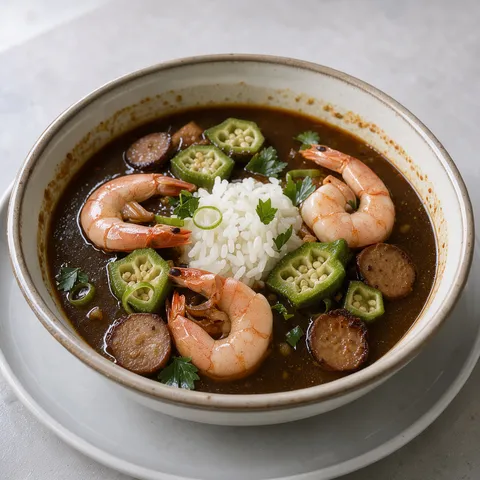 Louisiana Prawn and Okra Gumbo2 hr 15 min · Soup
 Southern Fried Chicken1 hr 35 min · Main course
 Flaky Southern Scones50 min · Bread & pastry
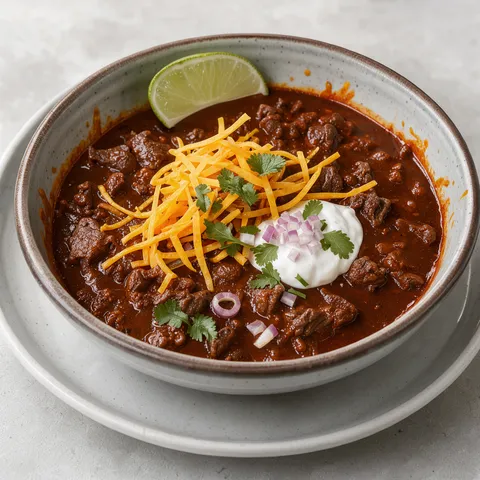 Bean-Free Chili con Carne3 hr · Main course
 Baked Cheddar Macaroni55 min · Main course