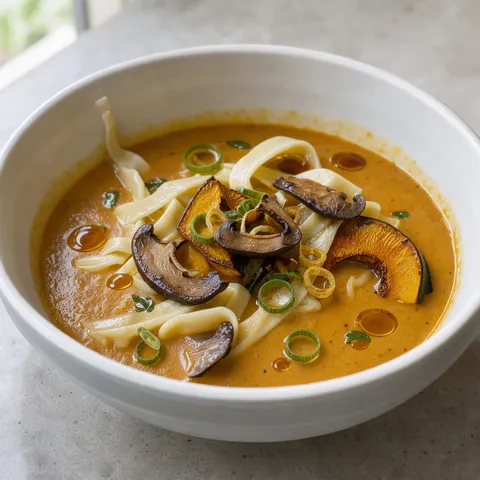
Hoto 2.0
A Japanese soup. Takes 1 hr 22 min, Serves 4. Difficulty: challenging.
At a glance
- Total time
- 1 hr 22 min
- Serves
- Serves 4
- Difficulty
- Challenging
- Cuisine
- Japanese cuisine
- Dish type
- Soup
- Allergens
- Gluten, Milk, Fish, Soya
Ingredients
Noodles
- 200 g plain flour
- 95 ml water
- 1/2 tsp salt
- extra flour
Dashi
- 1 litre water
- 10 g kombu
- 8 dried shiitake
Velouté
- 500 g pumpkin (peeled cubes)
- 2 tbsp medium miso
- 1 small onion
- 1 tbsp neutral oil
- 1 tbsp mirin
- 50 ml milk
- salt
Roasted pumpkin
- 250 g pumpkin (1 cm slices)
- 1 tbsp miso
- 1 tbsp mirin
- 1 tbsp neutral oil
Crispy shiitake
- 100 g fresh shiitake
- 3 tbsp cornflour
- 300 ml oil for deep-frying
- salt
Spring onion oil
- 3 spring onions
- 50 ml neutral oil
- salt
To finish
- 1 tbsp toasted pumpkin seeds
- seven-spice
Equipment
- Saucepan
- Oven
- Baking tray
- Blender
- Fine sieve / chinois
- Rolling pin / oklava
- Mixing bowls
- Chopping board
- Chef's knife
- Colander
- Frying pan
- Balloon whisk
- Probe thermometer (optional)
Method
- Knead the dough: Mix the flour, salt and water and knead for 6 min until firm and smooth. The dough should be tight so that it does not fall apart in thin strips. Wrap in cling film and set aside (~8 min)
- Make the dashi and rest the dough: Quickly heat the kombu and shiitake in the water, simmer gently for 10 min and remove the kombu. Meanwhile the dough rests for 20 min. Squeeze and chop the shiitake and set aside for the velouté. The dashi provides the vegetarian depth of the soup (~20 min)
- Roast the pumpkin and cook the velouté: Preheat the oven to 200°C. Mix the pumpkin slices with the miso, mirin and oil, arrange on a tray and roast for 22 min, until the edges are brown. At the same time, stir the onion in oil for 3 min, add the pumpkin cubes and 600 ml dashi and boil for 15 min, until soft (~22 min)
- Blend the velouté: Blend the pumpkin and dashi in a blender for 2 min, add the miso and milk and blend for 1 min more. Pass through a fine sieve and season with salt. The consistency should be silky and runny, and if it stays thick, loosen with dashi (~5 min)
- Roll out and cut the noodles: Roll the dough out on a floured worktop with a rolling pin to 2 mm thick, fold it over with plenty of flour and cut into strips 1.5 cm wide. Keep the noodles separate so that they do not stick together (~10 min)
- Fry the crispy shiitake: Slice the shiitake caps 3 mm thick, coat in the cornflour and shake. Fry in oil at 175°C for 2 min until crisp and salt on kitchen paper. The starch coating protects the moisture of the mushroom while crisping the outside (~5 min)
- Make the spring onion oil: Chop the spring onions very finely and salt them, pour over the heated oil (120°C), leave for 1 min and stir with a whisk. This makes a green, aromatic finishing oil (~4 min)
- Boil the noodles: Cook the noodles in boiling salted water for 4 min, until they rise to the surface and soften. Drain and quickly toss with 2 tbsp velouté so that they do not stick (~5 min)
- Plate: Ladle the hot velouté into the bottom of shallow bowls. Place the noodles in a nest in the middle and arrange the roasted pumpkin slices around the edges. Top with the crispy shiitake, pumpkin seeds, drops of spring onion oil and seven-spice. Serve straight away (~3 min)
Chef's note
Classic Hoto is a dish in which everything cooks together in one pot and thickens the soup. Here the components are separated: the pumpkin is both a smooth velouté and caramelised slices, the shiitake is crisp and the noodles are a side element. Check the flavour of the velouté before serving: miso is salty, so loosen with 1 tbsp hot water if needed. Do not shorten the 4 min, so that the noodles do not taste of raw flour. If the oil for the crispy shiitake goes above 175°C it turns bitter, so check with a thermometer. For vegans, plain oat milk can be used in place of milk, but some brands of miso contain fish, so check the label.
Frequently asked questions
- How does Hoto 2.0 differ from classic Hoto?
- The pumpkin is used twice, as a velouté and as caramelised slices. The noodles sit in a separate nest and the shiitake are served crisp.
- How do I get the velouté really smooth?
- Blitz the pumpkin and dashi in a powerful blender for a long time, then pass it through a fine sieve. Adjust the consistency with dashi.
- Why are the crispy shiitake coated in starch?
- The starch holds the mushrooms' moisture inside and makes the surface crisp.
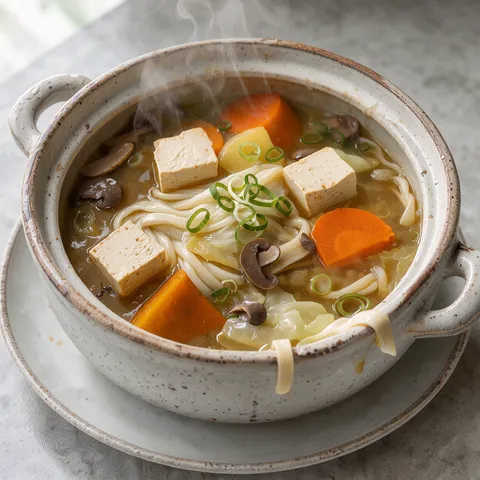 Hoto1 hr 15 min · Soup
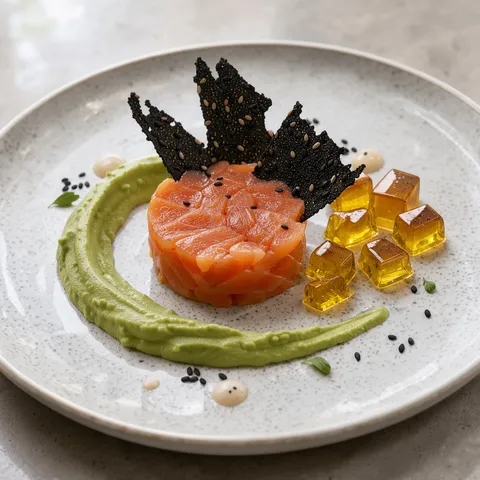 Salmon Tartare, Black Sesame Crisp, Wasabi Avocado45 min · Starter
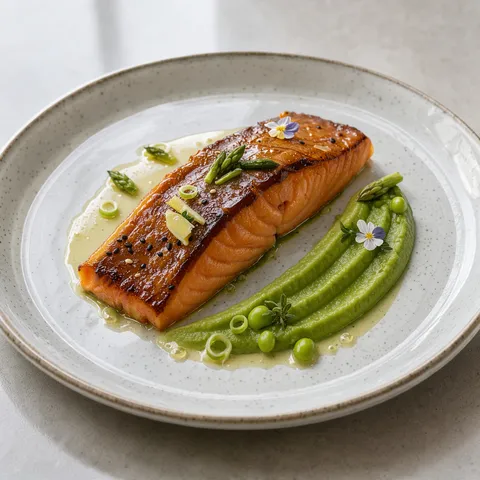 Salmon, Miso Glaze, Dashi Beurre Blanc, Edamame Purée50 min · Main course
 Ichiban Dashi1 hr 45 min · Basic recipe
 Miso Soup15 min · Soup
 Sushi Rice1 hr 15 min · Basic recipe
 Nigiri45 min · Main course