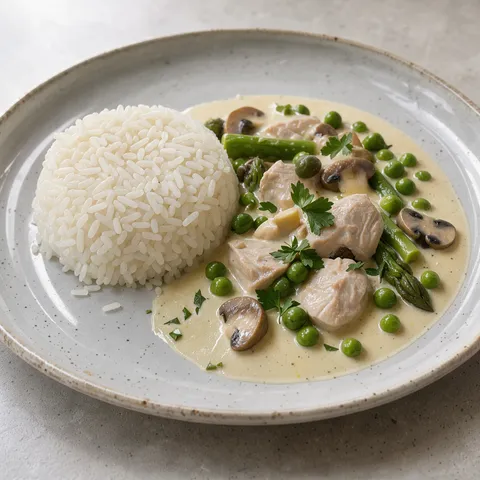
German Chicken Fricassee with Rice Hühnerfrikassee
A German main course. Takes 1 hr 15 min, Serves 4. Difficulty: challenging.
At a glance
- Total time
- 1 hr 15 min
- Serves
- Serves 4
- Difficulty
- Challenging
- Cuisine
- German cuisine
- Dish type
- Main course
- Allergens
- Gluten, Milk, Eggs, Celery
Ingredients
Poaching
- 4 chicken legs (with thighs, on the bone and skin-on, about 1.2 kg)
- 1.5 litres water
- 1 carrot (about 100 g)
- 100 g celeriac
- 1 onion (about 100 g, halved)
- 1 leek top (green part)
- 1 bay leaf
- 5 black peppercorns
- 1 tsp salt
Vegetables
- 150 g button mushrooms
- 200 g green asparagus (fresh or frozen)
- 150 g frozen peas
Sauce
- 40 g butter
- 40 g plain flour
- 500 ml strained poaching liquid
- 100 ml double cream (35%)
- 1 egg yolk
- 1 tbsp lemon juice
- 1 tbsp capers
- 1/2 tsp salt
- 1/4 tsp white pepper
- a pinch of nutmeg
Rice
- 250 g long-grain rice
- 450 ml water
- 10 g butter
- 1/2 tsp salt
To serve
- 1 tbsp finely chopped flat-leaf parsley
Equipment
- Saucepan
- Heavy-based saucepan
- Ladle
- Fine sieve / chinois
- Baking tray
- Colander
- Balloon whisk
- Chef's knife
- Chopping board
- Mixing bowls
- Probe thermometer (optional)
Method
- Poach the chicken: Put the chicken legs, carrot, celeriac, onion, leek top, bay leaf, peppercorns and salt in a saucepan and add 1.5 litres cold water. Slowly bring to the boil over medium heat, skimming off the foam that rises during the first 5 min. Reduce the heat and cook with the lid ajar for 40 min, with the surface just trembling. The meat should come away from the bone easily and the internal temperature must exceed 80°C. Slow poaching keeps the meat juicy and the stock clear
- Cook the rice: When the chicken has cooked for 20 min, wash the rice in cold water three times, until the water runs clear, and drain. Toast it in 10 g butter in a small saucepan for 1 min, then add 450 ml water and the salt. When it boils, turn the heat to the lowest setting, cover and cook for 15 min. Take off the heat and leave to steam for 10 min without lifting the lid
- Prepare the vegetables: Wipe the mushrooms and quarter them. Snap off the woody ends of the asparagus and cut the spears into 3 cm pieces. Keep the frozen peas ready in a bowl
- Strip the chicken: Lift the legs out of the pan and let cool slightly on a tray for 10 min. Strain the stock through a fine sieve, measure out 500 ml and keep the rest for another soup. Remove the skin and bones and pull the meat into bite-sized pieces. The skin comes away easily while the chicken is warm, but turns gelatinous as it sits
- Cook the vegetables in the stock: Bring the 500 ml measured stock to the boil in a saucepan. Cook the mushrooms and asparagus for 3 min, adding the peas for the last 1 min, then lift out with a slotted spoon. Keep the stock hot. Cooking the vegetables separately preserves their colour and bite, and their flavour goes into the stock for the sauce
- Start the sauce: Melt 40 g butter in a heavy-based saucepan, add the flour and stir over medium-low heat for 2 min, without colouring, until it smells toasty and looks sandy. Gradually add the hot stock, whisking until smooth after each addition. Simmer over low heat for 5 min, then add the cream. The floury taste should have gone and the sauce should coat the back of a spoon
- Thicken with the yolk: Whisk the egg yolk in a small bowl and quickly stir in 3 tbsp of the hot sauce. Take the pan off the heat and whisk this mixture back into the sauce. The sauce must not boil from now on, or the yolk will cook and turn lumpy. Season with the lemon juice, capers, salt, white pepper and nutmeg. The yolk gives the sauce a silky sheen and a rounded flavour
- Combine: Add the chicken and vegetables to the sauce and heat over the lowest heat for 3 min without boiling
- Plate: Press the rice into a small bowl and turn it out onto one half of the plate. Spoon plenty of fricassee alongside, let the sauce run to the edge of the rice and scatter with parsley. Serve hot
Chef's note
Hühnerfrikassee is one of the well-known dishes of German home and canteen cooking, and its name is thought to come from the French fricassée. Older recipes also include ox tongue, crayfish or small meatballs, while today's home version is made with mushrooms, asparagus and peas. If asparagus is out of season, use frozen, or instead dice 1 carrot and cook it with the mushrooms for 5 min. You can reduce the capers to taste, as lemon balances their sharpness. Leftover chicken stock keeps in the fridge for 3 days.
Frequently asked questions
- How do you stop the fricassee sauce curdling when it is thickened with egg yolk?
- Add 3 tablespoons of the hot sauce to the yolk and stir quickly, then take the pan off the heat and pour the mixture into the sauce while whisking. The sauce must not boil again, or the yolk will cook and go lumpy.
- Why are the fricassee vegetables cooked separately?
- Cook the mushrooms, asparagus and peas separately in the measured poaching liquid. The vegetables keep their colour and bite, and their flavour passes into the liquid for the sauce.
- Why is the chicken poached slowly?
- Start the chicken in cold water and cook for 40 minutes with the surface barely trembling. Slow poaching keeps the meat juicy and the stock clear.
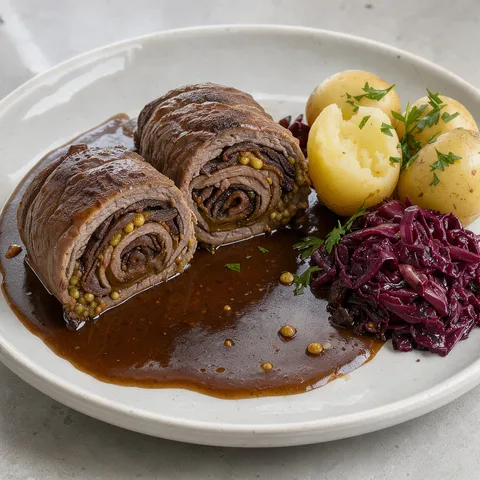 German Beef Roulades2 hr 30 min · Main course
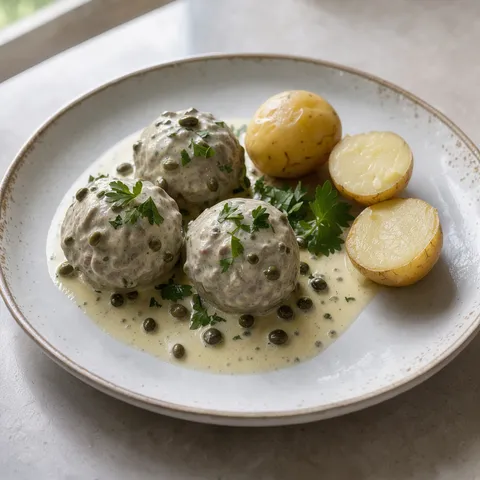 Meatballs in Caper Sauce1 hr 05 min · Main course
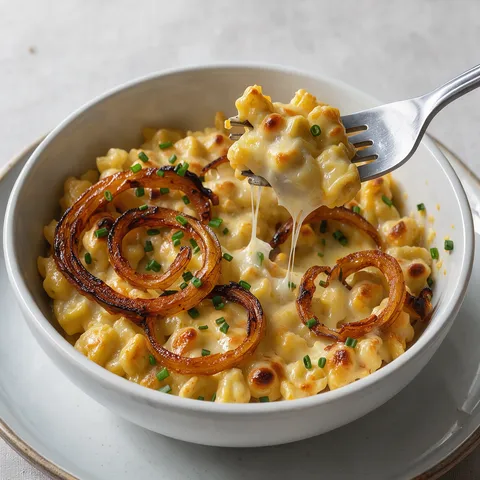 Swabian Cheese Noodles55 min · Main course
 Swabian Potato Salad1 hr · Side dish
 Bavarian Pretzels1 hr 55 min · Bread & pastry
 Käsespätzle 2.01 hr 20 min · Main course