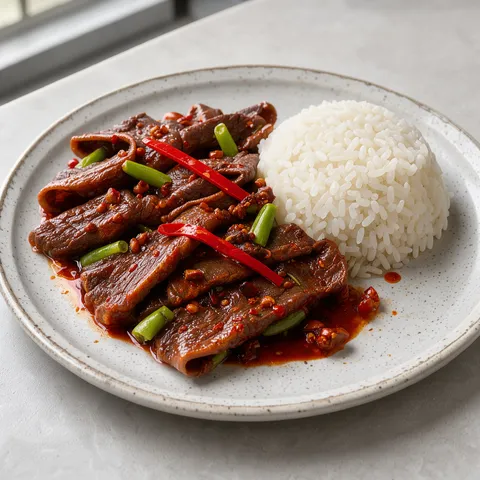
Hui Guo Niu Rou Twice-Cooked Beef Brisket
A Chinese main course. Takes 1 hr 48 min (pressure cooker: ~58 min), Serves 4. Difficulty: medium.
At a glance
- Total time
- 1 hr 48 min (pressure cooker: ~58 min)
- Serves
- Serves 4
- Difficulty
- Medium
- Cuisine
- Chinese cuisine
- Dish type
- Main course
- Allergens
- Gluten, Soya, Lupin
Ingredients
Boiling
- 600 g beef brisket (one piece)
- 3 slices ginger
- 2 spring onion stalks (white part)
- 1 tbsp Shaoxing rice wine
- 1 tsp whole Sichuan peppercorns
- 1.5 litres water
Vegetables
- 200 g garlic stems (or the green part of a leek)
- 1 long green pepper
- 1 long red pepper
Sauce
- 1.5 tbsp Pixian doubanjiang (fermented hot broad bean paste)
- 1 tbsp sweet fermented bean paste
- 1 tsp dark soy sauce
- 1 tsp sugar
- 2 garlic cloves (thinly sliced)
- 2 tbsp neutral oil
To serve
- 250 g rice (plain boiled)
Equipment
- Saucepan
- Ladle
- Chopping board
- Wok
- Mixing bowls
- Pressure cooker (optional)
Method
- Boil: Put the brisket in cold water, add the ginger, spring onions, wine and Sichuan peppercorns. When it comes to the boil, skim off the grey scum from the surface with a ladle, lower the heat and cook with the lid ajar for 80 min. It is ready when a thin skewer goes in without resistance. In a pressure cooker this stage takes about 30 min (~80 min)
- Rest: Take the meat out of its liquid and leave to cool on a board for 10 min. Hot meat falls apart when sliced, while warm meat keeps its fibres and is easy to cut (~10 min)
- Slice: Slice the meat across the grain 3 mm thick, in pieces that fit into the palm of your hand. Thin slices curl and crisp at the edges in the second cooking, while thick slices stay rubbery (~4 min)
- Prepare the vegetables: Cut the garlic stems diagonally 4 cm long and the peppers into triangles. Mix the doubanjiang and sweet paste in a small bowl with the soy sauce and sugar. Everything should be to hand because the wok stage goes quickly (~4 min)
- Brown the slices: In a dry wok over medium-high heat, spread the slices out and fry for 3 min. Wait until the meat releases its own fat and the edges curl and turn golden, then push the slices to the side (~4 min)
- Fry the paste: In the cleared space in the wok, put the neutral oil and sliced garlic and stir for 15 sec. Add the paste mixture and fry in the oil for 30 sec, until the oil turns red. Then bring all the meat together with the sauce (~3 min)
- Add the vegetables: Add the garlic stems and peppers and toss over high heat for 1.5 min. The stems should stay bright green and keep a little crispness (~2 min)
- Plate: Arrange the slices on a flat plate, overlapping slightly, pile the vegetables alongside and drizzle the red oil from the bottom of the wok over the top. Serve hot with plain boiled rice alongside (~1 min)
Chef's note
The original recipe uses pork belly; here it is made with beef brisket, and the fat and collagen of the brisket give the same glossy edges in the second cooking. Do not throw away the cooking liquid: cool it and use it as a soup base.
Frequently asked questions
- What does hui guo rou mean?
- In Chinese it means twice-cooked meat. The meat is boiled first, then sliced and stir-fried again in a wok with hot bean paste.
- Can I use beef brisket instead of pork?
- Yes. The fat and collagen in the brisket make the edges curl in the second stir-fry, but the boiling time is longer than for pork belly.
- What if I can't find doubanjiang?
- There is no exact substitute for fermented hot broad bean paste. You can mix chilli paste with fermented soybean paste, but the flavour will be milder.
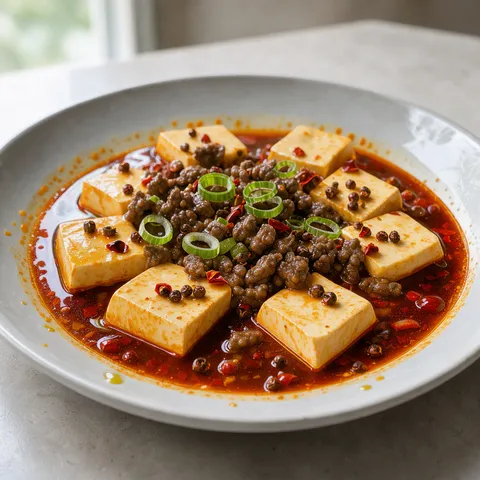 Mapo Tofu35 min · Main course
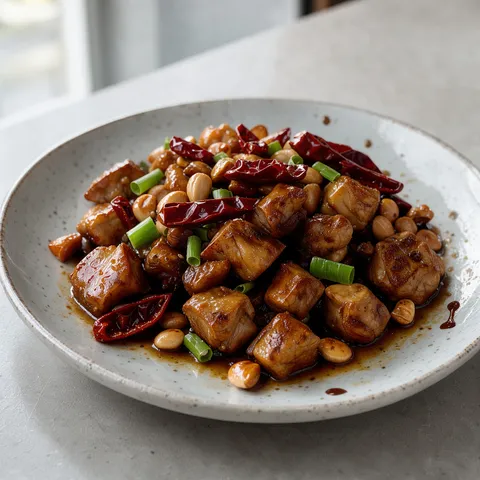 Kung Pao Chicken30 min · Main course
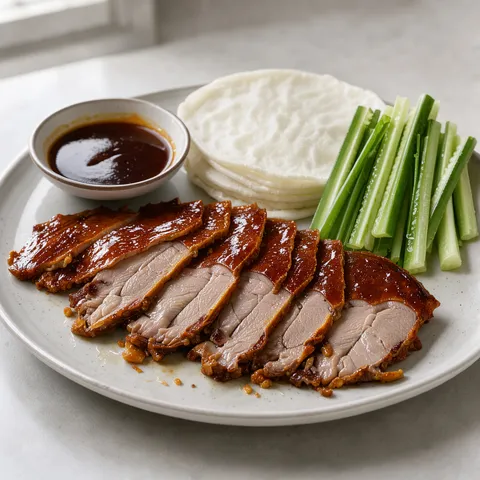 Peking Duck2 hr · Main course
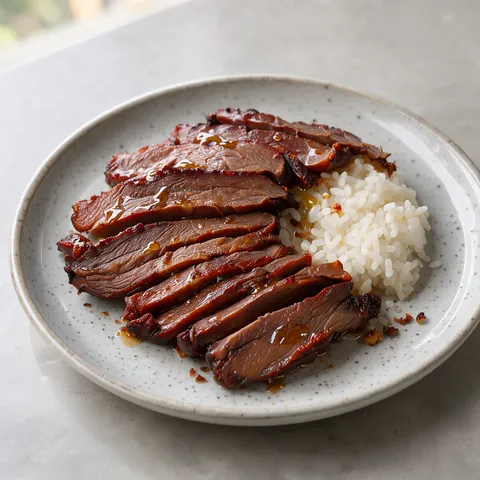 Char Siu1 hr · Main course
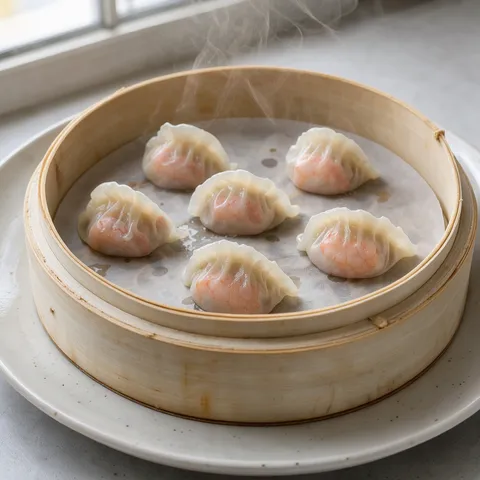 Crystal Prawn Dumplings1 hr 30 min · Starter
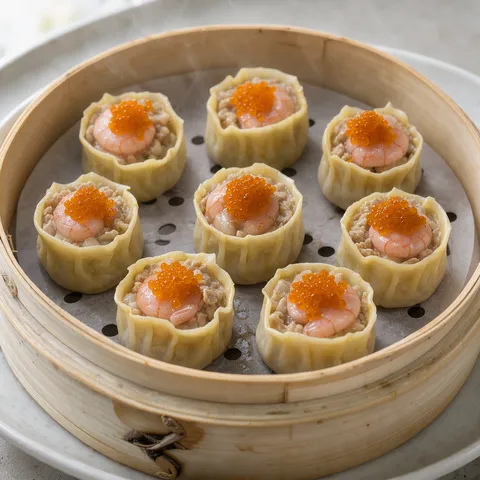 Open-Topped Dumplings50 min · Starter