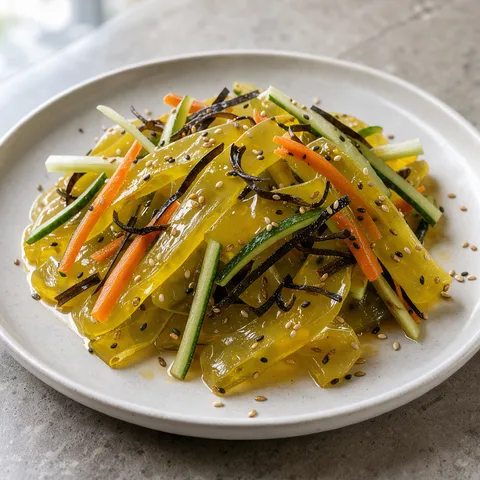
Korean Yellow Mung Bean Jelly Salad Hwangpo-mook Muchim
A Korean meze. Takes 32 min · +1 hr 15 min soaking and chilling, Serves 4. Difficulty: medium.
At a glance
- Total time
- 32 min · +1 hr 15 min soaking and chilling
- Serves
- Serves 4
- Difficulty
- Medium
- Cuisine
- Korean cuisine
- Dish type
- Meze
- Allergens
- Gluten, Sesame, Soya
Ingredients
Jelly
- 100 g mung bean starch (nokdu)
- 700 ml water
- 2 dried gardenia fruits (chija)
- 150 ml lukewarm water (for the gardenia)
- 1/2 tsp salt
- 1 tsp sesame oil
Vegetables
- 1 small cucumber (matchsticks)
- 100 g soybean sprouts
- 1 sheet toasted nori (thin strips)
Sauce
- 2 tbsp soy sauce
- 1 tbsp sesame oil
- 1 tbsp toasted sesame seeds
- 1 garlic clove (crushed)
- 1 tsp gochugaru (Korean chilli flakes)
- 1 tsp sugar
- 1 spring onion (thin rings)
Equipment
- Saucepan
- Balloon whisk
- Wooden spoon / spatula
- Mixing bowls
- Chef's knife
- Colander
- Silicone mould
- Chopping board
Method
- Prepare the gardenia water: Crack the gardenia fruits and drop them into 150 ml lukewarm water. Leave for 15 min. The water should be bright yellow-orange. Hwangpo-mook means yellow mook and takes its colour from gardenia, and without the fruit the jelly stays pale and clear. Remove the fruits and strain the water (~15 min)
- Prepare the mould: Lightly grease the inside of a square 15×15 cm silicone mould with a thin layer of sesame oil. The oil lets the jelly come out easily afterwards. If you have no mould, use a small rectangular container (~2 min)
- Mix the starch: In a saucepan, whisk the starch with 700 ml cold water, the strained gardenia water and the salt until free of lumps. Starch settles at the bottom in cold water, so stir again just before cooking. The mixture should be cloudy like milk (~2 min)
- Cook until thickened: Over medium heat, stir constantly with a wooden spoon, scraping the bottom. For the first 4 min the mixture stays watery, then suddenly starts to thicken. Once it thickens, reduce the heat and cook for 7 min more, stirring constantly. The colour should turn from cloudy yellow to translucent bright yellow, and it should run very slowly off the spoon. Do not let it stick to the bottom (~11 min)
- Pour into the mould: Pour the hot jelly into the mould and level the surface with the back of a spoon. Tap the mould lightly on the worktop to release the air bubbles. The jelly is very hot and sticky at first (~2 min)
- Cool and set: Leave the mould at room temperature for 20 min, then in the fridge for at least 40 min. Once completely cold, the jelly turns elastic and firm enough to cut. If you cut it too early, it stays runny (~60 min)
- Boil the soybean sprouts: Meanwhile, bring 500 ml salted water to the boil in a small saucepan within 2 min, boil the soybean sprouts for 3 min, plunge them into cold water and drain in a colander. The sprouts should lose their raw smell but stay crisp (~5 min)
- Cut: Loosen the jelly from the mould with a knife around the edges and turn it out onto a chopping board. Wetting the knife, cut into sticks of 1×1×5 cm. A wet knife does not stick to the jelly and makes a clean cut (~4 min)
- Prepare the sauce: In a bowl, mix the soy sauce, sesame oil, sesame seeds, garlic, gochugaru, sugar and spring onion. The sauce should taste salty, hot and sesame-rich, and as the jelly is neutral on its own, the sauce should be assertive (~3 min)
- Mix and plate: Toss the jelly sticks, cucumber and soybean sprouts with the sauce very gently, so the jelly does not break. Pile on a serving plate and scatter the nori strips and sesame seeds over (~3 min)
Chef's note
Hwangpo-mook, found on the hanjeongsik tables of the Jeonju region, is a clear jelly made from green mung beans and coloured yellow with gardenia fruit. The starch (nokdu starch) is a traditional ready-made product and is sold in Asian grocers. The water ratio varies with the brand and type of starch, and if the jelly stays too firm, add 50 ml water and cook again. Gardenia is found dried in Asian grocers.
Frequently asked questions
- Why is hwangpo-mook yellow?
- It gets its colour from the gardenia fruit, which is why it's called yellow mook. Steep the fruit in lukewarm water for 15 minutes and add the water to the jelly.
- Why does the jelly not set or turn too firm?
- If the starch isn't cooked enough it won't set, and if there's too little water it turns rubbery. Cook, stirring, until the mixture turns translucent yellow. If it's too firm, add 50 ml of water and cook again.
- Can it be prepared ahead and stored?
- The jelly keeps for 2 days in the fridge in its water. Mix the sauce and vegetables in just before serving.
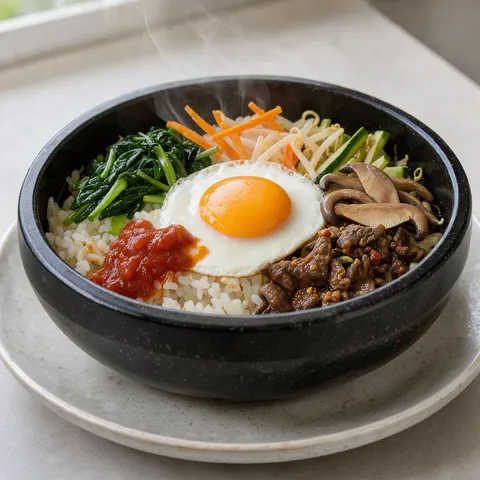 Bibimbap1 hr 15 min · Main course
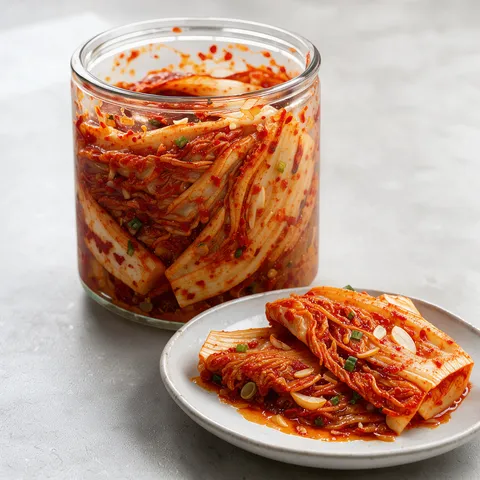 Kimchi3 hr · Side dish
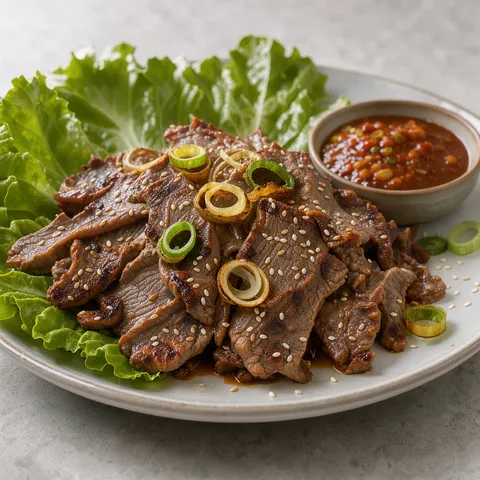 Bulgogi30 min · Main course
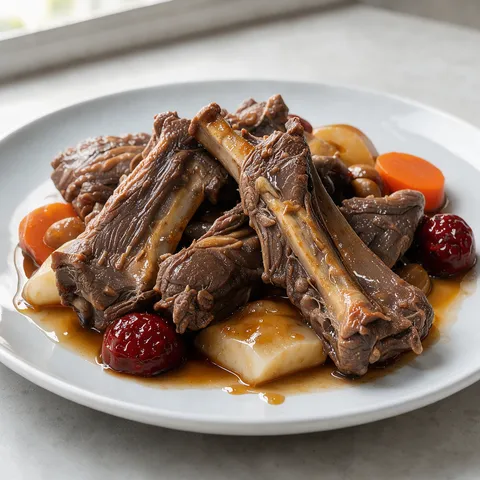 Korean Braised Short Ribs1 hr 30 min · Main course
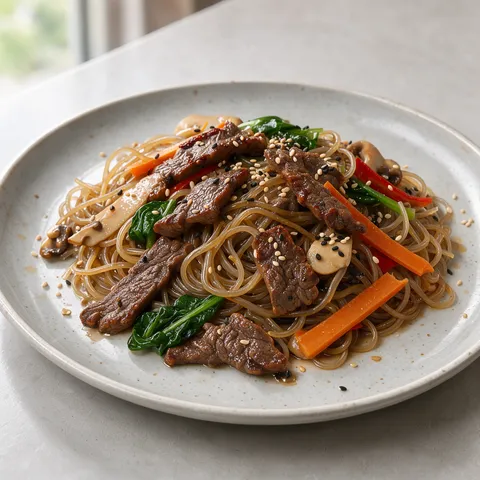 Korean Glass Noodles with Vegetables45 min · Main course
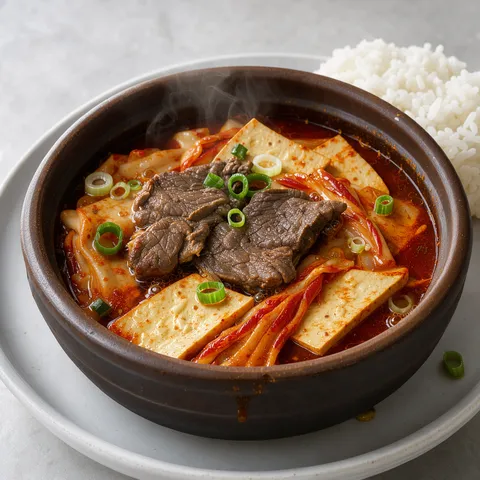 Kimchi Stew40 min · Soup