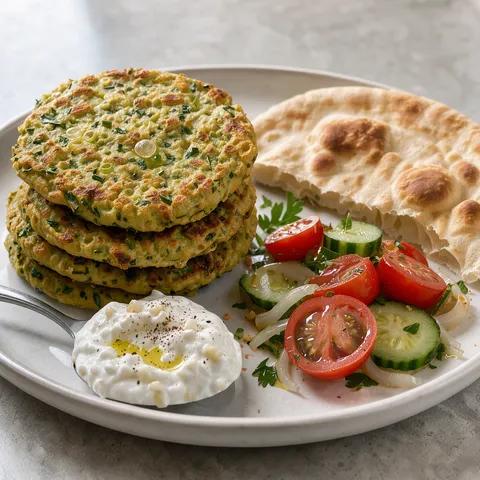
Damascus Herb Omelette Fritters Ijjeh
A Syrian main course. Takes 23 min, Serves 4. Difficulty: easy.
At a glance
- Total time
- 23 min
- Serves
- Serves 4
- Difficulty
- Easy
- Cuisine
- Syrian cuisine
- Dish type
- Main course
- Allergens
- Gluten, Milk, Eggs
Ingredients
Ijjeh
- 6 eggs
- 1 very generous bunch flat-leaf parsley (about 100 g)
- 4 spring onions
- 1 small onion
- 2 tbsp plain flour
- 1/2 tsp baking powder
- 1/2 tsp allspice
- 1/2 tsp black pepper
- 1/4 tsp cinnamon
- 1 tsp salt
- 4 tbsp sunflower oil (for frying)
To serve
- 150 g Garlic Yoghurt (Basics)
- 2 tomatoes
- 1/2 cucumber
- 4 Pitta Bread (Basics)
- 1 tsp sumac
Equipment
- Frying pan
- Mixing bowls
- Balloon whisk
- Silicone spatula
- Chef's knife
- Chopping board
Method
- Chop the herbs and onion: Wash the parsley, dry it thoroughly and chop it very finely, stalks included, with a chef's knife on a board. Slice both the white and green parts of the spring onions into rings. Dice the onion small. The amount of herbs should be almost half the amount of the eggs: ijjeh is a herb fritter rather than an omelette
- Whisk the eggs: Break the eggs into a large bowl and whisk with a whisk for 30 sec until frothy. Add the salt, black pepper, allspice and cinnamon. Allspice and cinnamon are the Damascene identity of ijjeh and give a light sweet, warm aroma. Too much cinnamon dominates, so a pinch is enough
- Add the flour: Sift the flour and baking powder together over the eggs and mix until lump-free. The flour binds the mixture and stops it falling apart as it fries. The mixture should be fluid but not thin, thick enough to cling to a spoon
- Fold in the herbs: Gently fold the parsley, spring onions and onion into the eggs with a spatula. Do not overmix, so the airy volume is not lost. The herbs should not swim in the egg mixture, and should cover everything
- Prepare the yoghurt and salad: Put the Garlic Yoghurt (Basics) in a bowl and check its salt and garlic. Chop the tomatoes and cucumber and toss with the sumac and salt. They set up a cool contrast beside the ijjeh
- Fry: Heat 2 tbsp of the oil in a large pan over medium heat. Drop the mixture in with a large spoon (about 3 tbsp) and spread lightly: you should get 8 fritters 8 cm across. Fry for 2 min on each side, until golden brown. When turning, lift the whole underside with a spatula. Add the remaining oil between batches. Medium heat is essential: high heat burns the outside and leaves the inside raw
- Plate: Drain the hot ijjeh on kitchen paper for 30 sec and arrange on plates. Put the yoghurt, salad and warm pitta alongside. Serve hot: in Damascus ijjeh is eaten hot at both breakfast and as a meze, and can also be wrapped in pitta
Chef's note
Vegetarian. Ijjeh (also ijje, and ijjeh bi baqdounes) is the herb omelette fritter of Syria and Lebanon, and it differs from Kuku Sabzi (Persian Herb Frittata) in being small, pan-fried and flavoured with allspice. Fresh eggs and plenty of herbs are the secret. If you want to bake it, it can be baked like a kuku in a thick tin at 180°C for 20 min. Bread can replace the pitta.
Frequently asked questions
- Why fry the ijjeh over a medium heat?
- High heat burns the outside and leaves the inside raw. Fry each side for 2 minutes until golden brown.
- Why is flour added to the ijjeh?
- The flour binds the mixture and stops it falling apart as it fries. The mixture should be thick enough to hold on a spoon.
- How many herbs does ijjeh need and how is it eaten?
- The herbs should make up almost half the volume of the eggs, as ijjeh is more a herb fritter than an omelette. In Damascus it is eaten hot at breakfast and as a meze, and can be wrapped in pitta.
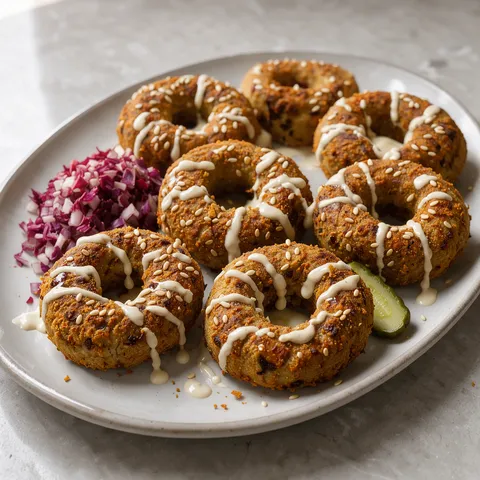 Syrian Falafel Rings with Tahini and Sumac Onions49 min · Meze
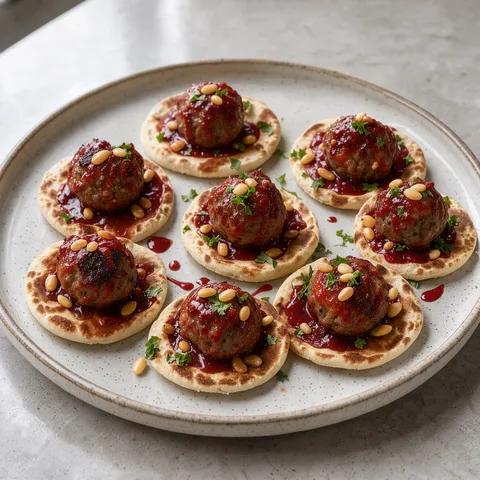 Aleppo Sour Cherry Lamb Kofte1 hr · Meze
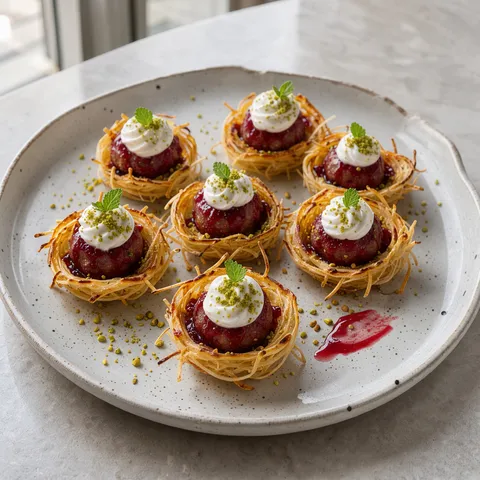 Kebab Karaz 2.01 hr 18 min · Meze
 Damascus-Style Chickpea Fatteh1 hr 50 min · Starter
 Damascus-Style Lamb in Yoghurt Sauce2 hr 15 min · Main course
 Lentils with Tamarind and Dough Squares1 hr 30 min · Main course