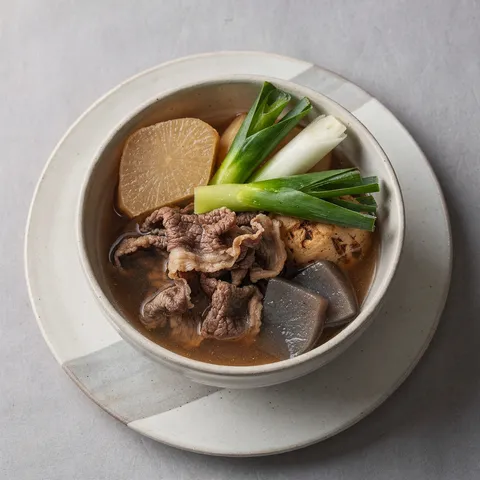
Imoni Taro and Beef Soy Soup
A Japanese soup. Takes 1 hr 6 min, Serves 4. Difficulty: medium.
At a glance
- Total time
- 1 hr 6 min
- Serves
- Serves 4
- Difficulty
- Medium
- Cuisine
- Japanese cuisine
- Dish type
- Soup
- Allergens
- Gluten, Fish, Molluscs, Soya
Ingredients
Soup
- 600 g taro or small taro tubers. 400 g beef topside or rib-eye (thinly sliced). 1 packet (250 g) konnyaku. 200 g shiitake or oyster mushrooms. 1 leek (or 3 spring onions)
Dashi
- 1.2 litres water
- 10 g kombu (about 10 cm)
- 15 g katsuobushi
Seasoning
- 60 ml soy sauce
- 50 ml mirin
- 50 ml sake
- 1 tbsp caster sugar
- 1 tsp salt
- 1 tbsp neutral oil
Equipment
- Saucepan
- Chopping board
- Chef's knife
- Fine sieve / chinois
- Ladle
- Colander
Method
- Make the dashi: Put the kombu into 1.2 litres cold water and heat over medium heat. When small bubbles appear at the edges (about 80°C), remove the kombu, as it turns bitter if it boils. Turn off the heat, add the katsuobushi, leave for 2 min and strain through a fine sieve. This clear dashi is the base of the soup (~12 min)
- Peel the taro: Peel the taro and cut it into 3 cm pieces. You can wear gloves while peeling, because taro can make the skin itch. Rinse in cold water for 2 min, then rub with salt and rinse again, which reduces the sticky slime (~8 min)
- Parboil the taro: Put the pieces in cold water, boil for 5 min after it comes to the boil, drain and rinse with water. This pre-boiling removes the slime and keeps the soup from turning cloudy. The boiled taro should offer slight resistance to a knife but still be firm inside (~8 min)
- Prepare the konnyaku: Tear the konnyaku with a spoon or by hand into irregular 2 cm pieces. The uneven surface holds the sauce better. Blanch in boiling water for 2 min and drain, which removes the smell (~4 min)
- Fry the meat: In a deep saucepan, heat the oil over medium-high heat, add the thinly sliced beef and turn for 1-2 min, until it changes colour. If you add the meat to the soup raw, the dashi turns cloudy, while lightly seared meat gives a sweet, deep aroma (~4 min)
- Build the soup: Add the dashi to the pan and bring to the boil. Add the taro, konnyaku and mushrooms and skim with a ladle. Simmer over low heat for 15 min, until the taro is easily pierced with a fork (~15 min)
- Season: Add the soy sauce, mirin, sake, sugar and salt and cook for 5 min more. Taro absorbs salt and turns sweet, so taste last and increase the soy sauce if needed. Cut the leek into 2 cm pieces and add it for the last 2 min (~7 min)
- Rest: Turn off the heat, cover and rest for 5 min. Taro keeps absorbing flavour as it rests, and the soup thickens slightly (~5 min)
- Serve: Divide the soup between hot bowls so that each bowl gets an equal amount of meat, taro and konnyaku. Sprinkle with finely chopped spring onion and serve very hot (~3 min)
Chef's note
Imoni is an autumn soup of Yamagata and is cooked in huge cauldrons on the riverbank as a community party. In Yamagata it is made with soy and beef, while in Miyagi it is made with miso and pork. Here the Yamagata style with soy and beef is made, with no pork. If you cannot find taro, you can use small sweet potatoes, but the texture will be different.
Frequently asked questions
- What is imoni?
- Imoni is a soup of taro, meat and vegetables cooked in large pots in autumn in the Tohoku region. The Yamagata version is made with soy sauce.
- What can I use if I cannot find taro?
- Small taro tubers are closest. Sweet potato also works, but the texture is softer.
- Why do I boil the taro first?
- The slimy coating on taro makes the soup cloudy and can itch. Boiling it first removes this.
 Salmon Tartare, Black Sesame Crisp, Wasabi Avocado45 min · Starter
 Salmon, Miso Glaze, Dashi Beurre Blanc, Edamame Purée50 min · Main course
 Ichiban Dashi1 hr 45 min · Basic recipe
 Miso Soup15 min · Soup
 Sushi Rice1 hr 15 min · Basic recipe
 Nigiri45 min · Main course