Fig-Set Milk Pudding 2.0 Incir Uyutmasi
A Turkish dessert. Takes 1 hr 15 min, Serves 4. Difficulty: challenging.
At a glance
- Total time
- 1 hr 15 min
- Serves
- Serves 4
- Difficulty
- Challenging
- Cuisine
- Turkish cuisine
- Dish type
- Dessert
- Diet
- Vegetarian
- Allergens
- Gluten, Milk, Tree nuts
Ingredients
Milk cream
- 1 litre whole pasteurised milk
- 4 soft dried figs (about 75 g, chopped)
- 1 fresh fig leaf (if available, optional)
- 40 ml freshly squeezed lemon juice
- 50 ml double cream (at least 35% fat)
- 1 tbsp pine honey
- a pinch of salt
Honey and thyme figs
- 8 dried figs (about 150 g)
- 250 ml water
- 2 tbsp pine honey or thyme honey
- 2 thyme sprigs
- 1 bay leaf
- 3 black peppercorns
- pared zest of 1/2 lemon (in strips)
Almond and olive oil crumble
- 40 g raw almonds
- 40 g plain flour
- 30 g caster sugar
- 25 g cold butter
- 15 ml extra virgin olive oil
- a pinch of salt
Honey glaze
- fig cooking liquid (from above)
- 1 tsp lemon juice
To finish
- 1 tbsp fruity extra virgin olive oil
- flaky salt
- thyme leaves
- finely grated zest of 1/2 lemon
Equipment
- Heavy-based saucepan
- Fine sieve / chinois
- Probe thermometer
- Wooden spoon / spatula
- Muslin
- Mixing bowls
- Colander
- Stick blender
- Cling film
- Saucepan
- Chef's knife
- Chopping board
- Oven
- Baking tray
- Baking paper
- Fine grater
Method
- Infuse the milk with figs: Start with this. Heat the milk and chopped dried figs in a heavy-based pan over medium heat to 60°C, stirring, then take off the heat. If you have a fig leaf, push it down into the milk. Cover and leave to infuse for 15 min: the figs give the milk a honey-coloured sweetness, and the leaf an aroma reminiscent of coconut and vanilla. Strain out the figs and leaf through a fine sieve and return the milk to the pan
- Curdle the milk: Bring the milk to 88°C over medium heat, scraping the bottom and checking with a thermometer, without letting it boil. Take off the heat, add the lemon juice all at once and stir slowly with a wooden spoon just twice. Within seconds white curds form and the whey turns a clear greenish yellow. This quick, reliable curdling replaces the classic enzyme setting that takes hours. Cover and leave undisturbed for 10 min so the curds firm up
- Drain: Line a fine sieve with 2 layers of damp muslin and set it over a bowl. Gently lift the curds into the sieve with a slotted spoon and leave to drain for 12-15 min, until as thick as strained yoghurt. Set aside 100 ml of the whey. Over-drained curds turn dry and floury, so check the texture with a spoon
- Turn into a cream: Put the drained curds (about 250 g) in a tall container with the cream, honey and salt and blend with a stick blender for 1 min, until completely smooth and glossy. It should be a silky cream that holds on a spoon: if it's too thick, add the reserved whey a spoonful at a time. Keep covered at room temperature, without letting the cling film touch the surface
- Cook the figs with honey and thyme: While the milk infuses, cut the stalks off the dried figs. Bring them to the boil in a small saucepan with the water, honey, thyme, bay leaf, peppercorns and lemon zest, then cover and cook over low heat for 20 min. The figs should plump up and soften but not fall apart. Lift out the figs with a slotted spoon and quarter them
- Reduce the honey glaze: Pass the fig cooking liquid through a fine sieve and return it to the pan. Boil over medium heat for 6-8 min, until reduced to about 60 ml and a glossy syrup that coats a spoon. Add the lemon juice. Toss the quartered figs in half the glaze and keep the rest for finishing
- Make the crumble: Preheat the oven to 170°C. Roughly chop the almonds with a knife. Mix the flour, sugar, salt and almonds, add the cold butter in cubes and rub in with your fingertips, then sprinkle over the olive oil to form coarse crumbs. Scatter loosely on a baking tray lined with baking paper and bake for 12-14 min, until golden. The olive oil brings the fruity, slightly bitter taste of the Aegean to the crumble
- Cool the crumble: Take the tray out of the oven and leave to cool for 10 min: the crumbs crisp up as they cool. Break into pieces of various sizes by hand
- Prepare the olive oil: Mix the fruity olive oil with half the lemon zest in a small bowl. The olive oil gives the dessert a bitter, green finish: this Aegean touch isn't in the classic
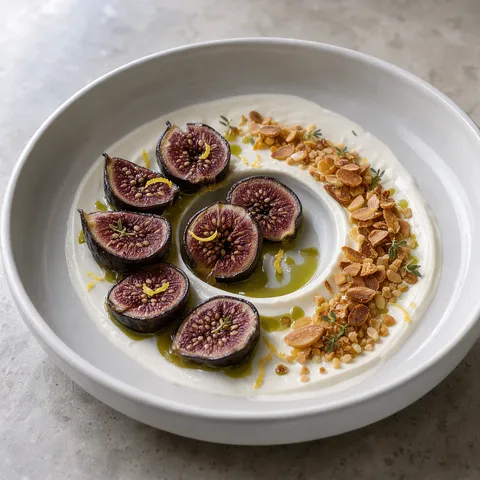
- Plate: Put two spoonfuls of the milk cream in the centre of a wide, shallow bowl and spread with the back of the spoon in a single circular movement, leaving a shallow hollow in the middle. Fan four honeyed fig quarters in the hollow and over one half of the cream, cut side up
- Finish: Scatter a crescent of the almond and olive oil crumble over the other half of the cream. Put a few drops of honey glaze on the figs and 4-5 drops of the lemon olive oil on the exposed white surface of the cream. Sprinkle the crumble with a pinch of flaky salt, the remaining lemon zest and small thyme leaves. Serve immediately
Chef's note
In the classic uyutma, the fig's enzyme sets the milk over hours of waiting, which doesn't fit a competition format. In 2.0 the milk is first infused with figs to take on their flavour, then quickly curdled with lemon and turned into a silky cream: the idea of milk meeting fig and setting is kept, but the technique changes. If you add the lemon to milk below 88°C the curds stay weak, so don't skip the thermometer.
Frequently asked questions
- How does the milk set in the Fig-Set Milk Pudding 2.0?
- Heat the milk to 88°C, take it off the heat, add the lemon juice and stir only twice, gently. Do not boil the milk.
- What happens if the curd is drained for too long?
- Over-drained curd turns dry and chalky. Check the texture with a spoon and stop when it reaches the consistency of strained yoghurt.
- How does this differ from the classic fig-set pudding?
- A quick set with lemon juice replaces the classic's enzyme setting that takes hours.
 Fig-Set Milk Pudding25 min · Dessert
 Chilled Wheat Yoghurt Soup1 hr · Soup
 Noodle and Yoghurt Soup1 hr 10 min · Soup
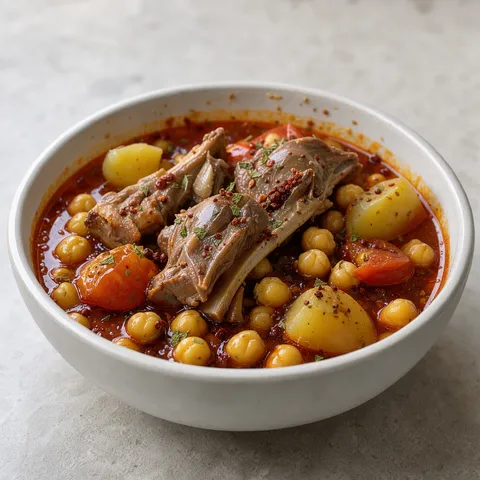 Lamb, Chickpea and Potato Stew1 hr 15 min · Soup
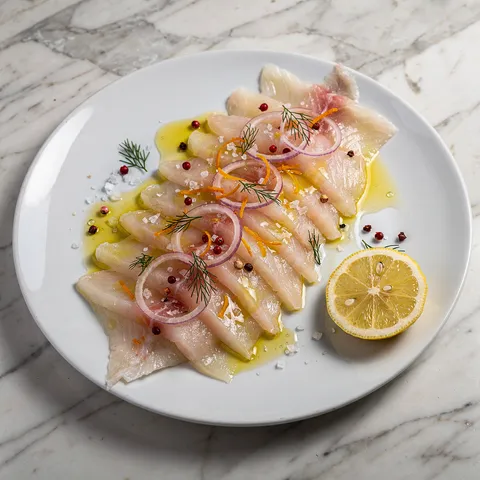 Marinated Sea Bass30 min · Meze
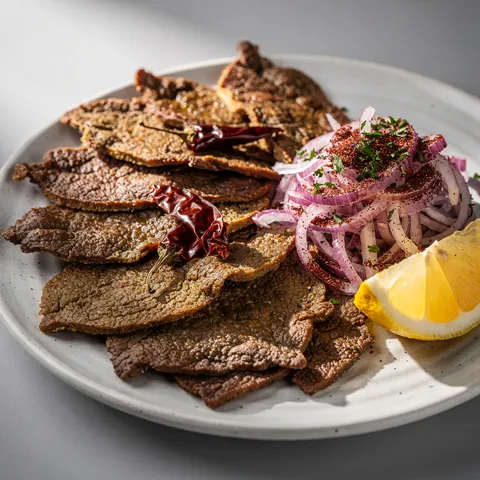 Crispy Fried Liver Slices25 min · Meze
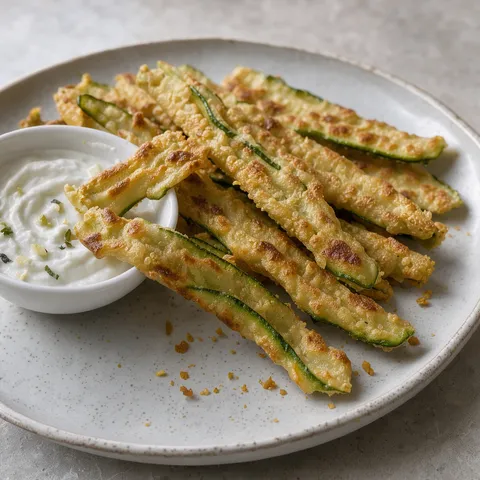 Courgette Crisps30 min · Meze