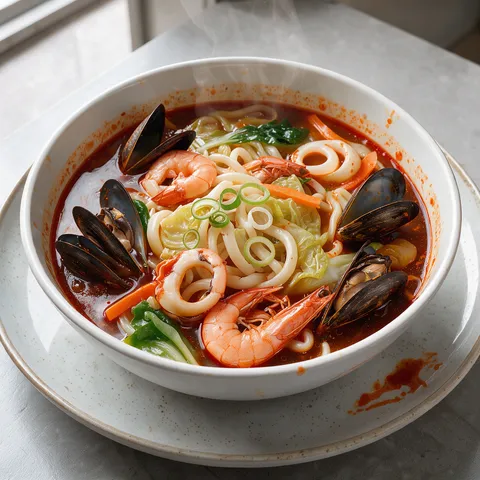
Jjamppong Korean Spicy Seafood Noodle Soup
A Korean main course. Takes 25 min, Serves 4. Difficulty: easy.
At a glance
- Total time
- 25 min
- Serves
- Serves 4
- Difficulty
- Easy
- Cuisine
- Korean cuisine
- Dish type
- Main course
- Allergens
- Gluten, Fish, Crustaceans, Molluscs, Sesame, Soya
Ingredients
Seafood
- 300 g prawns (shell-on)
- 200 g mussels (in the shell)
- 200 g squid rings
Soup
- 1200 ml water
- 10 g kombu
- 4 dried shiitake
Vegetables
- 1 onion
- 1 carrot
- 150 g cabbage
- 1 small courgette
- 5 garlic cloves
- 2 cm fresh ginger
- 2 green chillies
Chilli oil
- 3 tbsp neutral oil
- 3 tbsp gochugaru (Korean chilli flakes)
Noodles
- 300 g dried udon or thin wheat noodles
Seasoning
- 1 tbsp soy sauce
- 1 tsp salt
- 1 tsp caster sugar
To serve
- 2 spring onions
Equipment
- Wok
- Saucepan
- Colander
- Mixing bowls
- Chef's knife
- Ladle
Method
- Make the dashi: Put the kombu and shiitake in the water in a pan over medium heat. When bubbles rise, take out the kombu and simmer the shiitake for 5 min more. Keep the stock hot on the hob (~10 min)
- Chop the vegetables: While the dashi is infusing, thinly slice the onion, carrot and courgette and cut the cabbage into thick strips. Finely chop the garlic and ginger and cut the green chillies into rings. The pieces should be thin, as they will cook briefly (~8 min)
- Prepare the seafood: While the dashi is infusing, hold the prawn shell and score the back with a knife and remove the vein. Scrub the mussels with a brush. Pat the squid dry with kitchen paper. Seafood cooks quickly, so everything must be ready (~5 min)
- Make the chilli oil: Heat the oil in a wok over low heat, add the chilli flakes and stir for 30 sec until the oil turns red. The chilli must not burn, otherwise it tastes bitter and woody. Add the garlic and ginger and stir for 20 sec (~2 min)
- Sauté the vegetables: Turn up the heat and stir-fry the onion, carrot, cabbage and courgette in the wok for 3 min. The vegetables should be coated with oil and lightly browned (~3 min)
- Add the soup: Pour the hot dashi into the wok and add the soy sauce, salt and sugar. When it boils, add the mussels and cover. The shells open within 3 min, so discard any that stay closed (~4 min)
- Boil the noodles: While the soup cooks, in a separate pan boil the noodles in boiling water for 6 min, as the packet directs. Drain in a colander and rinse in cold water. The noodles should not cook in the soup, or the soup turns cloudy (~7 min)
- Cook the seafood: Add the prawns and squid to the soup. Cook for 2 min, until the prawns turn pink, before the squid firms up. If overcooked, they turn rubbery (~2 min)
- Serve: Divide the noodles between deep bowls and ladle over the boiling soup, seafood and vegetables. Scatter over the spring onion rings. The chilli oil glistens on top, so serve immediately (~1 min)
Chef's note
Jjamppong is the spicy seafood noodle soup of Chinese restaurants in Korea. The original recipe uses pork pieces; here it is made only with seafood. Gochugaru (Korean chilli flakes) is a traditional ready-made spice. Soy sauce is also a traditional ready-made product. Boiling the noodles separately keeps the soup clear.
Frequently asked questions
- Why are the noodles boiled separately in jjamppong?
- If the noodles cook in the soup it turns cloudy. So boil them in a separate pan, drain and rinse in cold water.
- What do I do with mussels that don't open?
- The shells open once the mussels go into the soup and the lid goes on. Throw away any that stay shut.
- How do I stop the prawns and squid turning rubbery?
- Add them to the soup last and take them out before the prawns go pink and the squid toughens. If overcooked they turn rubbery.
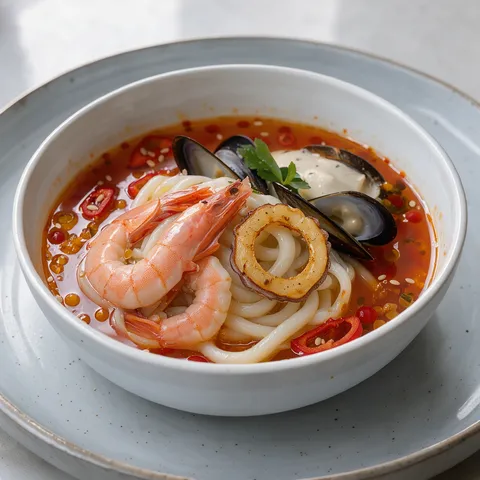 Jjamppong 2.048 min · Main course
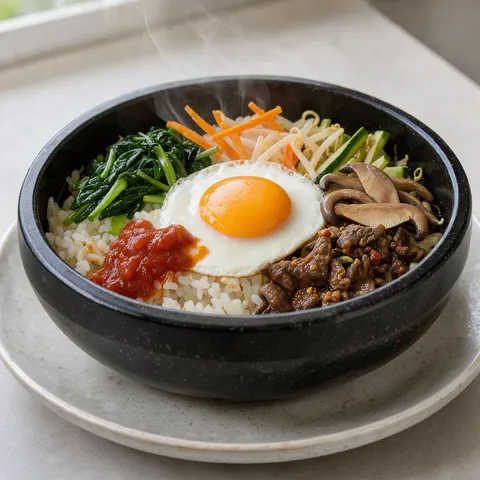 Bibimbap1 hr 15 min · Main course
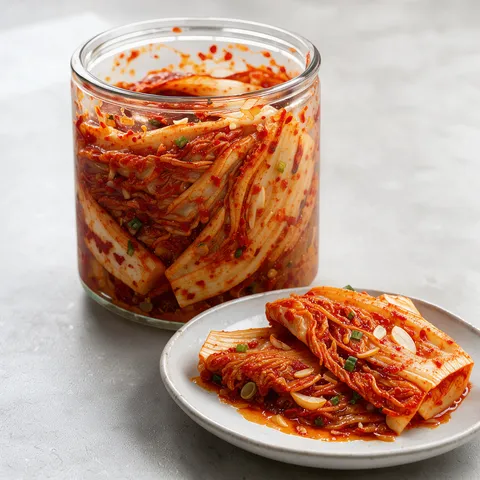 Kimchi3 hr · Side dish
 Bulgogi30 min · Main course
 Korean Braised Short Ribs1 hr 30 min · Main course
 Korean Glass Noodles with Vegetables45 min · Main course
 Kimchi Stew40 min · Soup