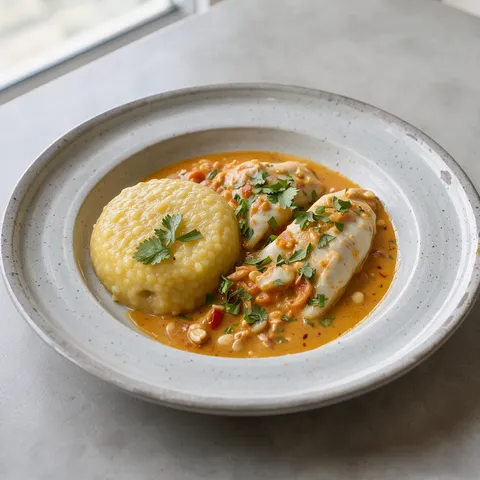
South Sudanese Peanut Fish Stew Kajaik
A South Sudanese main course. Takes 50 min, Serves 4. Difficulty: medium.
At a glance
- Total time
- 50 min
- Serves
- Serves 4
- Difficulty
- Medium
- Cuisine
- South Sudanese cuisine
- Dish type
- Main course
- Allergens
- Gluten, Fish, Peanuts
Ingredients
Fish
- 800 g skinless white fish fillets (sea bass or sea bream, 8 pieces)
- 1/2 tsp salt
- juice of 1/2 lemon
Sauce
- 100 g roasted unsalted peanuts
- 200 ml water (for the peanut paste)
- 3 tbsp sunflower oil
- 2 onions (finely chopped)
- 3 garlic cloves (crushed)
- 2 tbsp tomato paste
- 3 tomatoes (grated)
- 1 green chilli (finely chopped)
- 1/2 tsp cumin
- 1/2 tsp black pepper
- 1 tsp salt
- 300 ml water
Asida
- 250 g fine cornmeal (in place of sorghum flour)
- 1 litre water
- 1/2 tsp salt
To serve
- 2 tbsp chopped coriander
Equipment
- Mixing bowls
- Food processor
- Sauté pan
- Box grater
- Heavy-based saucepan
- Balloon whisk
- Wooden spoon / spatula
- Probe thermometer
- Ladle
Method
- Prepare the fish: Pat the fillets dry with kitchen paper, rub with the salt and lemon juice and leave in the fridge for 10 min until cooking. The lemon and salt firm up the flesh and stop it breaking up in the stew
- Grind the peanut paste: Grind the peanuts in the food processor for 2 min, until they release their oil and form a fine paste. Add the 200 ml water a little at a time and process for 1 min more to get a creamy peanut milk. In some South Sudanese stews peanut sauce thickens and takes the place of oil
- Cook the onion: In a 28 cm wide sauté pan with a lid, heat the oil over medium heat and cook the onion for 8 min, until soft and golden. Add the garlic and stir for 1 min
- Fry the paste and tomato: Add the tomato paste and fry for 2 min. Add the grated tomato, chilli, cumin and black pepper and cook for 6 min, until the sauce thickens and the oil separates at the edges
- Thicken with the peanuts: Add the peanut milk and 300 ml water, season with the salt and cook over low heat for 10 min, stirring often. Peanuts catch on the bottom quickly. The sauce should become a creamy orange consistency that coats the spoon, and if it thickens too much, add 50 ml water
- Cook the asida: While the sauce cooks, make the asida (firm porridge). Bring 750 ml water to the boil with the salt in a medium heavy-based pan. Make a smooth slurry in a bowl from the cornmeal and the remaining 250 ml cold water and pour it into the boiling water, whisking. Cook over low heat for 15 min, constantly scraping the bottom of the pan with a wooden spoon, until a firm dough forms that does not stick to the spoon and comes away from the side of the pan. Use a long-handled spoon, as it can spit
- Cook the fish in the sauce: Arrange the fish fillets in a single layer in the sauce, spoon sauce over them, cover and cook over low heat for 8 min. The thickest part of the fish should reach 63°C and flake easily with a fork. Do not stir the fish, just shake the pan
- Shape the asida: With a wet ladle or bowl, take four dome-shaped portions of asida and turn them out onto deep plates
- Serve: Put two fish fillets and plenty of sauce around the asida and scatter with coriander. In South Sudan kajaik is eaten by hand from a communal plate, scooping the sauce with pieces torn from the asida
Chef's note
Kajaik is a fish stew loved by the communities along the Nile in South Sudan, traditionally cooked with dried fish, and in some recipes peanut paste is added. This recipe is a peanut interpretation. The original recipe uses dried Nile perch or tilapia, and here it is made with fresh sea bass or sea bream. For the salty, smoky taste of dried fish, add 50 g of flaked smoked mackerel to the sauce if you like. Asida is traditionally made with sorghum flour, and fine cornmeal gives a similar texture. The sauce can be made a day ahead and the fish added on the day of serving.
Frequently asked questions
- What is asida and how is it cooked?
- Asida is a stiff dough made from fine maize meal. Mix the flour with cold water to a slurry, whisk it into boiling water and stir constantly for 15 minutes.
- What if the kajaik sauce gets too thick?
- A peanut sauce sticks to the bottom quickly, so stir often. If it gets too thick, add 50 ml water.
- What is used instead of sorghum flour in kajaik?
- The recipe uses fine maize meal as a substitute for sorghum flour.
 South Sudanese Okra and Tomato Soup28 min · Soup
 South Sudanese Peanut Meringue Cookies57 min · Dessert