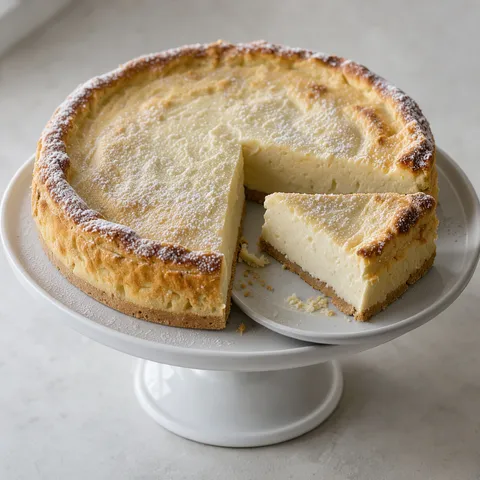
German Curd Cheesecake, Shortcrust Base Käsekuchen
A German patisserie. Takes 1 hr 43 min · +4 hr chilling, 23-24 cm yaylı tin, 12 slices. Difficulty: medium.
At a glance
- Total time
- 1 hr 43 min · +4 hr chilling
- Serves
- 23-24 cm yaylı tin, 12 slices
- Difficulty
- Medium
- Cuisine
- German cuisine
- Dish type
- Patisserie
- Diet
- Vegetarian
- Allergens
- Gluten, Milk, Eggs
Ingredients
Shortcrust base
- 200 g plain flour
- 80 g caster sugar
- 100 g cold butter (diced)
- 1 egg
- a pinch of salt
Filling
- 500 g fresh curd cheese from Homemade Ricotta and Fresh Curd Cheese (Basics)
- 250 g strained yoghurt from Strained Yoghurt and Labneh (Basics)
- 4 eggs (separated)
- 150 g caster sugar
- 40 g cornflour
- 60 g melted butter
- zest and 2 tbsp juice of 1 lemon
- 2 tsp vanilla extract
- a pinch of salt
To serve
- icing sugar
Tin
- 24 cm springform tin
- 12 slices
Equipment
- Cake tin
- Baking paper
- Oven
- Hand mixer
- Mixing bowls
- Silicone spatula
- Box grater
Method
- Knead the dough: In a bowl, rub the flour, sugar, salt and cold butter together with your fingertips until like sand, add the egg and knead until the dough comes together. Do not overwork it, or it turns hard. Wrap in cling film and put in the fridge (8 min)
- Press into the tin: Line the base of the 24 cm springform tin with baking paper and grease the sides. Press the dough onto the base and 3 cm up the sides with your fingers and prick the base with a fork. The holes stop the base puffing up (7 min)
- Pre-bake the base: Preheat the oven to 180°C. Bake the base for 15 min, until the edges are lightly golden. Baking it first stops the base going soggy under the filling (15 min)
- Make the filling: While the base bakes, beat the fresh curd cheese and strained yoghurt in a bowl with a hand mixer until smooth. Add the yolks, 100 g of the sugar, the cornflour, melted butter, lemon zest and juice, vanilla and salt. Grate the lemon zest on a fine grater and add to the filling. In a separate bowl, whisk the egg whites with clean beaters and the remaining 50 g sugar to soft peaks, and fold slowly into the filling with a spatula. The white foam makes the filling light and puffy (in parallel, no extra time)
- Pour in the filling and bake: Reduce the oven to 170°C. Pour the filling onto the baked base and level the surface. Bake on the middle shelf for 55 min, until the edges are set and the centre is slightly wobbly. If the top darkens too much, cover with baking paper for the last 15 min (55 min)
- Rest in the oven: Turn off the oven, prop the door open 5 cm and leave the cake inside for 15 min. Sudden cooling makes the surface crack and sink (15 min)
- Unmould: Run a knife around the edge and release the springform tin. Rest until it reaches room temperature, then chill in the fridge for at least 4 hr, and only then slice, when the flavour has balanced. Dust with icing sugar before serving (3 min)
Chef's note
In Germany Käsekuchen is usually made with Quark. Here a mixture of fresh curd cheese and strained yoghurt stands in for the Quark, and if you use a dry fresh curd cheese, increase the yoghurt a little. A slice is served at coffee time in German homes. To avoid cracks, avoid sudden changes in temperature.
Frequently asked questions
- Why does the top of Käsekuchen crack or sink?
- Sudden cooling makes the surface crack and sink. When it is baked, turn off the oven and leave the door ajar, resting the cake inside for 15 minutes.
- Why is the shortcrust base blind baked?
- Baking the base first stops it going soggy under the filling. Pricking the base with a fork also stops it puffing up.
- When should Käsekuchen be sliced?
- It should come to room temperature first, then rest in the fridge for at least 4 hours. After that it can be sliced and the flavour has balanced.
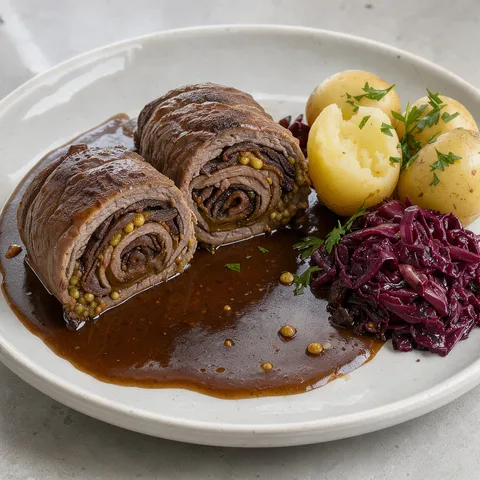 German Beef Roulades2 hr 30 min · Main course
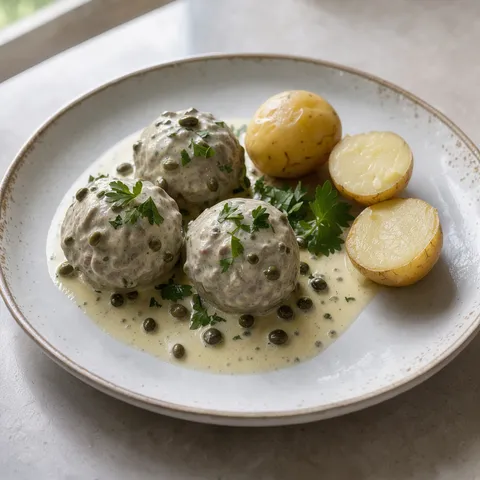 Meatballs in Caper Sauce1 hr 05 min · Main course
 Swabian Cheese Noodles55 min · Main course
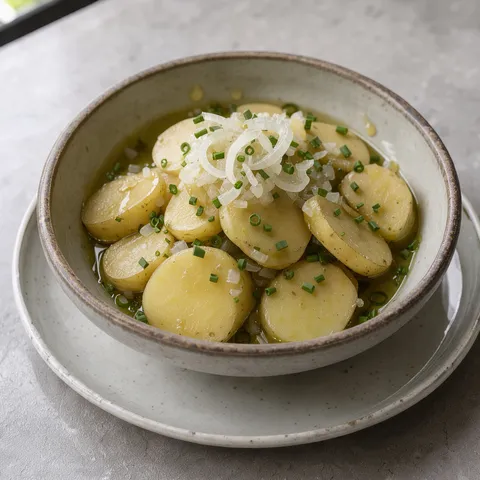 Swabian Potato Salad1 hr · Side dish
 Bavarian Pretzels1 hr 55 min · Bread & pastry
 Käsespätzle 2.01 hr 20 min · Main course