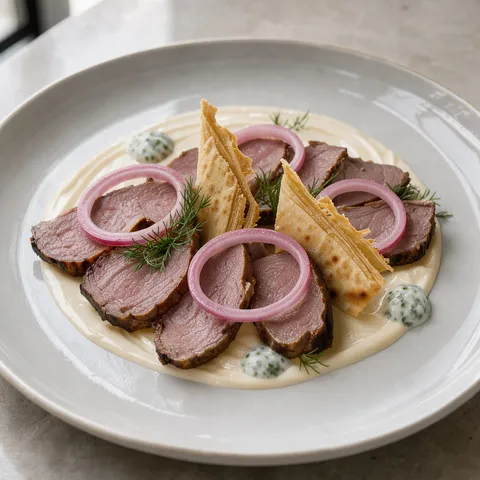
Kattama 2.0
A Kyrgyz main course. Takes 1 hr 25 min, Serves 4. Difficulty: challenging.
At a glance
- Total time
- 1 hr 25 min
- Serves
- Serves 4
- Difficulty
- Challenging
- Cuisine
- Kyrgyz cuisine
- Dish type
- Main course
- Allergens
- Gluten, Milk
Ingredients
Kattama layers
- 250 g plain flour (plus 30 g for rolling)
- 145 ml lukewarm water
- 1/2 tsp salt
- 60 g butter (soft)
- 2 tbsp sunflower oil
Lamb
- 600 g lamb sirloin or loin fillet (sinew removed, 2 pieces)
- 1 tsp salt
- 1/2 tsp black pepper
- 1/2 tsp ground cumin
- 1 tbsp sunflower oil
- 20 g butter
- 1 garlic clove (crushed)
Onion cream
- 3 onions (about 450 g, thin half-moons)
- 30 g butter
- 100 ml water
- 50 ml milk
- 1/2 tsp salt
Ayran and dill sauce
- 150 g strained (Greek-style) yoghurt
- 50 ml ayran
- 1/2 bunch dill (finely chopped)
- 1/2 garlic clove (grated)
- a pinch of salt
Pickled onion
- 1 small red onion (thin rings)
- 50 ml cider vinegar
- 50 ml water
- 1 tsp sugar
- 1/2 tsp salt
To finish
- dill sprigs
- flaky salt
- 1/4 tsp black pepper
Equipment
- Mixing bowls
- Saucepan
- Sauté pan
- Blender
- Rolling pin / oklava
- Oven
- Baking tray
- Baking paper
- Cast-iron frying pan
- Probe thermometer
- Chef's knife
- Balloon whisk
Method
- Knead the dough: Mix the flour with the salt, add the lukewarm water and knead for 6-7 min to a soft, elastic dough. Cover and rest for 20 min. Meanwhile, beat the butter with the sunflower oil until creamy
- Make the pickle: Bring the vinegar, water, sugar and salt to the boil in a small saucepan and pour over the red onion rings. Leave at room temperature for at least 30 min. This quick pickle cuts through the fattiness of the lamb and the buttery layers
- Cook the onion cream: Start while the dough rests, at the same time as step 1. Melt the butter in a large sauté pan over medium-low heat and add the onion and salt. Sweat, covered, for 15 min, stirring now and then, until the onion is completely soft and lightly golden. Add the water and cook uncovered for another 5 min. Add the milk and blend in a blender for 1 min until completely smooth. It should drop slowly from a spoon: if it is watery, reduce in the pan for another 2-3 min. Keep warm
- Roll the layers: Divide the dough in half. Roll each piece out on an oiled work surface to 35 cm, thin enough to see through, and spread with half the butter mixture. Roll up tightly like a Swiss roll, then coil like a snail. Rest for 10 min. Preheat the oven to 200°C
- Press the layers: Roll the snails out with a rolling pin into 26 cm rounds about 3 mm thick. Put each one on its own tray lined with baking paper and cover with a second sheet of baking paper and a second tray. Put the two pairs of trays on two separate shelves at the same time (4 trays in total). If you do not have 4 trays, roll the discs out to 20 cm, place them side by side on a single tray and press with a heavy cast-iron frying pan on top. Bake for 12 min, lift off the top trays and bake for another 4-6 min, until the surface is deep golden and crisp. Pressing turns the layers into thin, flat, brittle sheets. Once out of the oven, break each round by hand into 6 irregular pieces, 12 pieces in total
- Sear the lamb: While the discs are in the oven, pat the lamb dry and rub with the salt, pepper and cumin. Heat a cast-iron frying pan over high heat and add the oil. Turn the lamb for 2 min on each side, 8 min in total, until a deep brown crust forms. Lower the heat, add the butter and garlic and spoon the foaming butter over the meat for 1 min. When the internal temperature reaches 56-57°C, transfer to a board: it will be medium-rare
- Rest: Rest the lamb for 8 min so the juices redistribute through the meat. Meat cut without resting leaves the plate wet. Meanwhile, whisk the ingredients of the ayran and dill sauce until smooth
- Slice: Slice the lamb 2 cm thick against the grain with a sharp knife and divide so each person gets 5-6 slices. Sprinkle the cut faces with flaky salt and black pepper
- Plate: Put two spoonfuls of onion cream in the centre of a warm, flat plate and spread into a 10 cm circle with the back of the spoon. Fan five or six lamb slices over the cream
- Place the layered shards: Stand three pieces of kattama upright between the lamb slices at different heights so the layers show from the side
- Finish: Dot three small spots of ayran and dill sauce on the empty side of the plate. Scatter the drained pickled onion rings over the lamb, sprinkle with dill sprigs and serve immediately
Chef's note
The onion, butter and many-layered dough of the classic kattama are kept, but the onion comes out of the filling to become a silky cream, and the dough is pressed into crisp shards. The lamb and ayran of the Kyrgyz table complete the plate. Bake the layered shards no more than 1 hr before serving, as they soften in humid air. If lamb sirloin is expensive, slices of boneless lamb leg cook in the same time.
Frequently asked questions
- Why are the Kattama pieces pressed as they bake?
- Pressing turns the layers into a thin, flat, brittle sheet. The discs bake between two sheets of baking paper and a second tray for 12 minutes, then without the top trays for 4-6 minutes more.
- Why isn't the lamb fillet cut without resting?
- Meat cut without resting soaks the plate. Rest the lamb for 8 minutes, and its juices redistribute within the meat.
- How do you press the Kattama discs if you don't have 4 trays?
- Roll the discs out to 20 cm, put them side by side on one tray and press with a heavy cast iron pan on top.
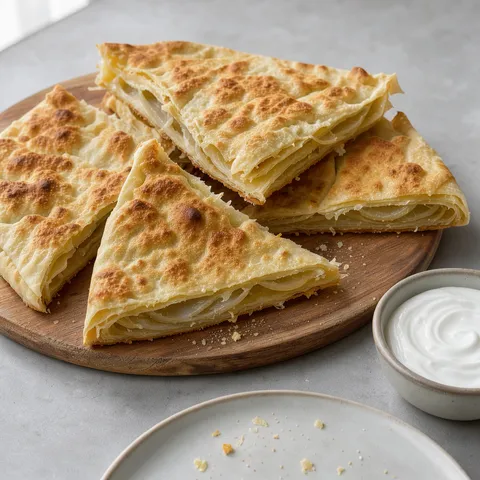 Kyrgyz Layered Flatbread with Onion and Butter1 hr 50 min · Bread & pastry
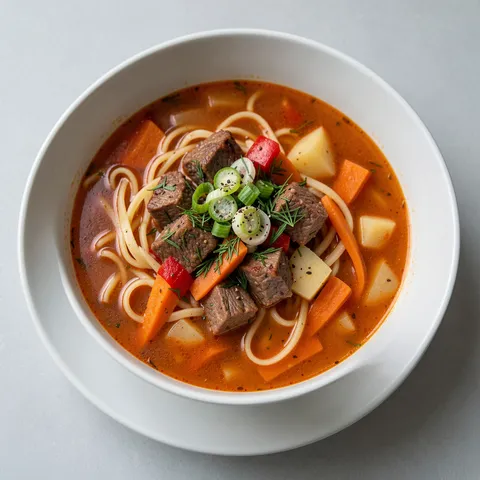 Kyrgyz Lamb Soup with Hand-Cut Noodles1 hr 30 min · Soup
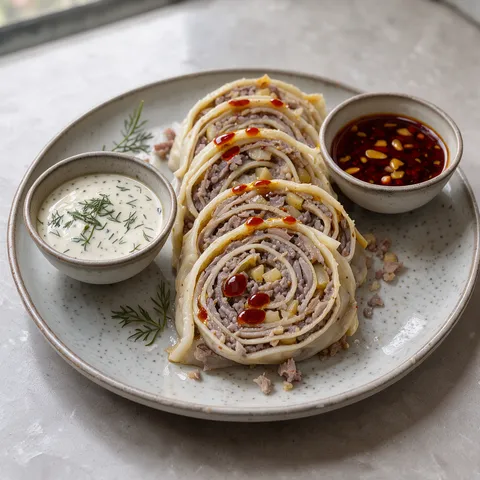 Kyrgyz Steamed Rolled Dumpling2 hr · Bread & pastry
 Ashlyamfu1 hr 20 min · Soup
 Ashlyamfu 2.01 hr 20 min · Soup
 Shorpo2 hr 30 min · Soup
 Kyrgyz Fried Lamb and Potatoes30 min · Main course