
Open Mince Pastries 2.0 Kaytaz Boregi
A Turkish starter. Takes 1 hr 15 min, 4 servings (12 pieces). Difficulty: challenging.
At a glance
- Total time
- 1 hr 15 min
- Serves
- 4 servings (12 pieces)
- Difficulty
- Challenging
- Cuisine
- Turkish cuisine
- Dish type
- Starter
- Allergens
- Gluten, Milk, Tree nuts
Ingredients
Yoghurt dough
- 140 g plain flour
- 70 g strained (Greek-style) yoghurt
- 30 ml olive oil
- 1/4 tsp baking powder
- 1/4 tsp salt
- 2 tbsp cold water
- 2 tbsp flour for rolling
Mince topping
- 200 g medium-fat lamb mince
- 1 small onion (about 70 g, grated and squeezed of its juice)
- 1 tbsp hot pepper paste
- 1 tsp tomato paste
- 1/2 tsp cumin
- 1/2 tsp Aleppo pepper
- 1/2 tsp salt
- 1 tbsp olive oil
Pomegranate glaze
- 2 tbsp pomegranate molasses
- 1 tsp honey
- 1 tbsp water
Charred pepper cream
- 2 romano peppers
- 120 g strained (Greek-style) yoghurt
- 30 g walnuts
- 1 small garlic clove
- 1 tbsp olive oil
- 1/4 tsp salt
Quick pickle
- 1 small red onion
- 3 tbsp cider vinegar
- 3 tbsp water
- 1 tsp sugar
- 1/4 tsp salt
- 1/2 tsp sumac
Parsley oil
- 30 g flat-leaf parsley leaves
- 60 ml sunflower oil
- 500 ml water and a pinch of salt for blanching
- iced water
To finish
- a few flat-leaf parsley leaves
- 1/2 tsp Aleppo pepper
Equipment
- Mandoline
- Saucepan
- Mixing bowls
- Cling film
- Oven
- Blender
- Piping bag
- Fine sieve / chinois
- Muslin
- Squeezy bottle
- Rolling pin / oklava
- Cake ring / food ring
- Baking tray
- Baking paper
- Frying pan
- Pastry brush
- Probe thermometer (optional)
Method
- Make the pickle: Slice the red onion into 1 mm rings on a mandoline. Bring the vinegar, water, sugar and salt to the boil in a small pan, pour over the onion, add the sumac and leave until serving. In 20 min the onion turns pink and becomes a crisp, tangy garnish, taking the place of the lemon served with classic kaytaz
- Char the peppers: Char the two romano peppers directly over a gas flame or under a hot grill (250°C) for 8-10 min, turning with tongs, until the skins are blackened all over. Transfer to a bowl, cover with cling film and leave to sweat for 10 min. The steam lifts the skin from the flesh
- Knead the dough: Preheat the oven to 220°C (conventional). Mix the flour with the baking powder and salt, add the strained yoghurt, olive oil and the cold water if needed, and knead for 2-3 min, until smooth but loose. This dough toughens if overworked, while brief kneading gives a crisp, flaky crust. Cover and rest for 15 min
- Make the mince topping: Knead the mince with the onion, both pastes, cumin, Aleppo pepper, salt and olive oil for 2 min, to a paste. This time the mixture is spread thinly over the base, as a thick layer would soak the dough and spoil its crispness
- Blend the cream: Peel and deseed the charred peppers and let the juices drain off. Blend the peppers, strained yoghurt, walnuts, garlic, olive oil and salt for 30-40 sec, until smooth and pale orange. Transfer to a piping bag and keep in the fridge
- Make the parsley oil: Blanch the parsley in boiling salted water for 10 sec, transfer to iced water and squeeze dry. Blend with the sunflower oil for 1 min, then strain through a fine sieve lined with muslin without pressing, and pour into a squeeze bottle. The brief blanching fixes the green colour
- Roll out and cut: Roll out the dough on a floured surface with a rolling pin to 3 mm thick and cut out 12 rounds with a 9 cm pastry ring, gathering and re-rolling the trimmings once. Arrange the rounds on two baking trays lined with baking paper and prick in a few places with a fork. The holes stop the centre of the dough ballooning
- Spread and bake: Spread about 25 g mince topping over each round with the back of a wet spoon, 4-5 mm thick, leaving a 5 mm border. Bake the trays on two shelves for 11-13 min, swapping them over at 6 min. The edges should be golden and crisp, the mince sizzling, and the internal temperature of the mince must exceed 71°C
- Glaze: Boil the pomegranate molasses, honey and water in a small frying pan for 1-2 min to a light syrup. Brush thinly over the mince as soon as the kaytaz come out of the oven. The pomegranate glaze gives the mince a shine and a sweet-sour finish
- Plate: Arrange three kaytaz on each plate, slightly overlapping, in an arc. Pipe a hazelnut-sized mound of charred pepper cream in the centre of each and top with two or three pickled onion rings. Dot 5-6 drops of parsley oil on the empty part of the plate, sprinkle the kaytaz with a pinch of Aleppo pepper and finish with parsley leaves. Serve at once: the contrast in temperature with the cream is best while the kaytaz are warm
Chef's note
The idea of classic kaytaz, a small open borek topped with mince, is kept, along with the hot pepper paste and the Antakya trio of mince, pepper and parsley. A crisp, yeast-free yoghurt dough replaces the yeasted one, and a thin mince topping replaces the thick filling. The charred peppers, walnuts and pomegranate molasses that sit separately on the table in the classic come onto the plate as a cream, a glaze and a pickle, like Antakya meze. The pepper paste and pomegranate molasses can be shop-bought. 3 per plate, 12 in total.
Frequently asked questions
- Why isn't the dough kneaded for long?
- Overworked dough turns tough. A short knead gives a crisp, flaky crust.
- Why is the dough pricked with a fork?
- The holes stop the middle of the dough puffing up like a balloon.
- Why is the mince layer spread thinly?
- A thick layer soaks the dough and spoils the crispness. Spread the mince 4-5 mm thick. It should reach 71°C inside.
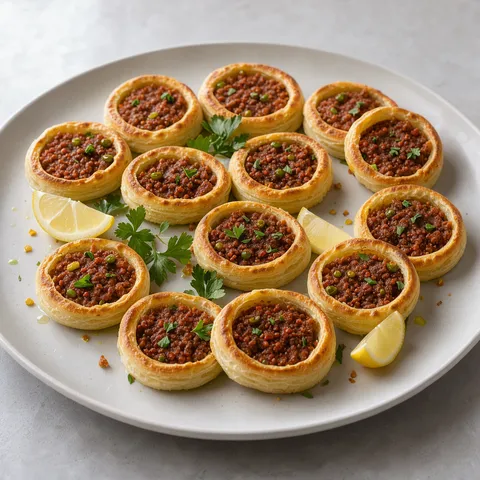 Open Mince Pastries1 hr 50 min · Bread & pastry
 Chilled Wheat Yoghurt Soup1 hr · Soup
 Noodle and Yoghurt Soup1 hr 10 min · Soup
 Lamb, Chickpea and Potato Stew1 hr 15 min · Soup
 Marinated Sea Bass30 min · Meze
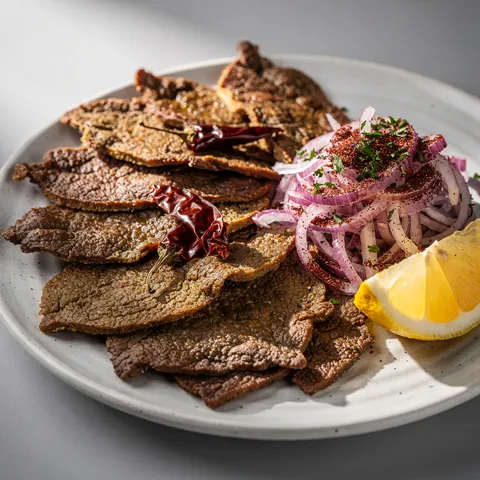 Crispy Fried Liver Slices25 min · Meze
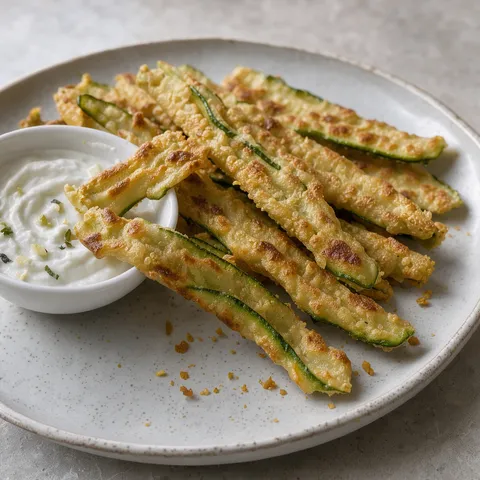 Courgette Crisps30 min · Meze