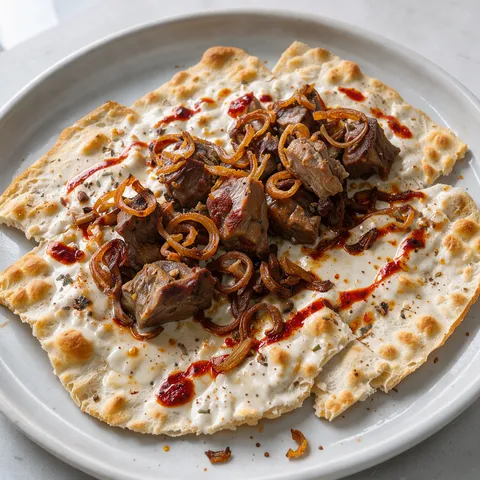
Lamb on Bread with Kurut Kelecos
A Turkish main course. Takes 1 hr 15 min (pressure cooker: ~50 min), Serves 4. Difficulty: challenging.
At a glance
- Total time
- 1 hr 15 min (pressure cooker: ~50 min)
- Serves
- Serves 4
- Difficulty
- Challenging
- Cuisine
- Turkish cuisine
- Dish type
- Main course
- Allergens
- Gluten, Milk
Ingredients
Kavurma
- 600 g fatty diced lamb (shoulder or breast)
- 40 g lamb tail fat or butter
- 1 tsp salt
- 1/2 tsp black pepper
Kurut
- 250 g kurut (dried strained yoghurt, about 2 balls)
- 600 ml lukewarm water
- 1 garlic clove (optional)
Bread
- 300 g day-old tandoor-baked flatbread or village lavash
Onions
- 3 onions (thinly sliced into half-moons)
- 60 g butter
To finish
- 30 g butter
- 1 tsp Aleppo pepper
- 1/2 tsp dried mint
Equipment
- Box grater
- Mixing bowls
- Heavy-based saucepan
- Frying pan
- Stick blender
- Saucepan
- Ladle
- Pestle and mortar (optional)
- Pressure cooker (optional)
Method
- Soak the kurut: Grate the kurut on the fine side of a grater or break it up in a mortar. Put it in a large bowl, pour over half the lukewarm water and leave for 30 min. Kurut is dried strained yoghurt: it softens and dissolves in lukewarm water, while in cold water it dissolves very slowly
- Cook the kavurma: While the kurut soaks, melt the tail fat in a heavy-based saucepan over medium heat and add the diced lamb. The meat first releases its juices: cover and cook in its own juices over low heat for 45 min. Uncover, turn the heat up to medium-high and fry for 10 min, until the liquid has evaporated completely and the meat browns in its own fat. Add the salt and pepper at this stage. In a pressure cooker the covered cooking drops to 20 min
- Fry the onions: While the kavurma cooks, melt the 60 g butter in a large frying pan, add the onions and fry over medium-low heat for 15-18 min, stirring now and then, until deep golden and sweet. The sweet depth of kelecos comes from these onions, so don't rush them and let them burn
- Make the kurut sauce: Blitz the soaked kurut with a stick blender for 1 min to a smooth liquid, then add the remaining lukewarm water and the crushed garlic if you like. Transfer to a saucepan and heat over low heat for 8-10 min, stirring constantly, until slightly thicker than ayran and thinly coating the back of a spoon. Kurut doesn't split, but it does sink to the bottom, so keep stirring. Check the salt: kurut is usually salty, so don't add any
- Prepare the bread: Tear the day-old bread into bite-sized pieces of about 3 cm. Don't cut it with a knife: the rough surfaces of torn bread absorb the kurut better. Spread evenly over a large, rimmed serving tray or dish
- Pour over the kurut: Ladle the hot kurut sauce evenly over the bread, so it is moistened all over. Leave for 3 min so the bread absorbs the sauce and softens without falling apart
- Add the kavurma: Toss the fried onions and the hot kavurma together and spread evenly over the bread
- Make the chilli butter: Melt the 30 g butter in a small pan until foaming, take off the heat, add the Aleppo pepper and dried mint and stir for 20 sec
- Plate: Drizzle the sizzling chilli butter over the tray, especially where the kurut shows. The red butter should make spots on the white kurut. Put the tray in the centre of the table and serve immediately, while hot: the bread gets too soft as it stands
Chef's note
Kelecos is a winter dish of Eastern Anatolia, Erzurum above all. In Erzincan it is made with yufka, and in Harput with cubed bread. Kurut is dried sheep's milk yoghurt and is traditionally bought ready-made: you'll find it at markets selling Eastern Anatolian produce. If you can't find kurut, loosen 400 g strained yoghurt with 200 ml water and use it with a pinch of salt: the taste will be less sour. Tandoor bread or lavash is a traditional bread bought from the bakery or grocer: to make it at home, see Lavash (Basics) and leave it to go stale for a day. If you have ready-made kavurma at home, skip the kavurma step and use it reheated.
Frequently asked questions
- Why is the kurut soaked in warm water?
- Kurut is dried strained yoghurt. It softens and loosens in warm water, but dissolves very slowly in cold water.
- Can the kurut sauce split?
- In this recipe the kurut does not split, but it settles to the bottom, so stir constantly over a low heat for 8-10 minutes. Kurut is usually salty, so taste before adding any salt.
- Why is the bread torn by hand for kelecos?
- Tear the stale bread by hand into bite-sized pieces. The rough surface of torn bread soaks up the kurut better.
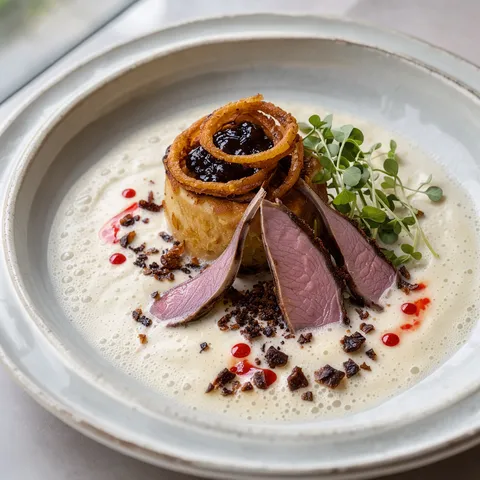 Lamb on Bread with Kurut 2.01 hr 25 min · Main course
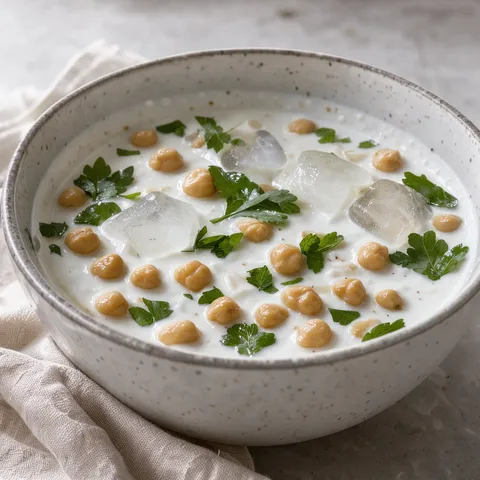 Chilled Wheat Yoghurt Soup1 hr · Soup
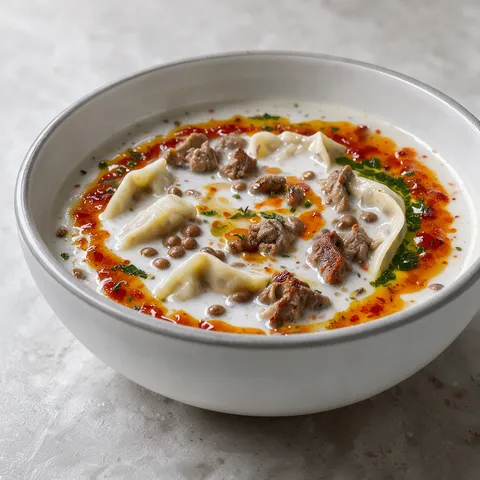 Noodle and Yoghurt Soup1 hr 10 min · Soup
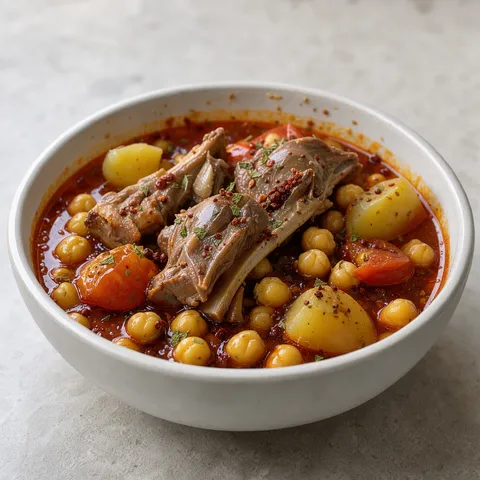 Lamb, Chickpea and Potato Stew1 hr 15 min · Soup
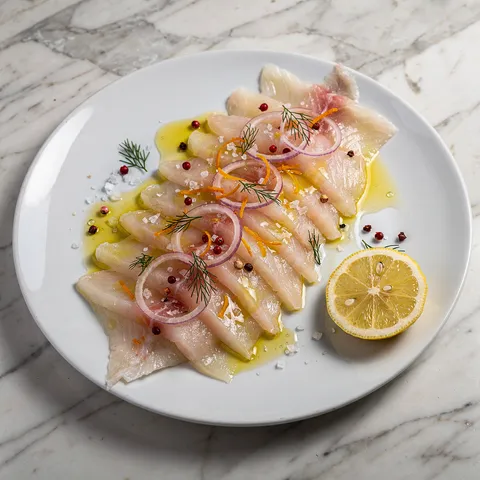 Marinated Sea Bass30 min · Meze
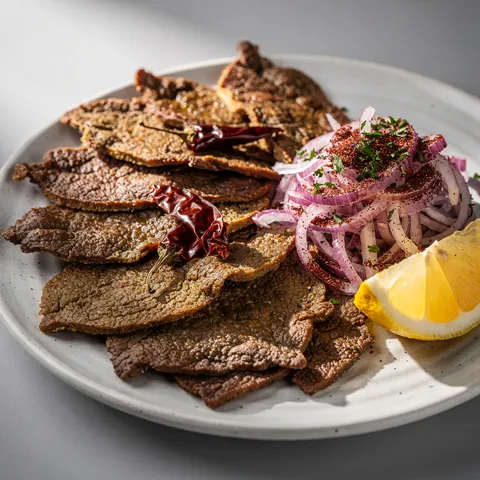 Crispy Fried Liver Slices25 min · Meze
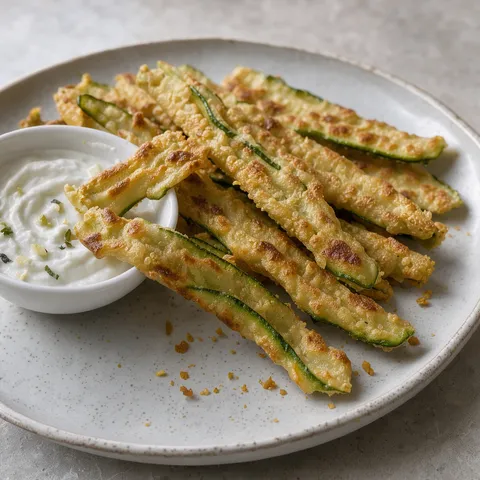 Courgette Crisps30 min · Meze