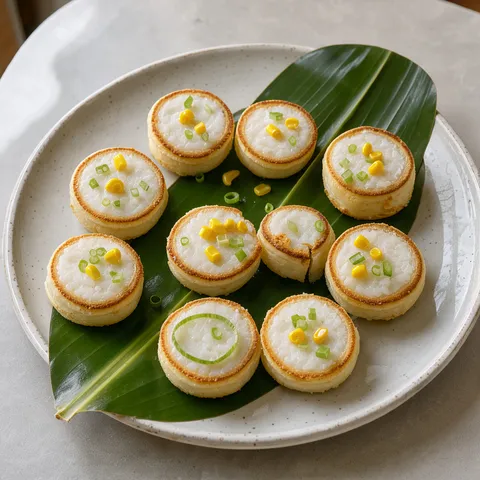
Thai Coconut Rice Cakes Khanom Krok
A Thai dessert. Takes 50 min (makes 24), 24 pieces (4 servings). Difficulty: medium.
At a glance
- Total time
- 50 min (makes 24)
- Serves
- 24 pieces (4 servings)
- Difficulty
- Medium
- Cuisine
- Thai cuisine
- Dish type
- Dessert
- Diet
- Gluten-free
- Allergens
- Milk, Tree nuts
Ingredients
Base batter
- 150 g rice flour
- 50 g cooked white rice (about 20 g raw rice, cooked and cooled)
- 200 ml unsweetened coconut milk
- 150 ml water
- 30 g sugar
- 1/4 tsp salt
Coconut topping
- 250 ml coconut cream (the thick part of the milk)
- 2 tbsp rice flour
- 1 tbsp tapioca starch or cornflour
- 50 g sugar
- 1/2 tsp salt
To top
- 3 spring onions (very thinly sliced)
- 60 g cooked sweetcorn kernels (from a fresh cob)
For the pan
- 2 tbsp neutral oil
Equipment
- Blender
- Mixing bowls
- Balloon whisk
- Pastry brush (optional)
Method
- Blend the base batter: Blend the cooked rice, rice flour, coconut milk, water, sugar and salt for 2 min, until completely smooth. The cooked rice gives a soft, slightly sticky centre: khanom krok made with flour alone is dry. Rest for 15 min
- Mix the topping: Whisk the coconut cream with the rice flour, starch, sugar and salt in a bowl until smooth. This layer should be saltier and creamier than the base: the taste of khanom krok is all about the sweet-salty pairing
- Heat the pan: Heat the khanom krok pan (or an aebleskiver pan with hemispherical hollows) over medium heat for 3-4 min. Oil each hollow with kitchen paper. If the pan is not hot enough the batter sticks: a drop of batter should sizzle and set at the edge straight away
- Pour in the base: Stir the base batter and fill each hollow two-thirds full. Cover and cook for 2 min, until the edges puff slightly and start to crisp
- Add the topping: Add a dessertspoon of the topping to each hollow and immediately scatter with a little spring onion or sweetcorn. Cover and cook for another 4-5 min. The centre should still be slightly wobbly, the edges deep golden and crisp
- Remove: Lift each one out by its edge with a small spoon or teaspoon. Oil the pan again and move on to the next batch. All 24 take about 3 batches
- Pair up: They are traditionally served with two halves pressed together. Join the cooked halves in pairs along their flat sides to make small balls
- Plate: Arrange the hot khanom krok in small groups on a banana leaf or a plate, leaving some halves open so the creamy tops and spring onion show. Serve at once: they lose their crispness as they cool
Chef's note
A khanom krok pan is a cast-iron pan with hollows; an aebleskiver pan or a Japanese takoyaki pan does the same job. Unsweetened coconut milk is traditionally bought ready-made, but pressed from freshly grated coconut it is even better. In Thailand it is sold from street stalls in the morning, and a portion is about 6 pieces.
Frequently asked questions
- Why is cooked rice added to the batter?
- Cooked rice gives the batter a soft, slightly sticky centre. Khanom krok made with flour alone turn out dry.
- What should I do if the khanom krok stick to the mould?
- The mould must be hot enough and every hollow greased. If a drop of batter sizzles and forms a crust at the edge straight away, the mould is ready.
- What can I use if I don't have a khanom krok mould?
- An aebleskiver pan with half-sphere hollows does the same job. Join the cooked half-spheres in pairs by their flat faces.
 Pad Thai40 min · Main course
 Hot and Sour Prawn Soup35 min · Soup
 Thai Coconut Chicken Soup35 min · Soup
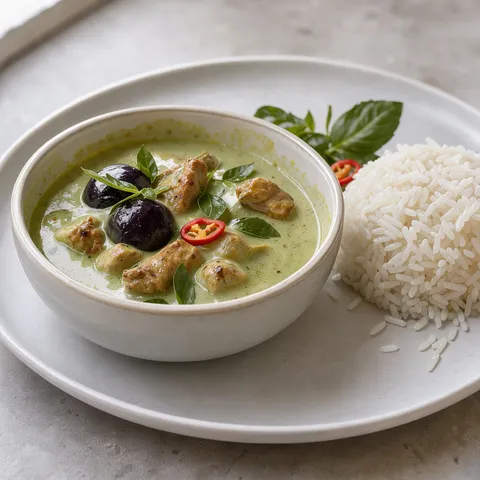 Green Curry40 min · Main course
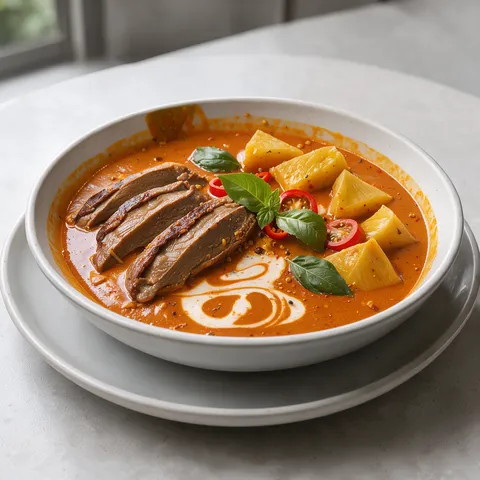 Red Curry with Duck and Pineapple40 min · Main course
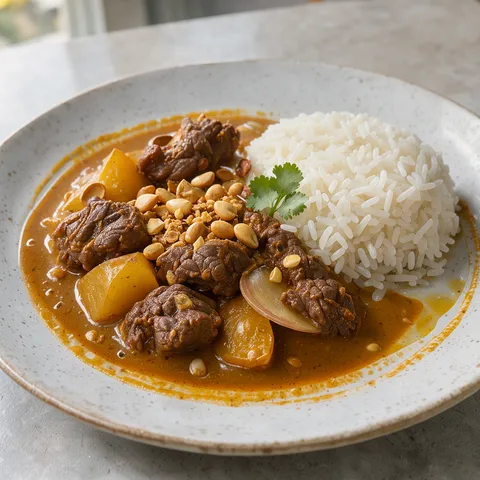 Massaman Curry1 hr 15 min · Main course