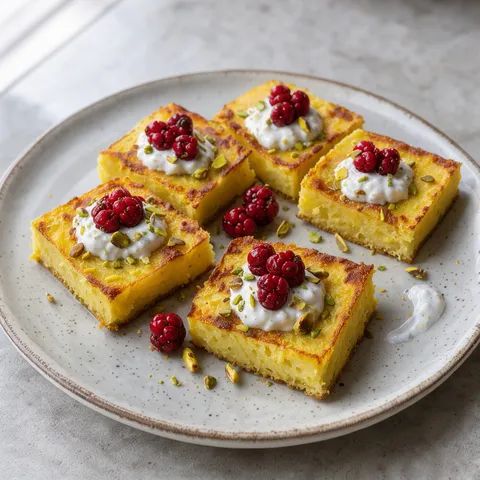
Iranian Potato Squares 5×5 cm Kuku Sibzamini
An Iranian meze. Takes 1 hr 21 min, 24 squares. Difficulty: medium.
At a glance
- Total time
- 1 hr 21 min
- Serves
- 24 squares
- Difficulty
- Medium
- Cuisine
- Iranian cuisine
- Dish type
- Meze
- Diet
- Vegetarian
- Allergens
- Gluten, Milk, Eggs
Ingredients
- Kuku (1.8 cm thick in a 20×30 cm tin, 24 squares of 5×5 cm, about 44 g each, about 1050 g in total): 700 g potatoes (about 580 g once coarsely grated and squeezed)
- 100 g onion (about 80 g once grated and squeezed)
- 6 eggs (about 300 g)
- 30 g plain flour
- 1/2 tsp baking powder
- 30 g melted butter
- 1 tsp turmeric
- 1/4 tsp saffron (steeped in 2 tbsp hot water)
- 1.5 tsp salt
- 1/2 tsp black pepper
- 1 tbsp butter for greasing the tin
Garnish
- 15 g zereshk (dried barberries, washed)
- 1 tbsp butter
- 1 tsp sugar
- 15 g raw pistachios (thinly sliced)
To serve
- Garlic Yoghurt (24 × 6 g, about 145 g, Basics)
Equipment
- Box grater
- Mixing bowls
- Balloon whisk
- Baking tray
- Baking paper
- Oven
- Sauté pan
- Chef's knife
- Probe thermometer (optional)
Method
- Grate and squeeze the potato: Peel the potatoes and coarsely grate, then at once squeeze them thoroughly in a thin clean cloth with your hands and discard the liquid. Grated potato turns dark on contact with air and gives up its water, so this step and the next are done quickly. Finely grate the onion too and squeeze out the juice (~12 min)
- Steep the saffron: Crush the saffron between your fingertips rather than in a mortar and steep in 2 tbsp hot water for 10 min. Steeped saffron gives its colour and aroma to the water, while dry threads do not give an even colour. Preheat the oven to 180°C. Do this while the potato is being grated
- Prepare the mixture: Whisk the eggs in a bowl with a whisk for 1 min until frothy and add the flour, baking powder, salt, black pepper, turmeric and saffron. Add the grated potato, onion and melted butter and mix. The mixture should be thick but run from a spoon, and if the potato is not mixed with the egg immediately, it darkens (~8 min)
- Fill the tin: Grease the 20×30 cm tin with butter and line with baking paper, pour in the mixture and spread it flat to 1.8 cm thick with a spatula, pressing into the corners. Uneven thickness burns the edge while leaving the middle raw (~6 min)
- Bake: Bake on the middle shelf at 180°C for 35 min, until the surface is deep golden and the edges pull away from the baking paper. A knife pushed into the middle should come out clean, and the internal temperature measured with a thermometer should reach 82°C. At low heat the kuku stays spongy, and at high heat the top burns. While it bakes, wash and drain the zereshk, sauté them in a sauté pan with the butter and sugar for 1 min to a shine, and slice the pistachios thinly (~35 min)
- Rest and cut: Rest the tin for 10 min so the structure sets, as hot kuku falls apart when cut. Cut 24 squares of 5×5 cm, 4 columns by 6 rows, with a heated, wet knife, wiping the knife after each cut. The cut surface should be smooth and the edges golden (~15 min)
- Plate: Place 2 squares side by side on a flat ceramic plate, put 6 g of Garlic Yoghurt on top of each with a spoon and garnish with the zereshk and pistachio slices. The flavour is balanced if the kuku is hot or warm and the yoghurt cold (~5 min)
Chef's note
Serve hot or warm. Allow 2 squares per person, 120 people × 2 = 240 squares. As the recipe makes 24 squares, the multiplier is 240/24 = 10, or 10.5 with 5% allowed for waste (7.35 kg potatoes, 1.05 kg onion, 63 eggs, 320 g butter for the kuku, 160 g zereshk, 1.53 kg garlic yoghurt). The kuku is baked 1 day ahead and stored in the tin covered with cling film in the fridge, with cutting and reheating on the day of serving (8 min in a 150°C oven). Oven capacity: 24 squares per 20×30 cm tin, 2 tins bake in one round in a 2-shelf oven, so 10.5 times needs 11 tins, that is 6 rounds (about 3.5 hr), which is why it is wise to bake in advance. Original kuku sibzamini is generally a flat potato omelette fried in a pan, and here it is baked in a tin and cut into squares. It differs from Kuku Sabzi (Persian Herb Frittata) in having potato and saffron. The internal temperature of the egg must not fall below 74°C, and this limit also applies when reheating pre-cooked squares in a 150°C oven
Frequently asked questions
- Why does grated potato darken and how do I prevent it?
- Grated potato darkens on contact with air and releases water. Grate it, squeeze it in a cloth straight away and mix it with the eggs immediately.
- Why does kuku fall apart if cut while hot?
- Hot kuku crumbles when cut. Rest the tin for 10 minutes so it firms up, then cut with a warmed, wet knife.
- How do I know the kuku is cooked?
- The surface should be deep golden, the edges should pull away from the baking paper and a knife inserted in the centre should come out clean. The internal temperature should reach 82°C.
 Iranian Spinach and Egg Skillet27 min · Main course
 Iranian Lentil and Date Rice1 hr 43 min · Main course
 Adas Polo 2.01 hr 17 min · Main course
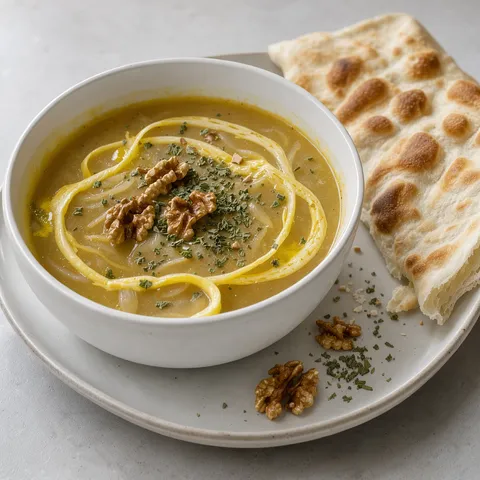 Iranian Onion and Fenugreek Soup27 min · Soup
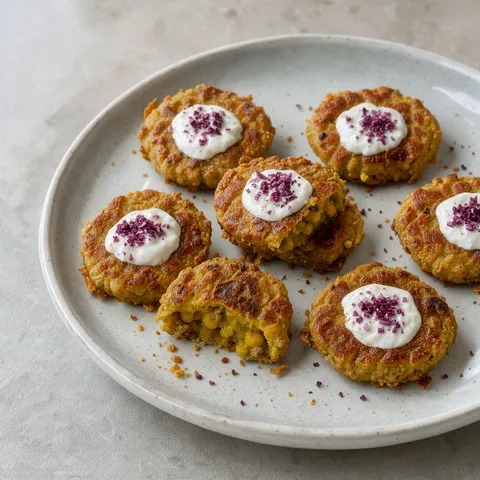 Gilan Chickpea and Beef Patties1 hr 32 min · Meze
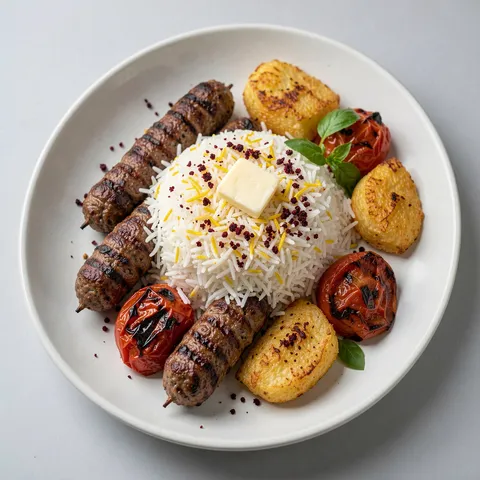 Koobideh Kebabs with Saffron Rice1 hr 30 min · Main course