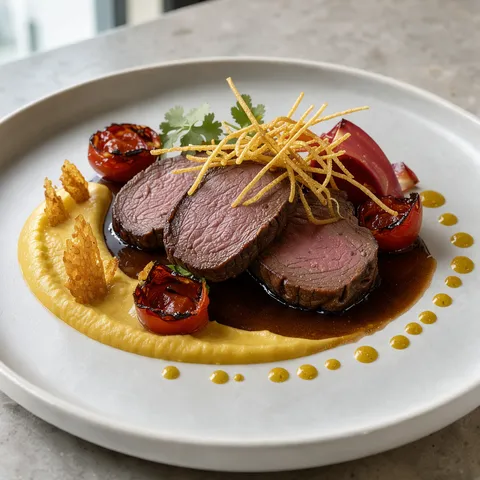
Lomo Saltado 2.0
A Peruvian main course. Takes 1 hr 30 min, Serves 4. Difficulty: professional.
At a glance
- Total time
- 1 hr 30 min
- Serves
- Serves 4
- Difficulty
- Professional
- Cuisine
- Peruvian cuisine
- Dish type
- Main course
- Allergens
- Gluten, Milk, Eggs, Soya, Celery, Mustard, Sulphites
Ingredients
Meat
- 600 g beef fillet in one piece (centre-cut, tied)
- 6 g salt
- 1/2 tsp black pepper
- 1 tbsp high-heat oil
- 20 g butter
Saltado jus
- 300 ml Brown Beef Stock (Basics)
- 2 tbsp soy sauce
- 1 tbsp red wine vinegar
- 1 tsp ají amarillo paste (if unavailable, homemade paste from yellow peppers; see the Lomo Saltado chef's note)
- 1/2 red onion (thick slices)
- 1 garlic clove
- 10 g cold butter
Ají amarillo mash
- 400 g floury yellow potatoes
- 80 ml milk
- 30 g butter
- 1 tbsp ají amarillo paste
- salt
Potato threads
- 2 large potatoes
- 1 litre oil for deep-frying
- salt
Crispy rice
- 80 g rice
- 3 tbsp sunflower oil
- salt
Ají amarillo emulsion
- 2 tbsp ají amarillo paste
- 1 pasteurised egg yolk
- 1 tsp lime juice
- 100 ml neutral oil
- salt
Charred onion petals
- 2 small red onions
- 60 ml red wine vinegar
- 1 tsp sugar
- 1/2 tsp salt
Tomatoes
- 12 cherry tomatoes
- 1 tsp olive oil
- flaky salt
To finish
- coriander shoots
Serves
- 4
Equipment
- Oven
- Saucepan
- Cast-iron frying pan
- Frying pan
- Baking paper
- Balloon whisk
- Squeezy bottle
- Mandoline
- Probe thermometer
- Colander
- Potato ricer
- Wooden spoon / spatula
- Fine sieve / chinois
- Chef's knife
Method
- Plan the workflow: Heat the oven to 200°C. First put the rice and the potatoes for the mash on to boil, leave the jus to reduce on the hob and char the onions. While these cook, prepare the emulsion and the potato threads. The last 25 min are for the meat, the crispy rice and plating
- Boil the rice: Boil the rice in plenty of boiling salted water for 15 min, until the grains are very soft and have released their starch. Drain, spread on baking paper and leave for 10 min to let the steam and moisture escape
- Boil the potatoes for the mash: Peel the potatoes, cut into large cubes and boil in cold salted water for 18-20 min, until a knife slides in without resistance. Drain and dry in the pan for 1 min
- Reduce the jus: Char the thick onion slices and the garlic in a pan over high heat for 3-4 min, until the edges burn. Pour in the vinegar and soy and let it sizzle. Add the stock and ají paste and reduce over medium heat for 15-20 min, until reduced by half and it coats a spoon in a thin film. Strain. The smoky flavour that a wok creates in seconds becomes a concentrated jus here
- Char the onion petals: Halve the onions in their skins. Char the cut sides in a dry cast-iron pan for 6-8 min without moving, until jet black. Cool slightly, discard the skins and separate the layers into individual petals. Warm the vinegar, sugar and salt to dissolve, pour over the petals and leave for 20 min. The petals stay smoky outside and sour inside
- Make the emulsion: Whisk the ají paste, egg yolk, lime juice and salt in a bowl. Add the oil first drop by drop, then in a thin stream, to build a mayonnaise-consistency emulsion. Transfer to a squeeze bottle
- Fry the potato threads: Peel the potatoes and cut into matchstick-thin threads 2 mm thick on a mandoline. Rinse twice in cold water to remove the starch and dry thoroughly with a cloth. Heat the oil to 170°C and fry the threads in batches for 2-3 min, until light golden and crisp. Drain on kitchen paper and season with salt. The fries of the classic become a straw-fine crispness here
- Finish the mash: Pass the potatoes through a ricer. Warm the milk and butter, add them to the potato with the ají paste and stir with a wooden spoon until glossy and silky, then season with salt. Press through a fine sieve and keep warm, covered
- Cook the meat: Dry the fillet and rub with the salt and pepper. Heat a cast-iron pan over high heat until smoking, add the oil and sear the meat for 4-5 min in total, 1 min on each side. Transfer the pan to the 200°C oven and cook for 8-10 min, until the internal temperature reaches 52-54°C. Return the pan to the hob, add the butter and spoon the foaming butter over the meat for 1 min. Rest for 8 min. The internal temperature rises to 56°C and the meat stays pink
- Make the crispy rice: While the meat rests, press the rice with 3 tbsp oil into a non-stick pan as a thin disc 5 mm thick. Cook over medium-high heat for 6-7 min without moving, until the underside is golden and crisp, turn and cook for 3 min more. Drain on kitchen paper, season with salt and break into irregular pieces. The rice of the classic reaches the plate as this crisp texture
- Blister the tomatoes: Turn the cherry tomatoes in the same pan with the olive oil over high heat for 2-3 min, until the skins split and are charred in places, and sprinkle with flaky salt
- Slice: Remove the string and cut the meat with a sharp knife into 8 slices 2 cm thick. Sprinkle flaky salt on the cut faces. Reheat the jus and whisk in the cold butter for shine
- Plate: Put a spoonful of the ají amarillo mash on one side of a warmed flat plate and drag it with the back of the spoon in one movement to make a yellow teardrop. Beside the mash, put two slices of fillet, slightly overlapping. Around the meat, stand three tomatoes and three charred onion petals like bowls, and pipe a drop of emulsion into one. Add five or six more dots of the ají amarillo emulsion on the plate
- Finish: Spoon the glossy jus over and beside the meat, so a dark glossy pool forms. Set a pinch of potato threads on the meat, stand the pieces of crispy rice upright in the mash and scatter over the coriander shoots. Serve immediately. The crisp elements begin to soften the moment they touch the jus
Chef's note
The spirit of the classic is kept: beef, the chifa flavour of soy and vinegar, ají amarillo, red onion, tomato, potato and rice. Each component is moved to a different technique: the smoky sauce of the wok is concentrated into a jus, the onion is charred and turned into a pickled petal, the potato is both a silky ají amarillo mash and straw-fine crisp threads, and the rice becomes a crispy rice crust in the pan. The only element not in the classic is the ají amarillo emulsion, which turns the fruity taste of the chilli into a cool bridge between the hot jus and the soft meat. If you cannot find a pasteurised egg, make the emulsion without egg: blend the ají paste with 2 tbsp milk and the lime juice, then bind it by pouring in the oil in a thin stream.
Frequently asked questions
- How do I cook the fillet so it stays pink?
- Sear each side of the meat in a pan first, then put it in the oven with the pan and cook until the internal temperature is 52-54°C. It rises to 56°C while resting and stays pink.
- What should I do if I can't find ají amarillo paste?
- The recipe suggests a homemade paste made from yellow peppers. The paste is used in the purée, the emulsion and the jus.
- Why are the potato strands rinsed?
- Rinse the strands cut on a mandoline twice in cold water to wash off the starch and dry them thoroughly with a cloth. Dry strands turn crisp when fried.
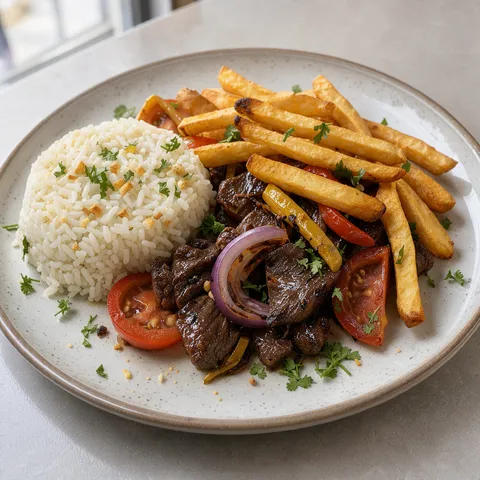 Peruvian Beef Stir-Fry1 hr · Main course
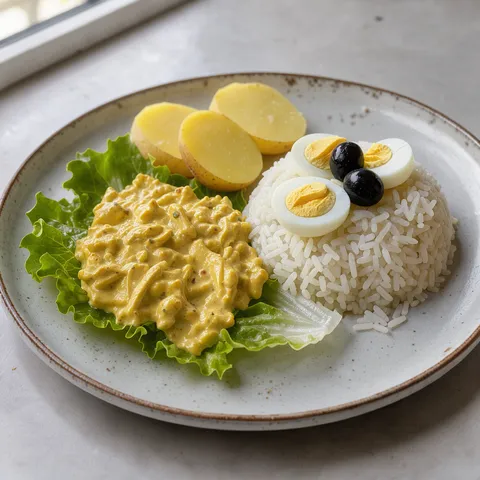 Peruvian Creamy Chicken Stew1 hr 45 min · Main course
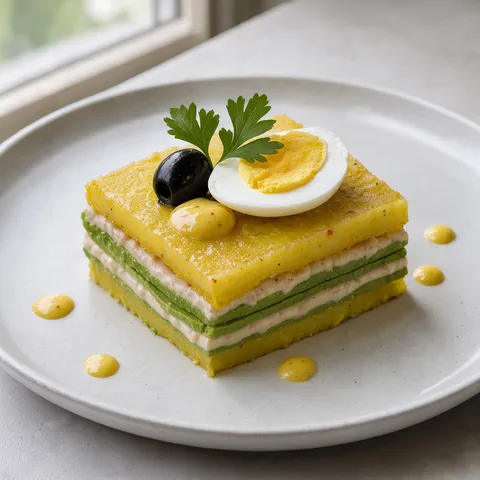 Peruvian Chicken and Potato Terrine1 hr 15 min · Starter
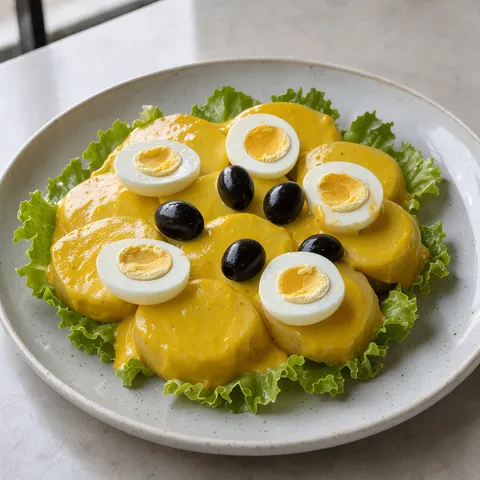 Potatoes in Yellow Cheese Sauce40 min · Meze
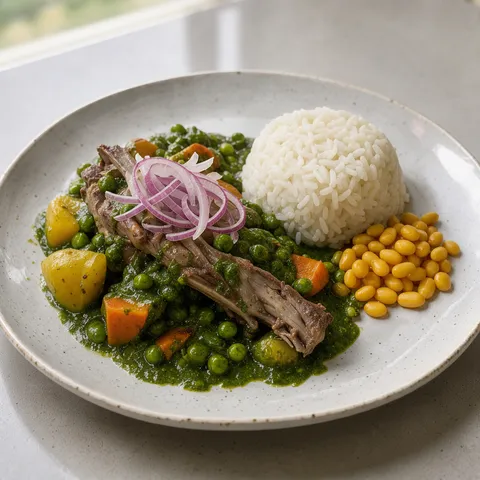 Peruvian Coriander Lamb Stew2 hr 45 min · Main course
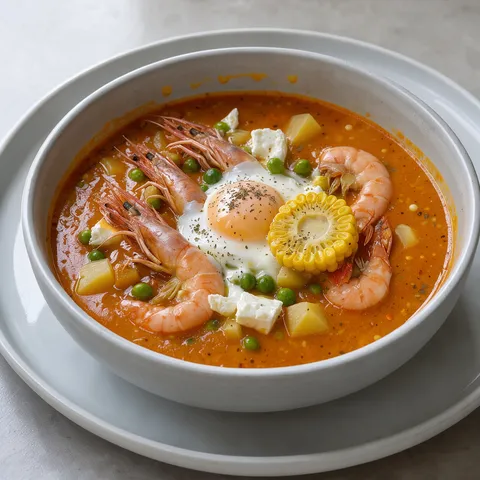 Peruvian Prawn Chowder1 hr 30 min · Soup
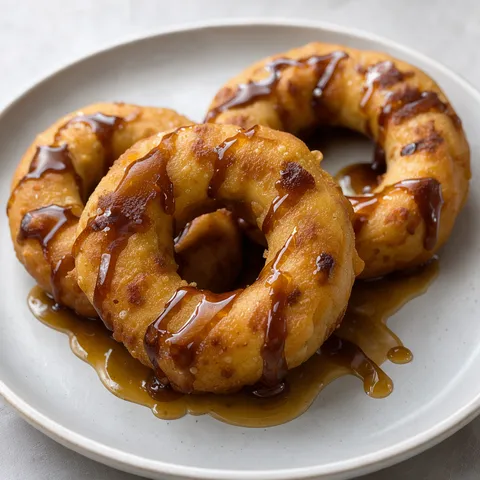 Peruvian Pumpkin Doughnut Rings1 hr 30 min · Dessert