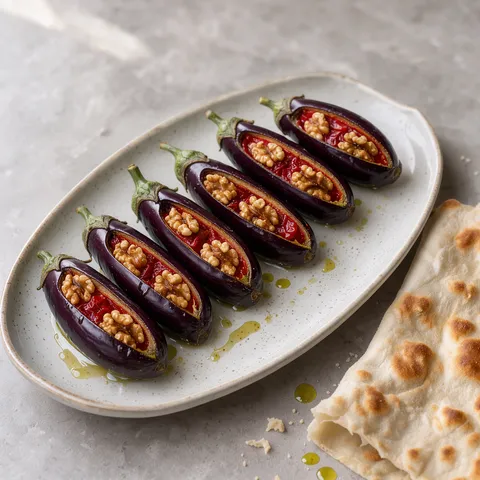
Aubergines Stuffed with Walnuts and Peppers Makdous
A Syrian meze. Takes 1 hr 15 min · +2.5 days draining · +7 days maturing, about 18-20 pieces. Difficulty: medium.
At a glance
- Total time
- 1 hr 15 min · +2.5 days draining · +7 days maturing
- Serves
- about 18-20 pieces
- Difficulty
- Medium
- Cuisine
- Syrian cuisine
- Dish type
- Meze
- Allergens
- Gluten, Milk, Tree nuts
Ingredients
Aubergines
- 1 kg very small
- thin-skinned aubergines (6-8 cm, about 18-20)
- 2 tbsp coarse salt
- 2 litres water (for boiling)
- 1 tbsp salt (for the cooking water)
Filling
- 250 g red chillies (or half of them romano peppers)
- 150 g walnuts (coarsely broken)
- 6 garlic cloves (finely chopped)
- 3 tbsp cider vinegar of at least 5% acidity (for the garlic)
- 1 tbsp cider vinegar (for the filling)
- 1 tsp salt
Storage
- about 500 ml olive oil
- 1 sterilised 1-litre glass jar
To serve
- Lavash (Basics). Makes about 18-20
Equipment
- Saucepan
- Colander
- Baking tray
- Muslin
- Food processor
- Mixing bowls
Method
- Prepare the aubergines: Pull off the green calyxes and trim the stalks to 1 cm. The aubergines should be small and even in size, as large ones don't hold the filling
- Acidify the garlic: Put the chopped garlic in a small glass container and cover it completely with the 3 tbsp vinegar. Close the lid and refrigerate for at least 24 hr. Raw garlic kept airless in oil is the riskiest ingredient for botulism, and soaking it in vinegar acidifies it. Don't skip this step: the garlic spends this time in the fridge while the aubergines drain
- Boil: Bring 2 litres of water to the boil with the salt. Add the aubergines and boil for 8-12 min, until a thin skewer goes in easily. If they fall apart, they are overcooked
- Drain and cool: Transfer the aubergines to a colander and leave to cool completely
- Make a pocket: Cut a slit lengthways in each aubergine, without going right to the ends, to make a pocket. Sprinkle a pinch of coarse salt inside
- Press out the liquid: Arrange the aubergines slit side down on a sloping tray. Put a plate and a weight on top and leave in the fridge for 24-48 hr to release their liquid. If the liquid doesn't fully come out, it foams in the oil and the preserve spoils
- Prepare the peppers: Deseed the peppers and pulse them in a food processor to the texture of coarse mince. Mix with the salt and leave to drain in muslin for 6 hr. A watery filling also makes the oil foam and spoils the preserve
- Mix the filling: Drain the garlic from its vinegar. Mix the drained peppers, walnuts, garlic and the 1 tbsp vinegar
- Stuff: Put 1-2 tsp of filling into the pocket of each aubergine and close it slightly. The filling should show through the slit
- Pack into the jar: Pack the aubergines tightly into the sterilised jar. Turn the jar upside down, open, onto a plate and leave in the fridge for 12 hr to drain off any remaining liquid
- Seal with oil: Turn the jar upright and fill with olive oil to 2 cm above the aubergines. Release any air bubbles with a clean skewer and close the lid
- Mature: Leave the jar to mature in the fridge, at 4°C or below, for at least 7 days. The jar is never left at room temperature: take out only as many as you need for serving. Use a clean, dry spoon every time you take some from the jar, and keep the aubergines covered by oil at all times
- Plate: Arrange 5-6 makdous side by side on a small oval plate, slits facing up so the red pepper and walnut filling shows. Drizzle with olive oil from the jar and serve with Lavash (Basics)
Chef's note
Makdous is a staple of the Syrian breakfast and meze table, traditionally jarred at the end of summer for the winter. In this recipe storage is entirely in the fridge (4°C or below), and the jar never stands at room temperature. Garlic and vegetables kept airless in oil carry a risk of botulism, which is why the garlic was acidified in vinegar and vinegar was added to the filling. The aubergine itself is not acidified: the real protection is keeping the jar at 4°C at all times and the 4-week limit. Eat the contents of the jar within 4 weeks at most, including maturing. Olive oil turns cloudy and thickens in the fridge. This is normal, and it clears in a few minutes at room temperature. If you see foam, rising bubbles or a bulging lid, or smell sourness or mould, discard the jar immediately. Botulinum toxin can be present without any smell, foam or bulging lid, so these signs are not the only test: do not exceed the time limit. In Hatay a similar preserve is made under the name makdus.
Frequently asked questions
- How is makdous stored?
- Keep the jar in the fridge at 4°C or below and never leave it at room temperature. Use a clean, dry spoon, and the aubergines should always stay under the oil.
- Why is the garlic soaked in vinegar beforehand?
- Raw garlic sealed in oil without air is the riskiest ingredient for botulism. Soaking it in vinegar acidifies it, so this step must not be skipped.
- What does it mean if bubbles appear in the oil?
- The liquid hasn't fully come out of the aubergines. If it isn't fully drawn out, bubbles form in the oil and the product spoils. The filling must not be wet either.
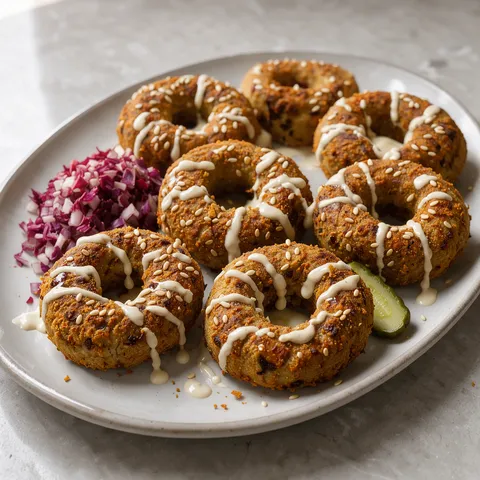 Syrian Falafel Rings with Tahini and Sumac Onions49 min · Meze
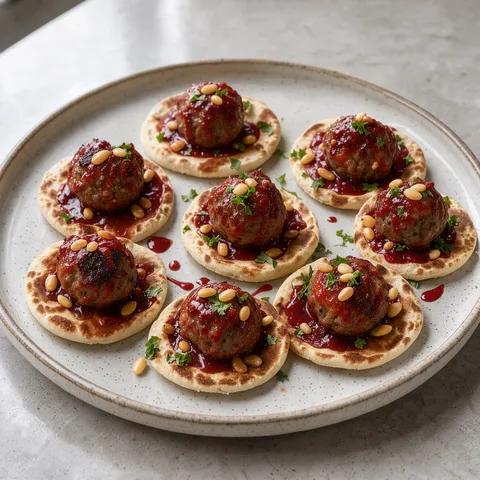 Aleppo Sour Cherry Lamb Kofte1 hr · Meze
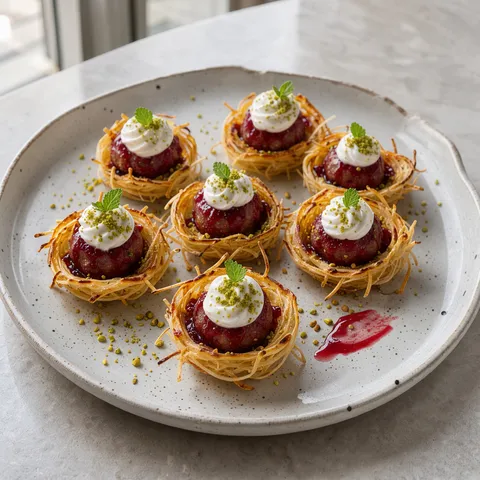 Kebab Karaz 2.01 hr 18 min · Meze
 Damascus-Style Chickpea Fatteh1 hr 50 min · Starter
 Damascus-Style Lamb in Yoghurt Sauce2 hr 15 min · Main course
 Lentils with Tamarind and Dough Squares1 hr 30 min · Main course