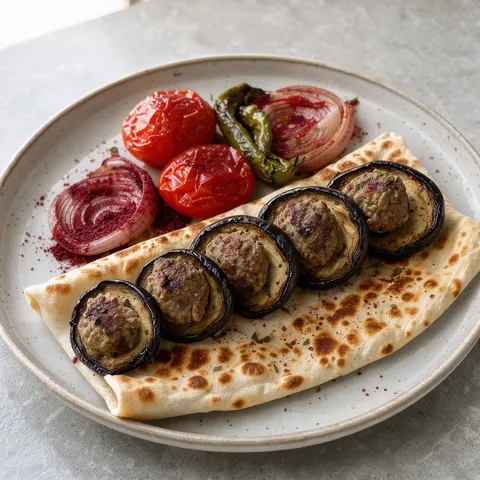
Aubergine and Kofte Skewers Patlican Kebabi
A Turkish main course. Takes 1 hr 25 min, Serves 4. Difficulty: medium.
At a glance
- Total time
- 1 hr 25 min
- Serves
- Serves 4
- Difficulty
- Medium
- Cuisine
- Turkish cuisine
- Dish type
- Main course
- Allergens
- Gluten, Milk
Ingredients
Aubergines
- 4 medium bostan aubergines (plump round aubergines, about 900 g)
- 1.5 litres water and 1 tbsp salt for soaking
Kofte
- 500 g medium-fat mixed lamb and beef mince
- 1 small onion (about 70 g, grated and squeezed of its juice)
- 1 tsp salt
- 1/2 tsp black pepper
- 1 tsp Aleppo pepper
Charred vegetables
- 4 medium tomatoes
- 6 long green peppers (long green)
To serve
- 2 lavash from Lavash (Basics) or fresh from the bakery
- 1/2 bunch flat-leaf parsley
- 1 red onion
- 1 tsp sumac
Equipment
- Chef's knife
- Chopping board
- Mixing bowls
- Box grater
- Griddle pan
- Charcoal barbecue (optional)
- Probe thermometer (optional)
Method
- Cut the aubergines: Wash the aubergines, cut off the stalks and slice into 3 cm thick rounds, skin on. The skin holds the aubergine on the skewer, while peeled aubergine falls off as it cooks
- Draw out the bitterness: Drop the slices into the 1.5 litres of salted water, weigh them down with a plate and leave for 15 min. The salted water draws out the bitterness and stops the slices releasing too much oil and water on the griddle. Then drain and pat dry thoroughly with kitchen paper
- Knead the kofte: While the aubergines soak, knead the mince with the grated onion, salt, black pepper and Aleppo pepper for 5 min. Divide it into as many pieces as there are aubergine slices, about 20, and with wet hands shape into flat patties slightly smaller than the slices, about 5-6 cm across and 1 cm thick
- Thread onto skewers: Thread alternate aubergine slices and kofte onto long metal skewers, pressing them tightly together without gaps. The fat from the kofte seeps into the aubergine, and the aubergine keeps the kofte from drying out. You should have 4-5 skewers
- Heat the griddle and char: Heat a griddle pan or the barbecue over high heat for 5 min. Char the tomatoes and peppers for 8-10 min, turning now and then, until the skins blacken and they soften, then transfer to a plate
- Cook the skewers: Put the skewers on the griddle over medium-high heat and cook for 15-18 min, turning every 3 min. The aubergine skin should blacken and the flesh turn creamy, the kofte should be deep brown and their internal temperature must exceed 71°C. A knife tip should slide into the aubergine without any resistance. On a griddle pan, cook in two batches
- Prepare the onion: Thinly slice the red onion into half-moons and mix with the sumac and chopped parsley
- Warm the lavash: Warm the lavash on the griddle for 10 sec on each side and fold into quarters
- Plate: Put a folded lavash on each plate. Slide the aubergine and kofte off one skewer onto the lavash, in the order they were threaded. Add charred tomatoes and peppers and the sumac onions alongside and serve hot. The aubergine flesh is crushed into the lavash as you eat
Chef's note
Patlican kebab is one of Malatya's best-known dishes, recognised in the region for its unpeeled aubergine threaded onto skewers with kofte and cooked over embers. Similar aubergine kebabs are made in Gaziantep and Sanliurfa. Large long dark kemer aubergines can be used instead of bostan aubergines. If you have no flat skewers, ordinary metal skewers will do. Lavash is traditionally bought fresh from the bakery; to make it at home, see Lavash (Basics). Unlike the tray-baked aubergine kebab, here the unpeeled aubergine is chargrilled on skewers together with the kofte.
Frequently asked questions
- Why aren't the aubergines peeled for Patlican Kebabi?
- The skin holds the aubergine on the skewer. Peeled aubergine falls off as it cooks.
- Why are the aubergines soaked in salted water?
- Leave the slices in 1.5 litres of salted water for 15 minutes. The salt water draws out the bitterness and stops them releasing too much oil and water on the grill.
- Why are the kofte threaded next to the aubergine?
- The fat from the kofte runs into the aubergine, and the aubergine keeps the kofte from drying out.
 Chilled Wheat Yoghurt Soup1 hr · Soup
 Noodle and Yoghurt Soup1 hr 10 min · Soup
 Lamb, Chickpea and Potato Stew1 hr 15 min · Soup
 Marinated Sea Bass30 min · Meze
 Crispy Fried Liver Slices25 min · Meze
 Courgette Crisps30 min · Meze