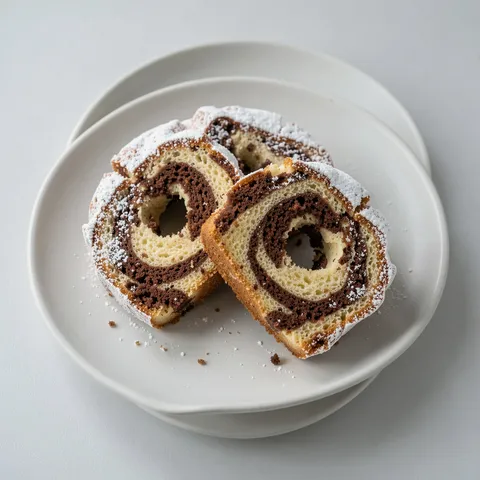
German Marble Cake Marmorkuchen
A German patisserie. Takes 1 hr 26 min · +30 min cooling, 22 cm gugelhupf tin, 12 slices. Difficulty: medium.
At a glance
- Total time
- 1 hr 26 min · +30 min cooling
- Serves
- 22 cm gugelhupf tin, 12 slices
- Difficulty
- Medium
- Cuisine
- German cuisine
- Dish type
- Patisserie
- Diet
- Vegetarian
- Allergens
- Gluten, Milk, Eggs
Ingredients
Batter
- 250 g room-temperature butter
- 200 g caster sugar
- 4 eggs (room temperature)
- 300 g plain flour
- 8 g baking powder
- 100 ml milk
- 1 tsp vanilla extract
- a pinch of salt
Cocoa part
- 30 g cocoa powder
- 3 tbsp milk
- 1 tbsp sugar
Tin
- 22 cm gugelhupf tin or 25 cm loaf tin
Greasing
- 1 tbsp butter
- 2 tbsp plain flour
To serve
- icing sugar. 12 slices
Equipment
- Cake tin
- Mixing bowls
- Silicone spatula
- Oven
- Balloon whisk
Method
- Prepare the tin: Brush the tin with melted butter, coat with flour and tap out the excess. Preheat the oven to 175°C. Greasing every groove makes the cake come out easily. (~5 min)
- Cream the butter and sugar: Beat the butter and sugar with a whisk for 4-5 min, until paler and doubled in volume. This stage puts air into the cake, and if rushed, the cake turns heavy. (~5 min)
- Add the eggs: Add the eggs one at a time, beating until each is fully mixed in. If the mixture curdles (separates), add 1 tbsp flour and beat. Fold in the vanilla and salt. (~5 min)
- Fold in the flour and milk: Sift the flour and baking powder and fold in 3 additions with a spatula, alternating with the milk. The mixture should be thick but drop from the spoon, as overmixing makes the cake tough. (~4 min)
- Divide the batter: Set aside about a third of the batter and whisk in the cocoa, milk and sugar to make the cocoa part. If it is too thick, add 1 tbsp more milk. (~3 min)
- Make the marble pattern: Put half the vanilla batter into the tin, then the cocoa batter, and the remaining vanilla batter on top. Dip a fork into the batter and draw a spiral twice around the tin. If you mix too much, the pattern is lost. (~4 min)
- Bake: Bake on the bottom shelf of the 175°C oven for 55-60 min, until a skewer pushed into the middle comes out clean and the cake pulls away from the sides. If the top browns too much, cover it with foil for the last 15 min. (~58 min)
- Cool and unmould: Rest in the tin for 10 min, turn out and cool on a wire rack (waiting: 30 min). Dust with icing sugar. (~2 min)
Chef's note
Marmorkuchen is the best-known plain cake of German bakeries and cake shops, and has its place in childhood memories and Sunday breakfasts. Room-temperature ingredients prevent curdling. A cake cooled on a wire rack does not get a soggy crust, as no steam builds up underneath. If you use grated dark chocolate instead of cocoa, the flavour deepens.
Frequently asked questions
- What should I do if the cake batter curdles?
- Add the eggs one at a time and beat until each is fully mixed in. If the batter curdles (splits), add 1 tablespoon of flour and beat again.
- How do I make the marble pattern, and why does it disappear?
- Put half the vanilla batter in the tin first, then the cocoa batter, and the rest of the vanilla batter on top. Draw a fork through the tin in two spirals. If you stir too much, the pattern disappears.
- What if the top of the cake browns too much?
- Cover the top with foil for the last 15 minutes. The cake is done when a skewer pushed into the middle comes out clean.
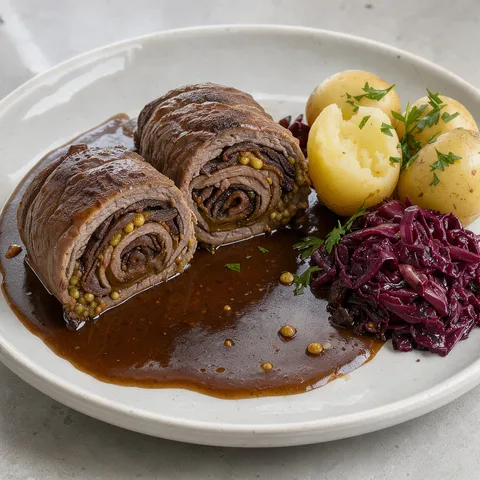 German Beef Roulades2 hr 30 min · Main course
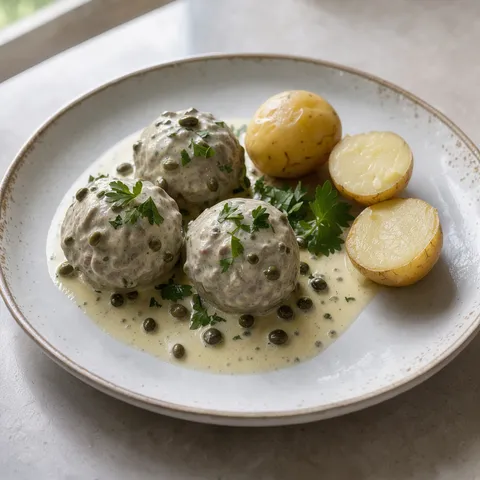 Meatballs in Caper Sauce1 hr 05 min · Main course
 Swabian Cheese Noodles55 min · Main course
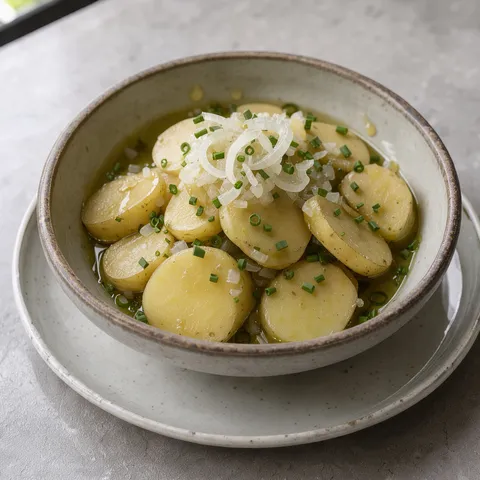 Swabian Potato Salad1 hr · Side dish
 Bavarian Pretzels1 hr 55 min · Bread & pastry
 Käsespätzle 2.01 hr 20 min · Main course