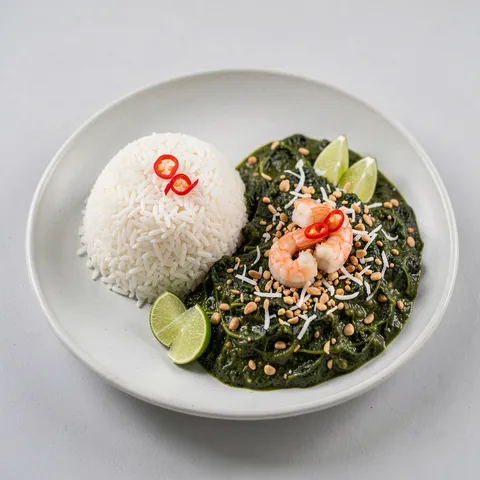
Mozambican Greens in Coconut and Peanut Matapa
A Mozambican main course. Takes 1 hr 20 min, Serves 4. Difficulty: medium.
At a glance
- Total time
- 1 hr 20 min
- Serves
- Serves 4
- Difficulty
- Medium
- Cuisine
- Mozambican cuisine
- Dish type
- Main course
- Diet
- Gluten-free
- Allergens
- Milk, Crustaceans, Peanuts, Tree nuts
Ingredients
Greens
- 700 g kale and spinach (half and half)
- 3 garlic cloves
- 1 onion
- 1 tsp salt
- 300 ml water
Peanuts
- 180 g raw shelled peanuts
Coconut
- 400 ml coconut milk
- 200 ml lukewarm water
Prawns
- 300 g peeled raw prawns
- 1/4 tsp salt
Rice
- 300 g long-grain rice
- 500 ml water
- 1/2 tsp salt
- 1 tbsp sunflower oil
To finish
- 1 lime
- 1 fresh red chilli (optional)
Equipment
- Frying pan
- Food processor
- Chef's knife
- Chopping board
- Heavy-based saucepan
- Mixing bowls
- Balloon whisk
- Wooden spoon / spatula
- Saucepan
- Ladle
Method
- Toast the peanuts: Toast the peanuts in a dry frying pan over a medium heat for 8-10 min, shaking constantly, until pale golden. Let cool and rub off the skins between your palms
- Grind the peanuts: Pulse the peanuts in a food processor for 30-40 sec to a flour as fine as sand. Blend them for too long and they release their oil and turn into a paste. In matapa, peanut flour melts into the sauce and gives it body, whereas a paste leaves an oily layer on the surface
- Prepare the greens: Remove the thick central ribs from the kale. Wash the leaves and the spinach and chop roughly. Pulse in a food processor with the garlic and onion until almost as fine as mince, in two batches if needed. In Mozambique cassava leaves are pounded with garlic in a wooden mortar, and this fine texture lets the greens merge with the sauce
- Cook the greens: Bring the water to the boil with the salt in a heavy-based saucepan, add the greens and cook over a medium heat with the lid ajar for 15 min. The greens turn dark green and reduce by half, and the water is almost completely absorbed
- Peanuts and coconut: Whisk the peanut flour with the coconut milk and lukewarm water in a bowl to a lump-free mixture. Pour it over the greens and mix well
- Slow-cook: Cook over a low heat with the lid ajar for 30 min. The peanuts tend to sink and catch, so stir every 5 min, scraping the base with a wooden spoon. It's ready when glossy droplets of oil start to separate on the surface and it is as thick as a creamy spinach purée. If it gets too thick, add a few spoonfuls of water
- Cook the rice: While the matapa cooks, wash the rice 3 times. Heat the oil in a saucepan, stir the rice in it for 1 min, then add the water and salt. Once it boils, cover and cook over a low heat for 15 min, then take off the heat and leave to steam for 10 min with a clean tea towel under the lid
- Add the prawns: Season the prawns lightly with salt and bury them in the matapa. Cover and cook for 4-5 min until the prawns are pink and curled into a C. Overcooked prawns curl into an O and turn rubbery
- Plate: Mould the rice into a dome on each plate using a bowl. Spoon plenty of matapa alongside so the prawns show on top. Add lime slices and, if you like, finely chopped chilli, and serve hot
Chef's note
Authentic matapa is made with cassava leaves. Raw cassava leaves contain cyanogenic compounds, so they are traditionally pounded and boiled for at least 1 hr. If you find frozen pounded cassava leaves in African shops, first cook them in water for 1 hr, then add the peanuts and coconut. On the coast it is made with prawns or crab, and inland with vegetables only.
Frequently asked questions
- Why aren't the peanuts turned into a paste for matapa?
- Pulse the peanuts in a food processor to a fine sand. If processed for long, they release oil and turn into a paste, leaving an oily layer on the surface.
- Does matapa catch on the bottom?
- Yes, the peanuts tend to sink and catch. Scrape the bottom regularly with a wooden spoon as it cooks.
- When are the prawns added?
- Nestle the prawns into the stew once it is cooked and cook briefly with the lid on. They are ready when pink and curled into a C shape, and overcooked prawns turn rubbery.
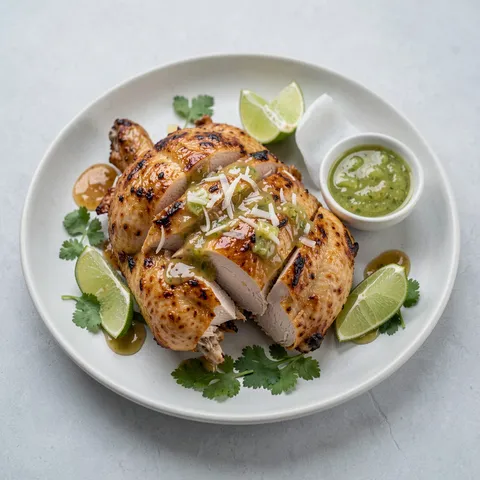 Mozambican Coconut Chicken1 hr 45 min · Main course
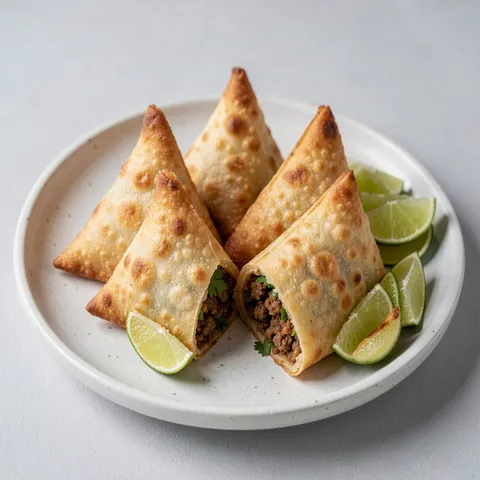 Mozambican Spiced Beef Samosas1 hr 30 min · Bread & pastry
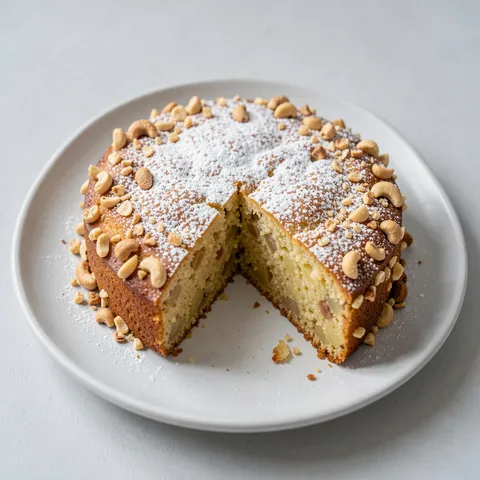 Mozambican Cashew and Potato Cake1 hr 45 min · Dessert
 Galinha à Zambeziana 2.01 hr 15 min · Main course
 Mozambican Prawns1 hr 05 min · Main course
 Mozambican Prawn Half-Moon Pasties1 hr 50 min · Bread & pastry