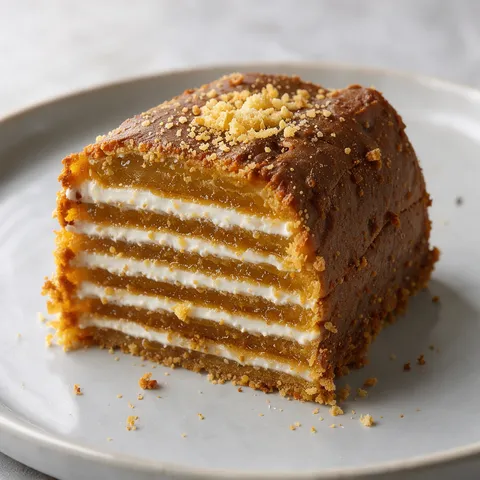
Russian Honey Layer Cake with Soured Cream Medovik
A Russian patisserie. Takes 1 hr 55 min · +6 hr resting, 22 cm cake, 12 slices. Difficulty: challenging.
At a glance
- Total time
- 1 hr 55 min · +6 hr resting
- Serves
- 22 cm cake, 12 slices
- Difficulty
- Challenging
- Cuisine
- Russian cuisine
- Dish type
- Patisserie
- Allergens
- Gluten, Milk, Eggs
Ingredients
Honey dough
- 100 g flower honey
- 150 g caster sugar
- 80 g butter
- 3 eggs
- 1 tsp bicarbonate of soda
- a pinch of salt
- about 450 g plain flour (sifted)
Cream
- 400 g Crème Fraîche (Basics)
- 300 ml whipping cream (35% fat, well chilled)
- 120 g icing sugar
- seeds of 1/2 vanilla pod
Equipment
- Bain-marie bowl
- Mixing bowls
- Balloon whisk
- Silicone spatula
- Precision scales
- Cling film
- Oven
- Rolling pin / oklava
- Baking paper
- Cake ring / food ring
- Baking tray
- Food processor
- Hand mixer
- Chef's knife
- Ladle
Method
- Melt the honey and sugar (0-10 min): Put the honey, sugar and butter in a heatproof bowl set over gently simmering water (bain-marie) and stir for 5 min, until the sugar has completely dissolved. In a separate bowl, lightly beat the eggs with the salt
- Add the eggs and bicarbonate (10-17 min): Whisk a ladleful of the honey mixture into the eggs to temper them, then pour the eggs into the bowl over the bain-marie and heat for 3 min, whisking constantly. Add the bicarbonate of soda and keep whisking. The mixture foams up until doubled in volume and changes colour from light amber to deep caramel. The honey-caramel aroma of medovik comes from this reaction
- Work in the flour (17-22 min): Take the bowl off the heat and fold in the flour with a spatula in three additions. While warm, the dough should be soft and slightly sticky: it firms up as it cools. The dough weighs about 920 g: divide it into 8 equal pieces of about 115 g each on the scales and cover with cling film. Preheat the oven to 180°C
- Roll out and bake the layers (22-70 min): Roll out one piece on baking paper with a floured rolling pin into a circle 2 mm thick and larger than 24 cm. Press a 22 cm cake ring on top to mark the cutting line, leaving the trimmings in place. Prick in a few places with a fork so it doesn't puff up like a balloon. Slide onto a tray on its paper and bake at 180°C for 5-6 min until deep golden. Roll out the next layer while one is in the oven
- Cut while hot (after each layer): As soon as a layer comes out of the oven, press the ring on again and cut along the marked line with a chef's knife, moving the trimmings to a separate tray. A layer that has cooled breaks rather than cuts. Cool the layers on a wire rack
- Make the crumbs (70-80 min): Bake the trimmings at 180°C for another 4-5 min, until completely dry and deep golden. Once cool, blitz to fine sand in a food processor. These crumbs coat the outside of the cake
- Whip the cream (80-90 min): Whip the cold cream with the icing sugar and vanilla using a hand mixer to soft peaks. Add the crème fraîche and whip for 30 sec more. You'll have about 820 g of cream: it should be soft but not runny, as it will soak into the layers and turn them into a cake-like texture
- Assemble the cake (90-110 min): Put one layer on a serving plate and spread with about 100 g of cream. Carry on stacking the layers in the same way, so that seven layers of cream sit in between. Spread the remaining cream thinly over the top and sides: the sides needn't be neat, as the crumbs will cover them
- Coat with crumbs (110-115 min): Take handfuls of crumbs and press them onto the sides and top of the cake: the whole surface should be covered in sandy gold
- Rest (+6 hr): Cover the cake with cling film and chill in the fridge for at least 6 hr, ideally overnight. The biscuit-dry layers draw moisture from the cream, soften and turn into a fine-layered cake that cuts with a fork
- Plate: Cut the cake into 12 slices with a knife dipped in hot water. Lay a slice on its side on a flat plate so the eight thin layers and the white lines of cream between them show, and sprinkle a pinch of crumbs on top
Chef's note
Medovik is said to have been born in the imperial court kitchen in the 19th century, though the story is disputed. The cake became a home and patisserie classic in the Soviet era. In Russia the cream is usually made with smetana; here a mix of crème fraîche and whipping cream is used. The darker the honey (chestnut, wild hive honey), the more caramel-sweet the cake.
Frequently asked questions
- Why are the Medovik layers cut as soon as they come out of the oven?
- Press a cake ring onto each layer straight from the oven and cut along the marked line. Once cooled, the layers break instead of cutting.
- Why does Medovik need to rest for at least 6 hours?
- In that time the biscuit-dry layers absorb moisture from the cream and soften. The cake turns into a tender sponge you can cut with a fork.
- What does the bicarbonate do in the Medovik dough?
- When the bicarbonate goes in, the mixture foams, doubles in volume and changes from light amber to dark caramel. The honey-caramel aroma of Medovik comes from this reaction.
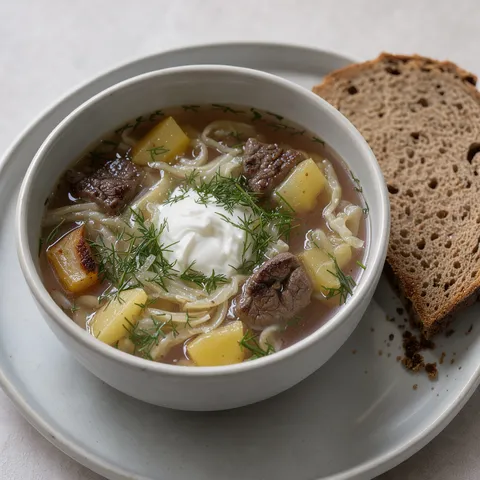 Russian Cabbage Soup2 hr 10 min · Soup
 Bef Stroganov1 hr 10 min · Main course
 Pelmeni2 hr · Bread & pastry
 Beef Stroganoff 2.01 hr 15 min · Main course
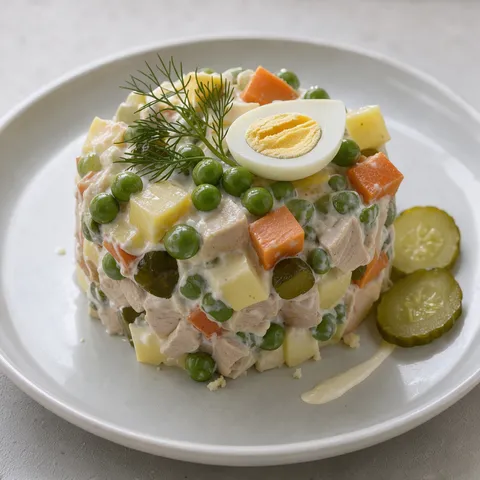 Russian Chicken Olivier Salad1 hr 20 min · Meze
 Buttery Chicken Cutlets1 hr 5 min · Main course