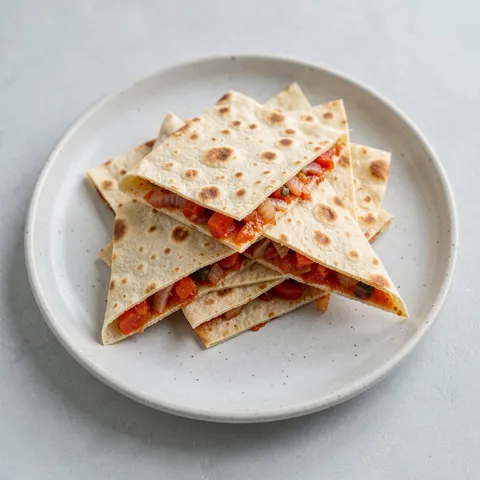
Algerian Stuffed Semolina Flatbread Mhadjeb
An Algerian bread & pastry. Takes 1 hr 45 min, Makes 10. Difficulty: medium.
At a glance
- Total time
- 1 hr 45 min
- Serves
- Makes 10
- Difficulty
- Medium
- Cuisine
- Algerian cuisine
- Dish type
- Bread & pastry
- Allergens
- Gluten, Milk
Ingredients
Dough
- 500 g fine semolina
- 1 tsp salt
- about 300 ml lukewarm water
- 2 tbsp sunflower oil
For rolling out
- 150 ml sunflower oil and 30 g melted butter (mixed)
Filling
- 4 tbsp olive oil
- 3 onions (very finely chopped)
- 2 garlic cloves (crushed)
- 1 red romano pepper and 1 long green pepper (finely chopped)
- 6 ripe tomatoes (peeled, finely chopped, about 900 g)
- 1 tbsp tomato paste
- 1 tsp sweet paprika
- 1 tsp Harissa (Basics) or 1/2 tsp hot paprika
- 1/2 tsp cumin
- 1 tsp salt
- 1/2 tsp black pepper
To finish
- 30 g butter. Makes 10
Equipment
- Mixing bowls
- Baking tray
- Cling film
- Sauté pan
- Cast-iron frying pan
- Silicone spatula
- Chef's knife
- Chopping board
- Saj (optional)
Method
- Knead the dough: Mix the semolina and salt. Add the water little by little and knead for 15 min. The dough starts out sandy, but over time it should become smooth, very soft and elastic, stretching like rubber when pulled. Semolina dough only reaches this elasticity with long kneading, and if you cut it short it tears when you roll it out. Add the oil and knead for 2 more min
- Divide into balls: Divide the dough into 10 equal balls (about 80 g), arrange on an oiled tray, brush with oil, cover with cling film and rest for at least 30 min
- Cook the filling: Cook the onions in the olive oil over medium heat for 8-10 min, until soft and translucent without colouring. Add the garlic and peppers and stir for 3 min. Add the tomatoes, tomato paste and spices and cook uncovered for 20-25 min. The sauce should turn into a paste so thick that a spoon dragged through it leaves a trail that does not close, as a watery filling soaks the dough and tears it. Cool completely
- Roll out: Generously grease the work surface and your hands with the oil mixture. Push one ball outwards with your fingertips, lifting and stretching it lightly from the edges, to a leaf about 40 cm across, thin enough to see light through the back
- Fill: Put 2 tbsp of filling in the middle of the sheet and spread it into a 12×12 cm square. Fold the edges of the sheet over the filling in turn, from the right, left, top and bottom, to make a closed square parcel. Brush a little oil on each fold, so the layers stay separate
- Cook: Heat a large cast-iron pan or saj dry over medium heat. Place the mhadjeb with the folds underneath and cook for 2-3 min, until the surface is spotted golden. Turn and cook the other side for 2 min. Press lightly on the edges with a spatula so the layers cook evenly
- Brush with butter: Straight from the pan, while hot, brush with a little butter and stack in a covered container to rest, so the steam softens the dough
- Plate: Cut the mhadjeb in half diagonally and stack on a white plate, overlapping, with the cut sides facing forward so the red filling shows. Serve hot with lben (buttermilk, similar to ayran) or mint tea
Chef's note
This is a pastry sold on the street in every Algerian city, and its filling is in fact an Algerian-style chakchouka. In some regions it is called mahdjouba. A dough made only with semolina can be hard to roll out, and replacing a third of the semolina with flour makes rolling easier.
Frequently asked questions
- Why is mhadjeb dough kneaded for so long?
- Semolina dough only becomes elastic with long kneading. If cut short, it tears when rolled out. The dough should stretch like elastic when pulled.
- Why mustn't the mhadjeb filling be wet?
- A wet filling soaks the dough and tears it. So cook the tomato filling until it is a paste thick enough that a spoon drawn through leaves a trail, and let it cool completely.
- Why are mhadjeb kept in a covered container after cooking?
- Brush with a little butter while hot and stack in a covered container. The steam softens the dough.
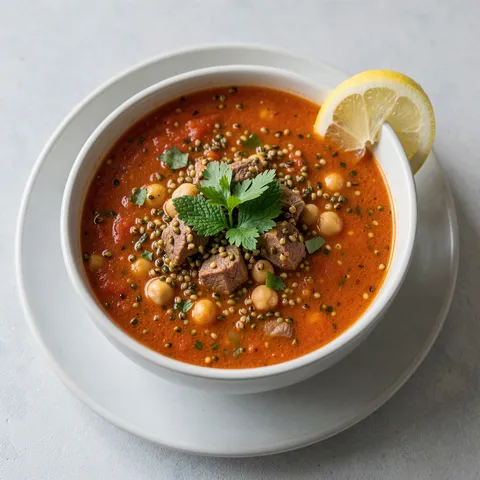 Chorba Frik1 hr 45 min · Soup
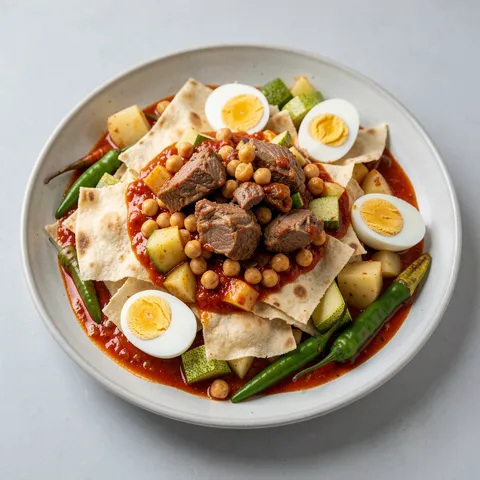 Biskra-Style Torn Flatbread with Lamb Stew2 hr 45 min · Main course
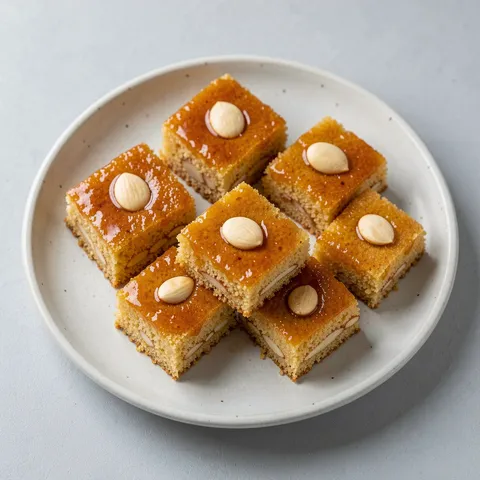 Algerian Almond Semolina Cake1 hr 45 min · Dessert
 Kalb el Louz 2.01 hr 25 min · Dessert
 Karantika, Algerian Baked Chickpea Flour Cake1 hr 30 min · Starter
 Algerian Chicken and Olive Stew1 hr 15 min · Main course