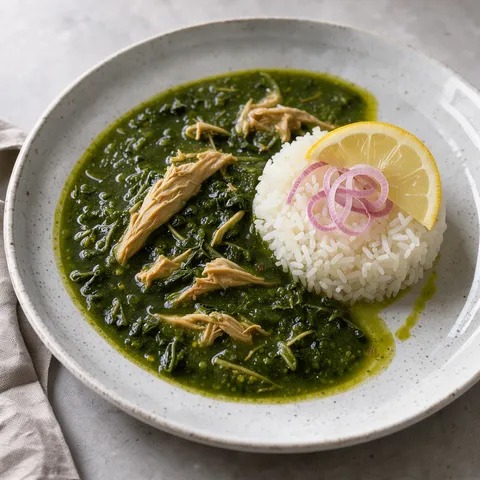
Damascus-Style Chicken and Jute Leaf Stew Mlukhiyeh
A Syrian main course. Takes 1 hr 50 min (pressure cooker: ~1 hr 20 min), Serves 4. Difficulty: challenging.
At a glance
- Total time
- 1 hr 50 min (pressure cooker: ~1 hr 20 min)
- Serves
- Serves 4
- Difficulty
- Challenging
- Cuisine
- Syrian cuisine
- Dish type
- Main course
- Diet
- Gluten-free
- Allergens
- Milk, Celery
Ingredients
Chicken and stock
- 4 chicken thighs on the bone (about 1 kg in total)
- 1 onion (halved)
- 2 bay leaves
- 4 cardamom pods
- 1 cinnamon stick
- 6 black peppercorns
- 2 litres cold water
- 1 tsp salt
Mulukhiyah
- 80 g whole dried mulukhiyah (jute) leaves
- 1 lemon (juiced)
Taklia
- 8 garlic cloves
- 1 bunch coriander (finely chopped)
- 1 tsp ground coriander
- 3 tbsp butter or clarified butter (ghee)
Rice
- 300 g rice
- 20 g butter
- 550 ml chicken stock (from above)
- 1/2 tsp salt
Pickled onion
- 1 red onion (finely chopped)
- 80 ml cider vinegar
- a pinch of salt
To serve
- 1 lemon (sliced)
Equipment
- Chef's knife
- Chopping board
- Mixing bowls
- Sauté pan
- Pestle and mortar
- Baking tray
- Ladle
- Saucepan
- Frying pan
- Fine sieve / chinois
- Pressure cooker (optional)
Method
- Poach the chicken: Put the thighs in a saucepan with the cold water, bring to the boil over medium heat and skim off the foam that rises with a ladle. Add the onion, bay leaves, cardamom, cinnamon, peppercorns and salt, then lower the heat and simmer gently with the lid ajar for 45 min. It is done when the meat comes away easily from the bone. In a pressure cooker this drops to 18 min
- Soak the leaves: While the chicken cooks, tip the dried leaves onto a large tray and pick out any stalks and debris. Rub the leaves lightly between your palms so they break into large pieces but not into dust. Soak in lukewarm water for 15 min, then squeeze out the water by hand twice. Soaking removes the grit and the dry bitterness of the leaves
- Strain the stock and shred: Lift out the chicken and pass the stock through a fine sieve. Remove the meat from the skin and bones and shred it into large pieces. Set aside 550 ml stock for the rice and 1.2 litres for the stew
- Make the pickled onion: Mix the red onion with the vinegar and salt and set aside. In 15 min it softens and turns pink
- Cook the rice: Stir the washed rice in the butter for 2 min, then add the 550 ml hot chicken stock and the salt. Bring to the boil, then cover and cook over the lowest heat for 15 min and leave to steam for 10 min
- Make the taklia: Crush the garlic to a paste with salt in a pestle and mortar. Heat the butter in a sauté pan over medium heat, add the garlic and ground coriander and stir for 1-2 min, until the garlic is lightly golden. Add the fresh coriander and stir for 1 min, until it wilts and turns dark green. Divide the taklia in half
- Sauté the leaves: Put half the taklia in a saucepan, add the squeezed leaves and stir over medium heat for 2-3 min, until the leaves absorb the fat and turn glossy
- Cook the stew: Add the 1.2 litres hot chicken stock, bring to the boil, then simmer over low heat with the lid ajar for 25 min. It is done when the leaves have softened and given the liquid a slight silkiness and the sauce has turned dark green. If you stir too often, the sauce becomes too slimy. Add the shredded chicken and heat through for 5 min
- Finish: Add the remaining taklia and the lemon juice to the stew and take off the heat. The freshly added garlic and coriander lift the aroma of the dish. Adjust the seasoning
- Plate: Spoon a mound of rice onto one side of a deep plate and ladle the dark green mulukhiyah alongside, with the chicken pieces on top. Put a spoonful of pickled onion on the rice and serve with lemon slices
Chef's note
In Egypt mulukhiyah is made from chopped fresh leaves as a silky soup, while in Syria it is cooked with whole dried leaves into a thicker, stew-like dish. Dried mulukhiyah is sold in Arab and Asian grocers. A version made with lamb is also common.
Frequently asked questions
- Why are the dried mulukhiyah leaves soaked?
- Pick over the leaves and rub them, then soak in lukewarm water and squeeze out. Soaking removes the grit and dry bitterness from the leaves.
- Why does mlukhiyeh get too slimy?
- If you stir often the sauce gets too slimy. The stew is ready when the leaves have softened and given the liquid a slight slipperiness, and the sauce has turned dark green.
- Why is the taklia divided in two?
- Half goes in when the leaves are sauteed and the other half is added at the end of the stew. Freshly added garlic and coriander revive the aroma of the dish.
 Syrian Falafel Rings with Tahini and Sumac Onions49 min · Meze
 Aleppo Sour Cherry Lamb Kofte1 hr · Meze
 Kebab Karaz 2.01 hr 18 min · Meze
 Damascus-Style Chickpea Fatteh1 hr 50 min · Starter
 Damascus-Style Lamb in Yoghurt Sauce2 hr 15 min · Main course
 Lentils with Tamarind and Dough Squares1 hr 30 min · Main course