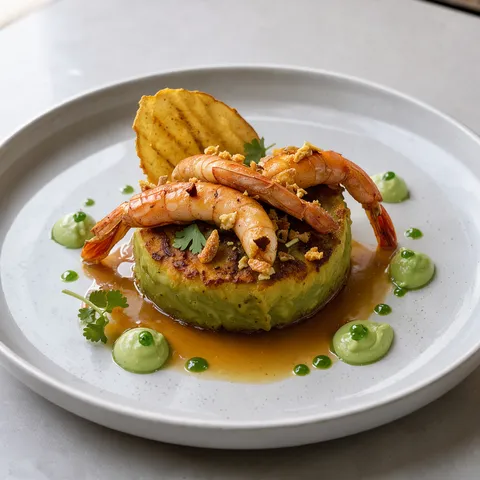
Mofongo 2.0
A Puerto Rican main course. Takes 1 hr 25 min, Serves 4. Difficulty: challenging.
At a glance
- Total time
- 1 hr 25 min
- Serves
- Serves 4
- Difficulty
- Challenging
- Cuisine
- Puerto Rican cuisine
- Dish type
- Main course
- Diet
- Gluten-free
- Allergens
- Milk, Fish, Crustaceans, Celery
Ingredients
Prawn stock
- shells and heads of 12 large prawns
- 1 tbsp olive oil
- 3 tbsp sofrito (1/4 onion, 1/4 green pepper, 1 ají dulce, 2 garlic cloves, 3 culantro leaves)
- 1 tsp tomato paste
- 600 ml water
- 1/2 tsp salt
- 20 g cold butter
Prawns
- 12 large prawns (cleaned, tails on)
- 1/2 tsp salt
- 30 g butter
- 1 tsp achiote oil
- 2 garlic cloves (thinly sliced)
- 1/2 lime
Mofongo cylinders
- 4 green plantains
- 1 litre oil for deep-frying
- 4 garlic cloves
- 40 ml olive oil
- 60 g chicken skin (crisp and crumbled)
- 80 ml hot prawn stock
- salt
Culantro oil
- 1 bunch culantro or coriander
- 100 ml neutral oil
Plantain crisps
- 1 green plantain
Avocado cream
- 1 ripe avocado
- juice of 1 lime
- 2 tbsp water
- salt
To finish
- flaky salt
- coriander shoots
Equipment
- Frying pan
- Saucepan
- Ladle
- Fine sieve / chinois
- Blender
- Muslin
- Mandoline
- Heavy-based saucepan
- Probe thermometer
- Pestle and mortar
- Cake ring / food ring
- Baking paper
- Sauté pan
- Stick blender
- Squeezy bottle
- Balloon whisk
- Mixing bowls
- Chef's knife
- Chopping board
- Food processor
Method
- Chicken skin crackling: Cut the chicken skin into small pieces and fry in a cold frying pan over a medium-low heat for 15 min, until it has released its fat and turned crisp. Transfer to kitchen paper and crumble finely. Keep the fat, as the garlic will be crushed with it
- Start the prawn stock: Blitz the sofrito ingredients in a food processor to a fine paste. Heat the olive oil in a frying pan over a high heat and fry the prawn shells and heads for 3-4 min, pressing down, until completely red and smelling toasted. Add the sofrito and tomato paste and stir for 1 min, then add the water and salt and simmer over a low heat for 20 min. Press the heads with a ladle to extract their juices and pass through a fine sieve. About 400 ml should remain. Set aside 80 ml for the mofongo and the rest for the sauce, to be reduced to 250 ml in step 10. All of this stock is the sauce poured onto the plate at the table
- Culantro oil: Blanch the culantro leaves and fine stalks in boiling water for 10 sec, plunge into iced water and squeeze thoroughly. Blend with the neutral oil for 2 min and, once the oil has cooled slightly, strain through muslin. Let it drip through without squeezing, as squeezing makes it cloudy. You get a bright, emerald-green oil
- Plantain crisps: Slice a plantain lengthways on a mandoline into 1.5 mm strips, soak in iced water for 5 min and pat dry. Bring the oil to 170°C and fry the strips for 2-3 min, until golden yellow and hard, then sprinkle with flaky salt. Lower the same oil to 165°C for the mofongo
- Mofongo plantains: Cut the remaining plantains into 2.5 cm rounds, pat dry and fry in the 165°C oil for 7-8 min, until completely soft inside and pale golden outside. At this temperature the plantain cooks from the inside and reaches a texture that can be mashed in the mortar
- Mash in the mortar: Crush the garlic with salt in the mortar and add the olive oil and 1 tbsp of the chicken fat. Add the hot plantains to the mortar in batches with half the crumbled chicken skin and the 80 ml hot prawn stock, and pound with the pestle into a coarse mixture that holds together. The prawn stock takes the place of the chicken stock in the classic and ties the mofongo to the prawns
- Shape the cylinders and crisp them: Set a 7 cm cake ring on baking paper, press a quarter of the mixture into it to form a 4 cm tall cylinder and lift off the ring. Make four cylinders. Heat 2 tbsp of the frying oil in a sauté pan over a medium-high heat and sear both flat sides of the cylinders for 2 min each, until a golden crust forms. Mofongo that is crisp outside and soft inside gives a contrast of textures the classic does not have
- Avocado cream: Blitz the avocado with the lime juice, water and salt using a stick blender for 30 sec to a smooth cream and fill a squeeze bottle. The acidity of the lime keeps its colour for 1 hr
- Cook the prawns: Pat the prawns dry and salt them. Heat the butter and achiote oil in a sauté pan over a medium-high heat until foaming and stir the garlic slices for 30 sec until fragrant. Add the prawns and cook for 1 min on each side, until they curl into a C and turn opaque, then squeeze over the lime and spoon the butter over them. If they curl into an O, they are overcooked
- Finish the sauce: Reduce the reserved prawn stock in a small saucepan over a high heat to 250 ml, take off the heat and whisk in the cold butter. It should be a glossy sauce with a little body. Pour into a small jug
- Plate: Set a mofongo cylinder in the centre of a warm deep plate. Lean three prawns crosswise against it with their tails pointing up. Squeeze four dots of avocado cream from the bottle around the cylinder and drip culantro oil between them. Scatter the remaining chicken skin crumbs on top of the cylinder, stand a plantain crisp upright in it and finish with coriander shoots
- Serve at the table: Pour the prawn stock from the jug down the side of the plate to the base of the mofongo. The sauce soaks the cylinder from below while the top crust stays crisp. Eat immediately
Chef's note
In the classic, mofongo is a dome shaped in the mortar and served with chicken stock. Here the same mortar technique is kept, but the dome becomes a crisp-crusted cylinder and the chicken stock becomes a sauce made from toasted prawn shells. The prawns are a nod to Puerto Rico's mofongo relleno de camarones tradition. The original recipe uses pork crackling (chicharrón); here it is made with chicken skin.
Frequently asked questions
- How are the plantains fried for mofongo?
- Cut the plantains into 2.5 cm rounds, pat them dry and fry them in oil at 165°C. At this temperature the insides soften enough to mash in a mortar.
- Why should the prawns curl into a C shape?
- When cooked briefly on each side, prawns curl into a loose C shape. If they curl into an O they are overcooked.
- Why can culantro oil turn cloudy?
- Blanch the culantro and plunge it into iced water, blend it with the oil, then let it drip through a muslin cloth. If you squeeze the cloth the oil turns cloudy.
 Garlicky Mashed Plantain1 hr 15 min · Main course
 Rice with Pigeon Peas1 hr · Main course
 Green Banana and Taro Fritters1 hr 15 min · Meze
 Soupy Chicken and Rice1 hr 15 min · Soup
 Coconut Milk Pudding30 min · Dessert
 Plantain and Mince Bake1 hr 25 min · Main course
 Bacalaítos1 hr 5 min · Meze