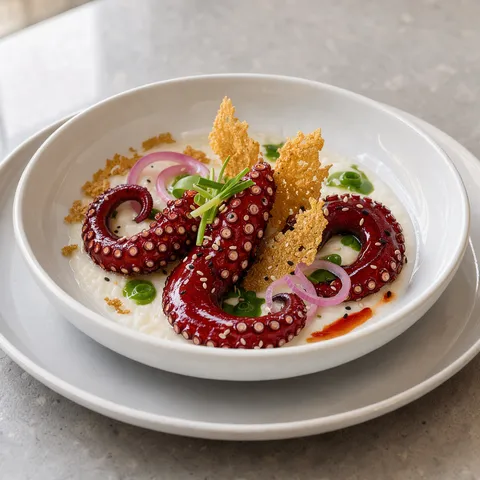
Nakji Bokkeum 2.0
A Korean main course. Takes 1 hr 15 min, Serves 4. Difficulty: challenging.
At a glance
- Total time
- 1 hr 15 min
- Serves
- Serves 4
- Difficulty
- Challenging
- Cuisine
- Korean cuisine
- Dish type
- Main course
- Allergens
- Gluten, Milk, Molluscs, Sesame, Soya
Ingredients
Octopus
- 900 g large octopus arms (cleaned)
- 2 tbsp coarse salt (for rubbing)
- 1 tbsp plain flour (for rubbing)
- 1 litre water
- 1/2 onion
- 2 bay leaves
- 1 tsp salt
Rice
- 200 g short-grain Korean rice
- 300 ml water
- 1 tbsp cold butter
- 1 tsp sesame oil
- salt
Gochujang glaze
- 2 tbsp gochujang
- 2 tbsp gochugaru (Korean chilli flakes)
- 2 tbsp soy sauce
- 1 tbsp honey
- 1 tbsp mirin
- 3 garlic cloves (crushed)
- 100 ml octopus cooking liquid
- 1 tsp sesame oil
Pickled onion
- 1 small red onion (thin rings)
- 80 ml rice vinegar
- 1 tbsp sugar
- 1/2 tsp salt
- 40 ml water
Spring onion oil
- 4 spring onions (thin rings)
- 1 green pepper (finely chopped)
- 80 ml neutral oil
- 1/2 tsp salt
- 1 tsp toasted sesame seeds
To serve
- 1 tbsp neutral oil (for searing)
- 1 tbsp toasted sesame seeds
- spring onion shoots
Equipment
- Pressure cooker
- Saucepan
- Frying pan
- Cast-iron frying pan
- Blender
- Fine sieve / chinois
- Mixing bowls
- Balloon whisk
- Silicone spatula
- Chef's knife
- Chopping board
- Baking tray
- Pastry brush
Method
- Make the pickled onion: Whisk the rice vinegar, sugar, salt and water in a small saucepan and heat for 2 min until the sugar dissolves. Put the onion rings in a bowl and pour the hot liquid over them. The pickle steeps by itself until serving and the onion turns bright pink. The sharpness of the vinegar is the acid that cuts the weight of the octopus and the glaze (~2 min)
- Rub the octopus: Rub the octopus arms with the salt and flour in a bowl with your palm for 5 min, until the sticky foam on the surface comes off. If this surface remains, the meat turns bitter and slimy. Rinse twice in plenty of cold water and allow 2 min for this. Pat the arms dry with kitchen paper (~7 min)
- Soften the octopus in the pressure cooker and cook the rice: Put the octopus arms, onion, bay leaves, salt and 1 litre water in a pressure cooker and close the lid. Heat over high heat until the cooker reaches pressure, then reduce the heat and cook for 18 min, 24 min in total. The pressure breaks down the collagen of the octopus and makes the meat buttery rather than rubbery, and in an open pan this takes more than 1 hr. In the same time, wash the rice in a medium saucepan, put it with 300 ml water and salt, and when it boils, turn the heat to the lowest and cook covered. The rice should stay grainy and substantial, and this water ratio does not make it mushy (~24 min)
- Release the pressure and cool: Take the pressure cooker off the heat and wait 8 min for the pressure to drop by itself. Open the lid without forcing the pressure. Lift out the arms with tongs, arrange on a tray and leave to cool for 2 min. Hot octopus is hard to handle and cut, and it falls apart. Strain 300 ml of the liquid left in the pot and set it aside, 100 ml for the glaze and 200 ml for the cream. As the pressure cooker liquid is salted with 1 tsp salt, taste before salting the glaze and cream (~10 min)
- Blend the rice cream: Blend half of the cooked rice, 200 ml octopus liquid, the butter and the sesame oil in a blender for 2 min until a smooth cream. Pass through a fine sieve for 2 min, and it should be lump-free and silky. The consistency should be like yoghurt running slowly off a spoon, and if it is too thick, add 2-3 tbsp water. Taste first, and as the liquid is already salty, add only a very little salt if needed and keep warm (~4 min)
- Make the crispy nurungji: Spread the remaining rice in a non-stick pan with a spatula 5-6 mm thick and press it down. Cook over medium heat for 10 min without touching, until the underside is golden and crisp. It is ready when the edges come away from the pan and the rice moves in one piece. Nurungji is the crisp layer of rice left at the bottom of the pot in Korea. Slide it from the pan onto a chopping board and break it with a knife into irregular 4 cm pieces (~10 min)
- Reduce the gochujang glaze: Boil the gochujang, gochugaru, soy sauce, honey, mirin, garlic, 100 ml octopus liquid and sesame oil in a small pan over medium heat. Reduce for 6 min to a glossy, sticky glaze that coats the back of a spoon. Do not forget to stir, as honey and gochujang burn easily (~6 min)
- Sear the octopus and glaze: Heat a cast-iron pan thoroughly over high heat and add the neutral oil. Make sure the octopus arms are dry, put them in the pan and sear for 2 min on each side until lightly charred spots appear, 6 min in total. Brush the glaze over the arms and turn for 30 sec more. Do not pour any excess into the pan, or the sugar burns (~6 min)
- Make the spring onion oil: Put the spring onion rings, chopped green pepper and salt in a heatproof bowl. Heat the neutral oil in a small pan for 2 min until it just begins to smoke and pour it over the spring onions. It should sizzle and smell fragrant. Add the sesame seeds and stir. This gives a bright green oil (~2 min)
- Plate: Put 2 tbsp rice cream in the middle of a warm, wide, shallow bowl and draw a wide circle with the back of a spoon. Curl three octopus arms over the cream and drip the rest of the glaze over the arms. Stand the crispy nurungji pieces upright around the edges of the cream. Spoon the drained pickled onion rings and the spring onion oil over. Finish with toasted sesame seeds and spring onion shoots (~4 min)
Chef's note
The spicy sauté identity of the classic nakji bokkeum is kept, but here the texture is split into components: the tender arm, silky rice cream and crisp nurungji rebuild the relationship between rice and octopus. Gochujang, gochugaru and soy sauce are traditional ready-made products. If you have no large octopus, small octopus is cooked in the pressure cooker in the same way for 12 min. Buy the octopus fresh and clean.
Frequently asked questions
- How many minutes does octopus take to soften in a pressure cooker?
- Large octopus arms cook for 18 minutes over low heat after the whistle. For baby octopus, 12 minutes is enough.
- What can I use instead of gochujang?
- A mix of chilli flakes and tomato paste with a little honey gives a similar glaze. The flavour is less fermented and less deep.
- What is nurungji and how is it made at home?
- Nurungji is the crisp layer of rice that sticks to the bottom of the pot. At home, spread cooked rice thinly in a non-stick pan and fry it over medium heat for 10 minutes without touching it.
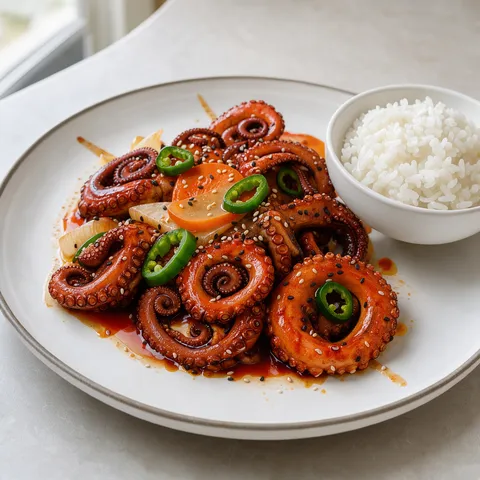 Korean Spicy Stir-Fried Baby Octopus with Vegetables21 min · Main course
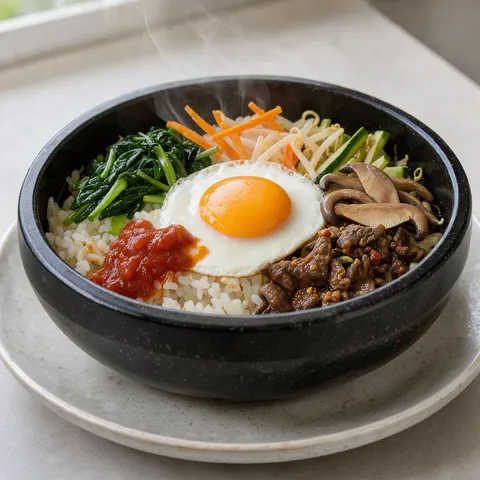 Bibimbap1 hr 15 min · Main course
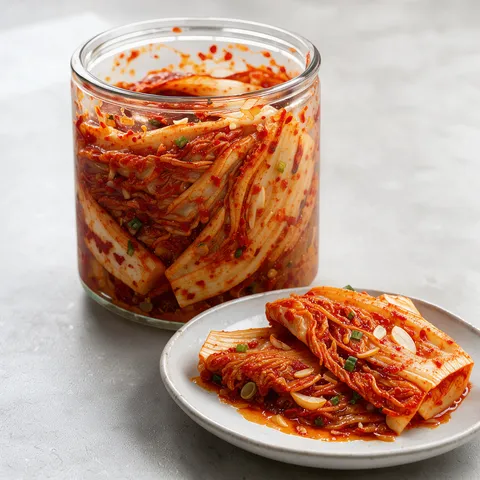 Kimchi3 hr · Side dish
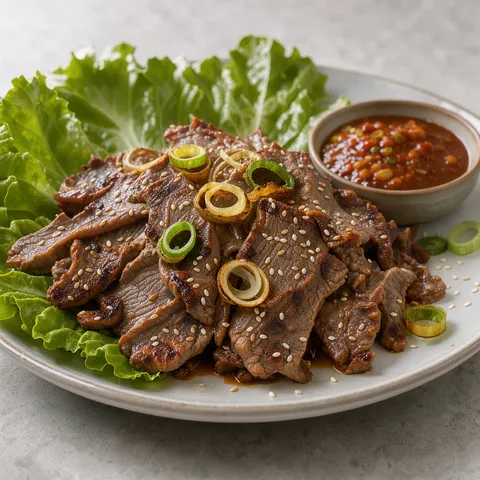 Bulgogi30 min · Main course
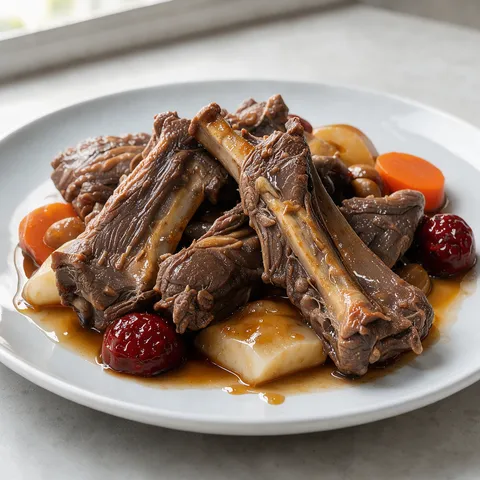 Korean Braised Short Ribs1 hr 30 min · Main course
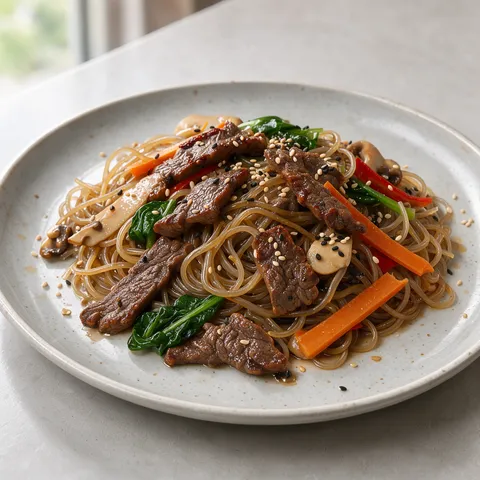 Korean Glass Noodles with Vegetables45 min · Main course
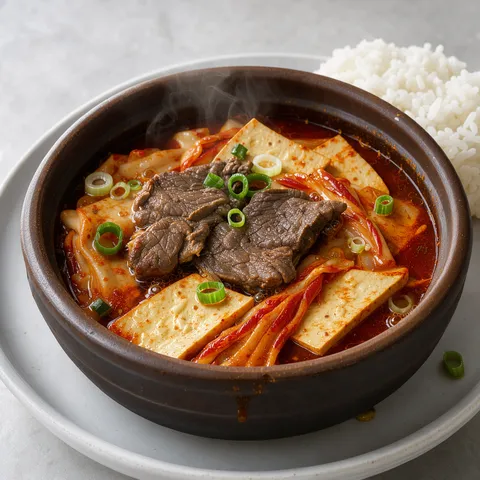 Kimchi Stew40 min · Soup