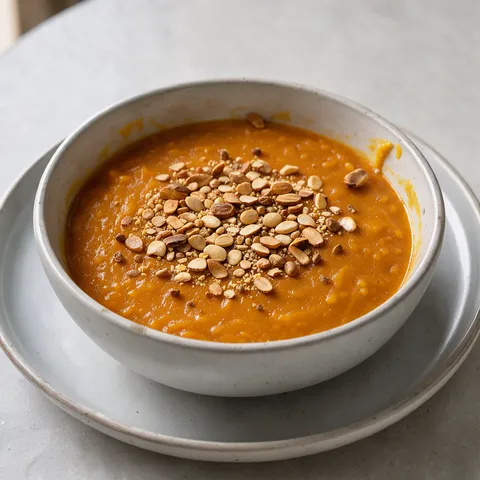
Zimbabwean Pumpkin and Peanut Porridge Nhopi
A Zimbabwean main course. Takes 50 min, Serves 4. Difficulty: medium.
At a glance
- Total time
- 50 min
- Serves
- Serves 4
- Difficulty
- Medium
- Cuisine
- Zimbabwean cuisine
- Dish type
- Main course
- Diet
- Vegetarian, Vegan, Gluten-free
- Allergens
- Peanuts, Tree nuts
Ingredients
Peanut butter
- 100 g raw shelled peanuts
Porridge
- 1 kg pumpkin (about 800 g peeled and deseeded)
- 400 ml water
- 60 g fine white maize meal
- 1/2 tsp salt
- 1-2 tbsp sugar (depending on the sweetness of the pumpkin, optional)
To serve
- a pinch of salt
- a few roasted peanuts (roughly crushed)
Equipment
- Chef's knife
- Chopping board
- Heavy-based saucepan
- Wooden spoon / spatula
- Food processor
- Baking tray
- Oven
- Vegetable peeler
- Potato masher (optional)
Method
- Roast and grind the peanuts: Preheat the oven to 170°C. Spread the peanuts on a tray and roast for 12 min, until golden brown. Rub in a tea towel to remove the skins and roughly crush a few for serving. Blend the rest in a food processor for 6-8 min to a runny butter. Takes 20 min in total, done while the pumpkin cooks
- Prepare the pumpkin: Peel the pumpkin with a peeler and scrape out the seeds and stringy centre with a spoon. Cut into 3 cm cubes with a sharp knife. Even cubes cook at the same time, while large pieces leave lumps in the porridge. Takes 10 min
- Boil the pumpkin: Put the pumpkin cubes in a heavy-based saucepan with the 400 ml water and the salt. Once it boils, cook covered over a medium-low heat for 20 min, until a knife slides in without resistance. The water should come halfway up the pumpkin, as too much water makes the porridge runny. Do not pour off the water: it becomes the liquid of the porridge
- Mash: Without taking the pan off the heat, mash the pumpkin in its liquid with a potato masher for 3 min, to a smooth purée. It does not have to be completely smooth: small fibres give the texture of Zimbabwean home cooking
- Add the maize meal: Sprinkle in the maize meal like rain with one hand while stirring constantly with a wooden spoon in the other. Cook over a low heat for 8 min, scraping the base. The maize meal gives the porridge body and binds the pumpkin liquid. It should be a thick porridge that drops slowly from the spoon, with no raw flour taste left
- Stir in the peanut butter: Add the peanut butter and the sugar if using, and cook for 3 min, stirring, until the butter is fully incorporated and the orange colour turns a pale honey shade. Season to taste. Once the peanut butter is in, the porridge catches easily, so keep the heat low
- Rest: Take off the heat and rest, covered, for 2 min. The peanut oil rises slightly to the surface and gives it a sheen
- Plate: Spoon the nhopi into a serving bowl or onto a plate and swirl the surface with the back of the spoon. Scatter over the crushed peanuts and a pinch of salt. Serve hot or warm: in Zimbabwe it is eaten at breakfast or at lunch in place of sadza
Chef's note
Nhopi is an old dish from the Shona cooking of Zimbabwe that brings together pumpkin and peanut butter, eaten both sweet and savoury. Without peanut butter it is called simply nhopi rather than nhopi dovi. Some families use other pumpkins or winter squash, and some leave out the maize meal altogether.
Frequently asked questions
- What if nhopi turns out thin, and how thick should it be?
- When boiling the pumpkin, the water should come halfway up the pieces, as too much water thins the porridge. The maize meal gives it body. It should be thick enough to fall slowly off the spoon, with no raw flour taste.
- When and how is nhopi eaten?
- Serve it hot or warm. In Zimbabwe it is eaten at breakfast, or at lunch in place of sadza. Sprinkle roughly crushed roasted peanuts and a pinch of salt on top.
- Why cut the pumpkin into even cubes?
- Even 3 cm cubes cook at the same time, while larger pieces leave lumps in the porridge. Boil the pumpkin in 400 ml water until a knife slides in without resistance, and do not discard the water.
 Zimbabwean Maize Porridge with Beef Stew1 hr 55 min · Main course
 Zimbabwean Greens in Peanut Sauce50 min · Main course
 Zimbabwean Cow Heel Stew2 hr · Main course
 Zimbabwean Candied Papaya with Ginger1 hr 15 min · Dessert
 Zimbabwean Maize and Bean Boil1 hr 45 min · Main course